Cortés-Ramírez Dionisio-Alejandro, Rodríguez-Tojo María-Jose, Coca-Meneses Juan-Carlos, Marichalar-Mendia Xabier, Aguirre-Urizar José-Manuel
Unidad de Medicina Bucal y de Patología Oral y Maxilofacial, Dpto. de Estomatología II, Universidad del País Vasco /EHU, Leioa 48940, Bizkaia, (Spain),
Med Oral Patol Oral Cir Bucal. 2014 Sep 1;19(5):e451-8. doi: 10.4317/medoral.19452.
The oral lichenoid disease (OLD) includes different chronic inflammatory processes such as oral lichen planus (OLP) and oral lichenoid lesions (OLL), both entities with controversial diagnosis and malignant potential. Epidermal growth factor receptor (EFGR) is an important oral carcinogenesis biomarker and overexpressed in several oral potentially malignant disorders.
To analyze the EGFR expression in the OLD to find differences between OLP and OLL, and to correlate it with the main clinical and pathological features.
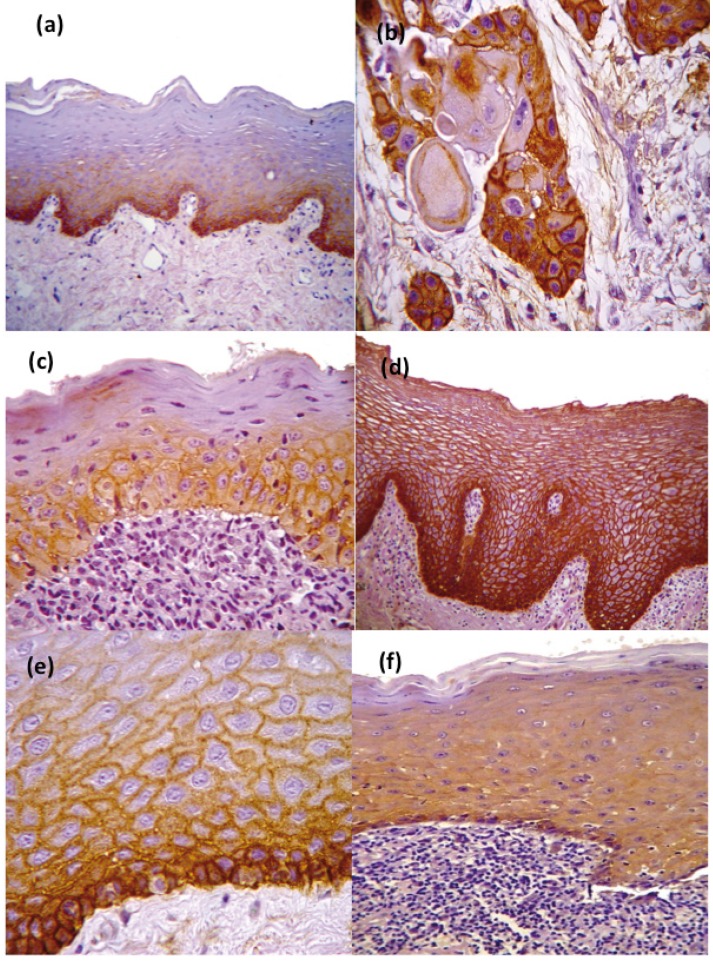
Forty-four OLD cases were studied and classified according to their clinical (Group C1: only papular lesions / Group C2: papular and other lesions) and histopathological features (Group HT: OLP-typical / Group HC: OLP-compatible) based in previous published criteria. Standard immunohistochemical identification of EGFR protein was performed. Comparative and descriptive statistical analyses were performed.
Thirty-five cases (79.5%) showed EGFR overexpression without significant differences between clinical and histopathological groups (p<0.05). Histological groups showed significant differences in the EGFR expression pattern (p=0.016). Conlusions: All OLD samples showed high EGFR expression. The type of clinical lesion was not related with EGFR expression; however, there are differences in the EGFR expression pattern between histological groups that may be related with a different biological profile and malignant risk.
口腔苔藓样病(OLD)包括不同的慢性炎症过程,如口腔扁平苔藓(OLP)和口腔苔藓样病变(OLL),这两种实体在诊断和恶性潜能方面存在争议。表皮生长因子受体(EFGR)是一种重要的口腔癌发生生物标志物,在几种口腔潜在恶性疾病中过度表达。
分析OLD中EGFR的表达,以发现OLP和OLL之间的差异,并将其与主要临床和病理特征相关联。
根据先前发表的标准,对44例OLD病例进行研究,并根据其临床(C1组:仅丘疹性病变/C2组:丘疹性及其他病变)和组织病理学特征(HT组:OLP典型/HC组:OLP符合)进行分类。对EGFR蛋白进行标准免疫组织化学鉴定。进行比较和描述性统计分析。
35例(79.5%)显示EGFR过度表达,临床和组织病理学组之间无显著差异(p<0.05)。组织学组在EGFR表达模式上存在显著差异(p=0.016)。结论:所有OLD样本均显示EGFR高表达。临床病变类型与EGFR表达无关;然而,组织学组之间在EGFR表达模式上存在差异,这可能与不同的生物学特征和恶性风险有关。