Aschbacher Kirstin, Kornfeld Sarah, Picard Martin, Puterman Eli, Havel Peter J, Stanhope Kimber, Lustig Robert H, Epel Elissa
Department of Psychiatry, University of California, San Francisco, CA, United States; The Institute for Integrative Health, Baltimore, MD, United States.
California School of Professional Psychology, Alliant International University, San Francisco, CA, United States.
Psychoneuroendocrinology. 2014 Aug;46:14-22. doi: 10.1016/j.psyneuen.2014.04.003. Epub 2014 Apr 13.
In preclinical studies, the combination of chronic stress and a high sugar/fat diet is a more potent driver of visceral adiposity than diet alone, a process mediated by peripheral neuropeptide Y (NPY).
In a human model of chronic stress, we investigated whether the synergistic combination of highly palatable foods (HPF; high sugar/fat) and stress was associated with elevated metabolic risk. Using a case-control design, we compared 33 post-menopausal caregivers (the chronic stress group) to 28 age-matched low-stress control women on reported HPF consumption (modified Block Food Frequency Questionnaire), waistline circumference, truncal fat ultrasound, and insulin sensitivity using a 3-h oral glucose tolerance test. A fasting blood draw was assayed for plasma NPY and oxidative stress markers (8-hydroxyguanosine and F2-Isoprostanes).
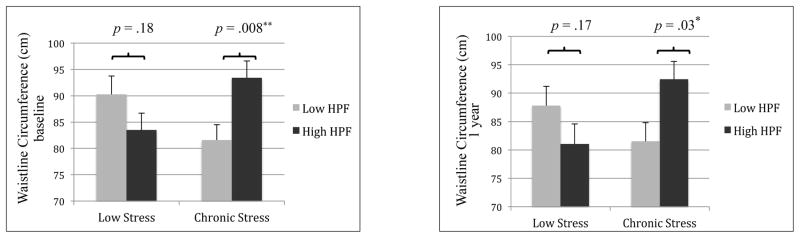
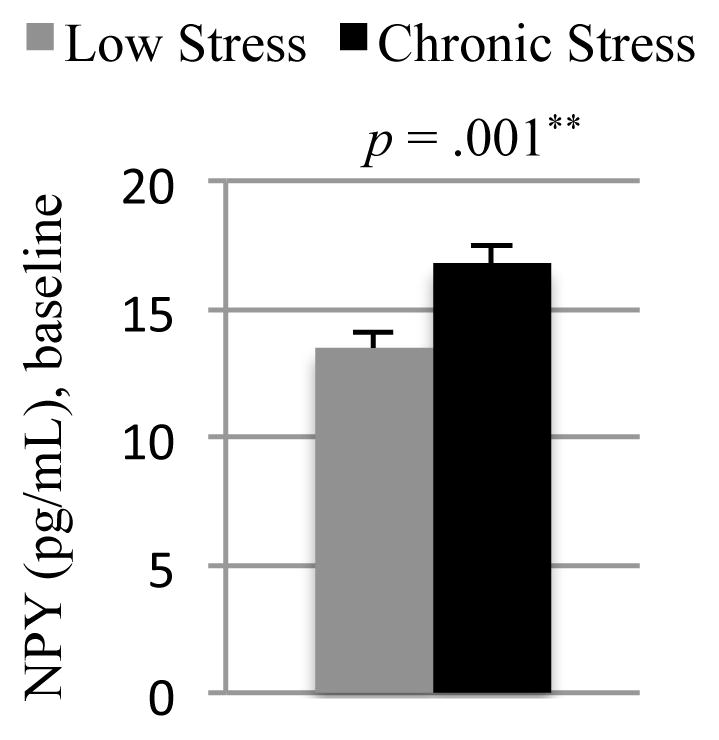
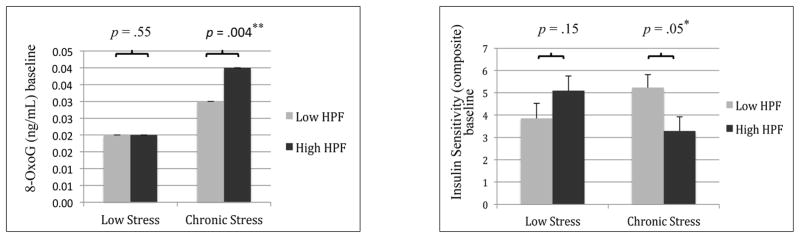
Among chronically stressed women only, greater HPF consumption was associated with greater abdominal adiposity, oxidative stress, and insulin resistance at baseline (all p's≤.01). Furthermore, plasma NPY was significantly elevated in chronically stressed women (p<.01), and the association of HPF with abdominal adiposity was stronger among women with high versus low NPY. There were no significant predictions of change over 1-year, likely due to high stability (little change) in the primary outcomes over this period.
Chronic stress is associated with enhanced vulnerability to diet-related metabolic risk (abdominal adiposity, insulin resistance, and oxidative stress). Stress-induced peripheral NPY may play a mechanistic role.
在临床前研究中,慢性应激与高糖/高脂饮食相结合比单纯饮食更能有效地促使内脏肥胖,这一过程由外周神经肽Y(NPY)介导。
在慢性应激的人体模型中,我们研究了美味食物(HPF;高糖/高脂)与应激的协同组合是否与代谢风险升高有关。采用病例对照设计,我们将33名绝经后护理人员(慢性应激组)与28名年龄匹配的低应激对照女性在报告的HPF摄入量(改良的布洛克食物频率问卷)、腰围、躯干脂肪超声以及使用3小时口服葡萄糖耐量试验评估的胰岛素敏感性方面进行了比较。空腹抽血检测血浆NPY和氧化应激标志物(8-羟基鸟苷和F2-异前列腺素)。
仅在慢性应激女性中,更高的HPF摄入量与基线时更大的腹部肥胖、氧化应激和胰岛素抵抗相关(所有p值≤0.01)。此外,慢性应激女性的血浆NPY显著升高(p<0.01),并且在NPY高的女性中,HPF与腹部肥胖的关联比NPY低的女性更强。在1年期间没有显著的变化预测,可能是由于在此期间主要结局具有高稳定性(变化很小)。
慢性应激与饮食相关代谢风险(腹部肥胖、胰岛素抵抗和氧化应激)的易感性增加有关。应激诱导的外周NPY可能起机制性作用。