Schnor Christine
Interface Demography, Vrije Universiteit Brussel, Pleinlaan 2, 1050 Brussels, Belgium.
Eur J Popul. 2014;30(2):129-160. doi: 10.1007/s10680-013-9304-7. Epub 2014 Jan 31.
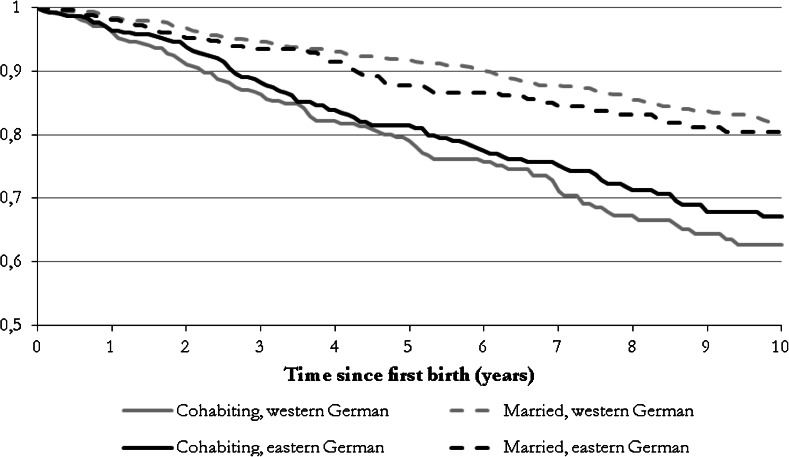
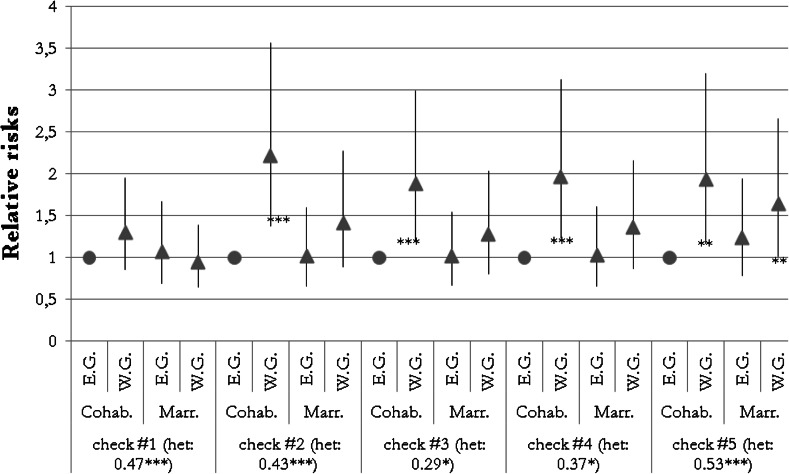
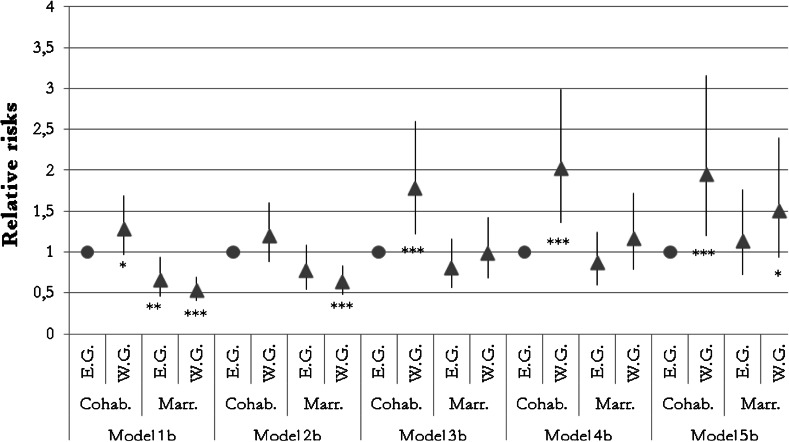
It is often assumed that cohabitation is much less stable than marriage. If cohabitation becomes more common among parents, children may be increasingly exposed to separation. However, little is known about how the proportion of cohabiting parents relates to their separation behavior. Higher shares of childbearing within cohabitation might reduce the proportion of negatively selected couples among cohabiting parents, which could in turn improve their union stability. This study focuses on parents who were cohabiting when they had their first child. It compares their union stability within a context in which they represent the majority or the minority. The German case is well-suited to this research goal because non-marital childbearing is common in eastern Germany (60 %) but not in western Germany (27 %). The data came from the German Family Panel (pairfam), and include 1,844 married and cohabiting mothers born in 1971-1973 and 1981-1983. The empirical results suggest that the union stability of cohabiting mothers is positively related to their prevalence: survival curves showed that eastern German cohabiting mothers had a greater degree of union stability than their western German counterparts. This difference increased in the event-history model, which accounted for the particular composition of eastern German society, including the relatively low level of religious affiliation among the population. Controlling for unobserved heterogeneity did not change this result. In sum, these findings indicate that context plays an important role in the union stability of cohabiting parents.
人们常常认为同居关系远不如婚姻关系稳定。如果同居在父母中变得更为普遍,孩子可能会越来越多地面临父母分离的情况。然而,对于同居父母的比例与其分离行为之间的关系,我们却知之甚少。同居生育比例的提高可能会减少同居父母中负面选择的夫妻比例,进而提高他们关系的稳定性。本研究聚焦于生育第一个孩子时处于同居状态的父母。它比较了在他们占多数或少数的背景下他们关系的稳定性。德国的情况非常适合这一研究目标,因为非婚生育在德国东部很常见(60%),而在德国西部则不然(27%)。数据来自德国家庭小组(pairfam),包括1971 - 1973年和1981 - 1983年出生的1844名已婚和同居母亲。实证结果表明,同居母亲关系的稳定性与她们的比例呈正相关:生存曲线显示,德国东部的同居母亲关系的稳定性程度高于德国西部的同居母亲。在考虑了德国东部社会特殊构成(包括人口中相对较低的宗教信仰水平)的事件史模型中,这种差异有所增加。控制未观察到的异质性并没有改变这一结果。总之,这些发现表明背景在同居父母关系的稳定性中起着重要作用。