Animaw Worku, Taye Wondimagegn, Merdekios Behailu, Tilahun Marilign, Ayele Gistane
Bahir Dar University, College of Medicine and Health Sciences, PO Box 79, Bahir Dar, Ethiopia.
BMC Public Health. 2014 May 17;14:464. doi: 10.1186/1471-2458-14-464.
Immunization averts an estimated 2 to 3 million deaths every year globally. In Ethiopia only quarter of children are fully immunized; the rest are remained at risk for vaccine-preventable mortality. To increase the immunization, its coverage and predictors has to be identified. This study has measured immunization coverage and identified the predictors.
Cross-sectional community based study has been conducted within 630 age 12-23 months children in 15 districts of Arba Minch town and Arba Minch Zuria district, Southern Ethiopia in March 2013. Census was done to identify eligible children. The 2005 world health organization expanded program of immunization cluster sampling method has been used. Data were collected using semi-structured pretested Amharic version questionnaire by interviewing index children's mothers/caretakers, copying from vaccine card and observing BCG vaccine scar. Data were processed using SPSS version 16. Associations between dependent and independent variables has been assessed and presented using three consecutive logistic regression models.
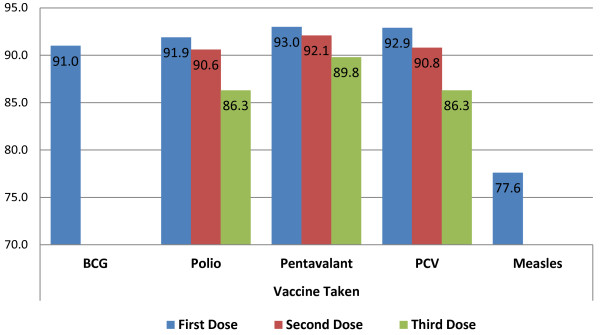
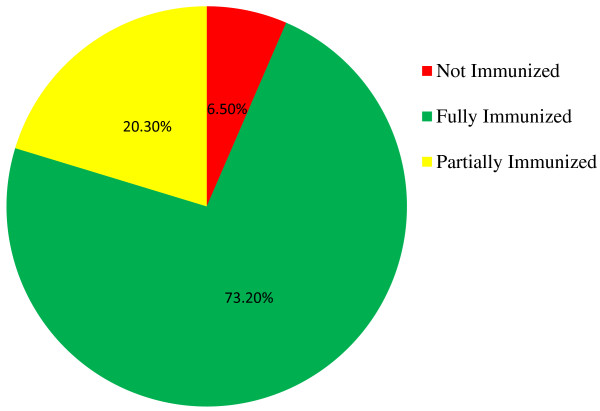
Nearly three fourth (73.2%) of children in Arba Minch Town and Arba Minch Zuria district were fully immunized. The rest 20.3% were partially immunized and 6.5% received no vaccine. Mother education, mothers' perception to accessibility of vaccines, mothers' knowledge to vaccine schedule of their site, place of delivery and living altitude were independent predictors of children immunization status.
Expanded program of immunization (EPI) coverage at Arba Minch town and Arba Minch Zuria district is better than the national immunization coverage but still below the goal. Educating mother, promoting institution delivery could help to maintain and enhance current immunization coverage. More emphasis should be given to the highland areas of the area.
免疫接种每年在全球范围内避免约200万至300万人死亡。在埃塞俄比亚,只有四分之一的儿童得到了充分免疫;其余儿童仍面临疫苗可预防疾病导致死亡的风险。为了提高免疫接种率,必须确定其覆盖率及预测因素。本研究测量了免疫接种覆盖率并确定了预测因素。
2013年3月,在埃塞俄比亚南部阿尔巴米琴镇的15个区和阿尔巴米琴祖里亚区对630名12至23个月大的儿童开展了基于社区的横断面研究。通过普查确定符合条件的儿童。采用了2005年世界卫生组织扩大免疫规划整群抽样方法。通过对指标儿童的母亲/照料者进行访谈、从疫苗接种卡上抄录信息以及观察卡介苗疤痕,使用经过预测试的阿姆哈拉语半结构化问卷收集数据。使用SPSS 16版软件对数据进行处理。使用三个连续的逻辑回归模型评估并呈现因变量和自变量之间的关联。
在阿尔巴米琴镇和阿尔巴米琴祖里亚区,近四分之三(73.2%)的儿童得到了充分免疫。其余20.3%的儿童部分免疫,6.5%的儿童未接种疫苗。母亲的教育程度、母亲对疫苗可及性的认知、母亲对当地疫苗接种时间表的了解、分娩地点和居住海拔是儿童免疫接种状况的独立预测因素。
阿尔巴米琴镇和阿尔巴米琴祖里亚区的扩大免疫规划(EPI)覆盖率高于全国免疫接种覆盖率,但仍未达到目标。对母亲进行教育、促进机构分娩有助于维持和提高当前的免疫接种覆盖率。应更加重视该地区的高地地区。