Campanelli G, Pascual M H, Hoeferlin A, Rosenberg J, Champault G, Kingsnorth A, Bagot d'Arc M, Miserez M
Department of Surgical Science, Istituto Clinico Sant'Ambrogio, University of Insubria, Milan, Italy,
Hernia. 2014 Oct;18(5):751-60. doi: 10.1007/s10029-014-1263-3. Epub 2014 Jun 3.
The Tisseel/Tissucol for mesh fixation in Lichtenstein hernia repair (TIMELI) study showed that mesh fixation with human fibrin sealant during inguinal hernia repair significantly reduced moderate-severe complications of pain 12 months post-operatively compared with sutures. Further analyses may assist surgeons by investigating predictors of post-surgical complications and identifying patients that may benefit from Tisseel/Tissucol intervention.
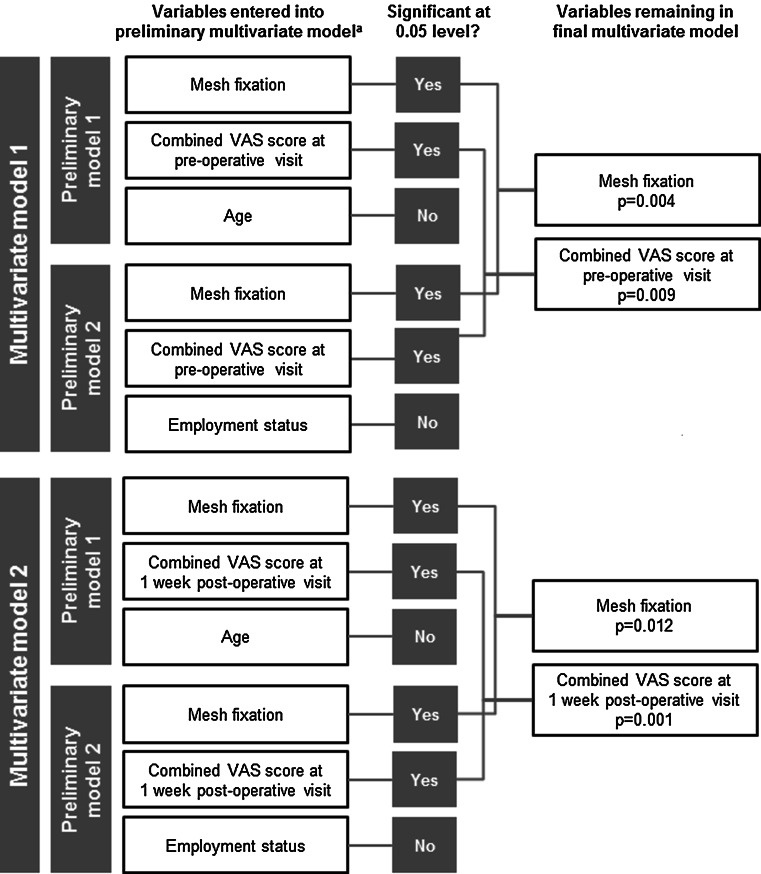
Univariate and multivariate analyses identified risk factors for combined pain, numbness and groin discomfort (PND) visual analogue scale (VAS) score 12 months post-operatively. Variables tested were: fixation method, age, employment status, physical activity, nerve handling, PND VAS score at pre-operative visit and 1 week post-operatively. The effect of fixation technique on separate PND outcomes 12 months post-surgery was also assessed. Analyses included the intention-to-treat (ITT) population and a subpopulation with pre-operative PND VAS > 30 mm.
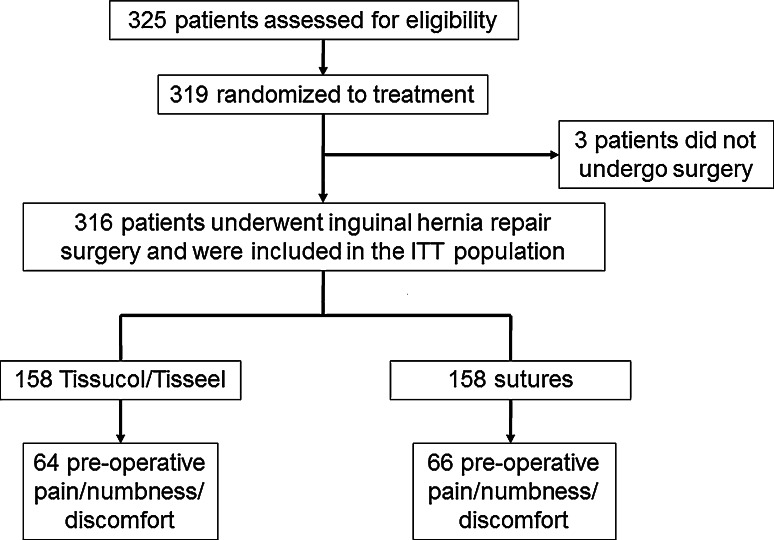
316 patients were included in the ITT, with 130 patients in the subpopulation with pre-operative PND VAS > 30. Multivariate analysis identified mesh fixation with sutures, worsening pre-operative PND and worsening PND 1 week post-surgery as significant predictors of 12-month PND in the ITT population; mesh fixation with sutures was a significant predictor of 12-month PND in the pre-operative PND VAS > 30 subpopulation (p < 0.05). Mesh fixation with Tisseel/Tissucol resulted in significantly less numbness and a lower intensity of groin discomfort compared with sutures at 12 months; there was no difference in pain between the treatment groups.
Pre-operative discomfort may be an important predictor of post-operative pain, numbness and discomfort. Tisseel/Tissucol may improve long-term morbidity over conventional sutures in these patients.
Tisseel/Tissucol用于Lichtenstein疝修补术中补片固定(TIMELI)研究表明,与缝合相比,腹股沟疝修补术中使用人纤维蛋白密封剂进行补片固定可显著降低术后12个月时中重度疼痛并发症的发生率。进一步分析通过研究术后并发症的预测因素并识别可能从Tisseel/Tissucol干预中获益的患者,可为外科医生提供帮助。
单因素和多因素分析确定了术后12个月时联合疼痛、麻木和腹股沟不适(PND)视觉模拟量表(VAS)评分的危险因素。测试的变量包括:固定方法、年龄、就业状况、体力活动、神经处理、术前访视时及术后1周的PND VAS评分。还评估了固定技术对术后12个月时单独PND结果的影响。分析包括意向性治疗(ITT)人群和术前PND VAS>30mm的亚组人群。
ITT人群纳入316例患者,术前PND VAS>30的亚组人群有130例患者。多因素分析确定,在ITT人群中,用缝线进行补片固定、术前PND恶化及术后1周PND恶化是12个月时PND的显著预测因素;在术前PND VAS>30的亚组人群中,用缝线进行补片固定是12个月时PND的显著预测因素(p<0.05)。与缝线相比,12个月时用Tisseel/Tissucol进行补片固定导致麻木显著减少,腹股沟不适强度降低;治疗组之间疼痛无差异。
术前不适可能是术后疼痛、麻木和不适的重要预测因素。在这些患者中,Tisseel/Tissucol可能比传统缝线改善长期发病率。