Department of Pediatrics, Kobe University Graduate School of Medicine, 7-5-2 Kusunoki-Cho, Chuo-ku, Kobe 650-0017, Japan.
BMC Pediatr. 2014 Jun 2;14:139. doi: 10.1186/1471-2431-14-139.
TAFRO syndrome is a unique clinicopathologic variant of multicentric Castleman's disease that has recently been identified in Japan. It is characterized by a constellation of symptoms: Thrombocytopenia, Anasarca, reticulin Fibrosis of the bone marrow, Renal dysfunction and Organomegaly (TAFRO). Previous reports have shown that affected patients usually respond to immunosuppressive therapy, but the disease sometimes has a fatal course. TAFRO syndrome occurs in the middle-aged and elderly and there are no prior reports of the disease in adolescents. Here we report the first adolescent case, successfully treated with anti-IL-6 receptor antibody (tocilizumab, TCZ) and monitored with serial cytokine profiles.
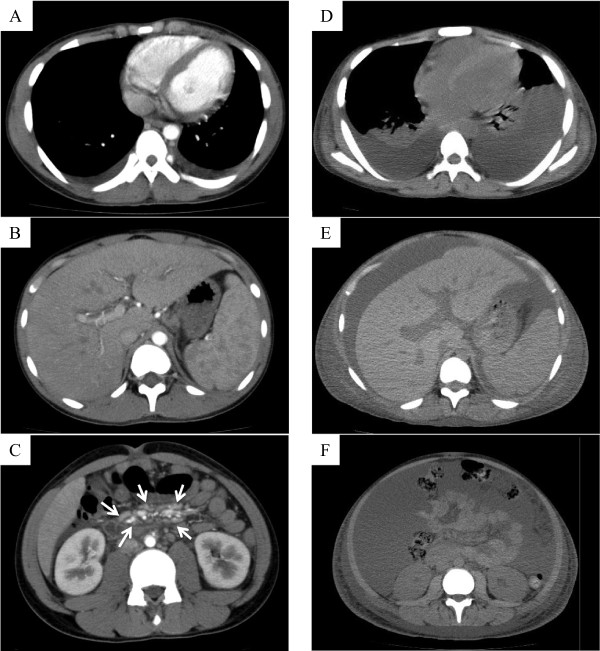
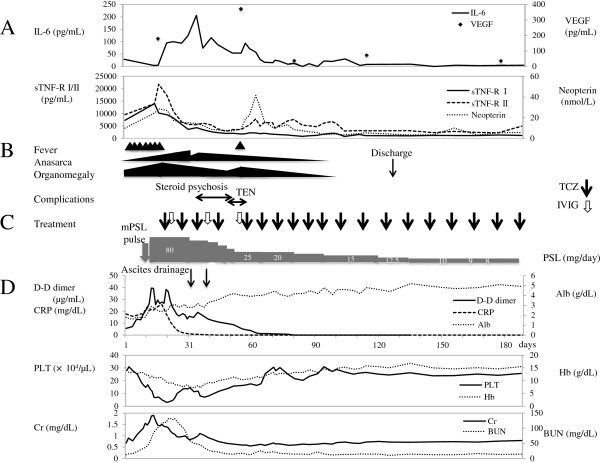
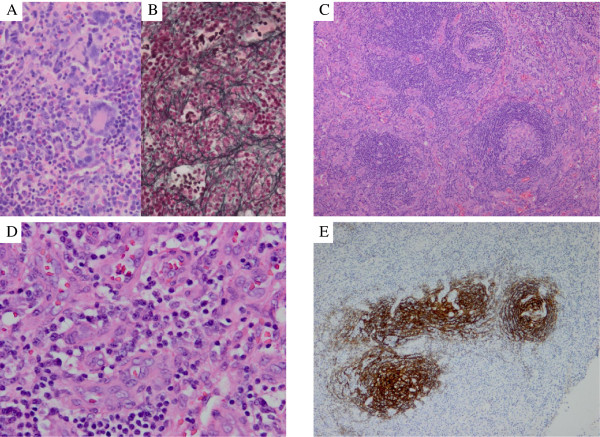
A 15-year-old Japanese boy was referred to us with fever of unknown origin. Whole body computed tomography demonstrated systemic lymphadenopathy, organomegaly and anasarca. Laboratory tests showed elevated C-reactive protein and hypoproteinemia. Bone marrow biopsy revealed a hyperplastic marrow with megakaryocytic hyperplasia and mild reticulin fibrosis. Despite methylprednisolone pulse therapy, the disease progressed markedly to respiratory distress, acute renal failure, anemia and thrombocytopenia. Serum and plasma levels of cytokines, including IL-6, vascular endothelial growth factor, neopterin and soluble tumor necrosis factor receptors I and II, were markedly elevated. Repeated weekly TCZ administration dramatically improved the patient's symptoms and laboratory tests showed decreasing cytokine levels.
To our knowledge, this is the first report of TAFRO syndrome in a young patient, suggesting that this disease can occur even in adolescence. The patient was successfully treated with TCZ. During our patient's clinical course, monitoring cytokine profiles was useful to assess the disease activity of TAFRO syndrome.
TAFRO 综合征是一种独特的多中心 Castleman 病的临床病理变异型,最近在日本被发现。其特征是一系列症状:血小板减少、全身性水肿、骨髓网状纤维增生、肾功能障碍和器官肿大(TAFRO)。先前的报告表明,受影响的患者通常对免疫抑制治疗有反应,但该疾病有时具有致命的病程。TAFRO 综合征发生在中年和老年人中,青少年中没有该疾病的先前报告。在这里,我们报告了首例青少年病例,成功地用抗白细胞介素 6 受体抗体(托珠单抗,TCZ)治疗,并通过连续的细胞因子谱进行监测。
一名 15 岁的日本男孩因不明原因发热被转介给我们。全身计算机断层扫描显示全身淋巴结病、器官肿大和全身性水肿。实验室检查显示 C 反应蛋白升高和低蛋白血症。骨髓活检显示增生性骨髓,伴有巨核细胞增生和轻度网状纤维增生。尽管给予甲基强的松龙脉冲治疗,但疾病明显进展为呼吸窘迫、急性肾衰竭、贫血和血小板减少。血清和血浆细胞因子水平,包括白细胞介素 6、血管内皮生长因子、新蝶呤和可溶性肿瘤坏死因子受体 I 和 II,明显升高。每周重复 TCZ 给药显著改善了患者的症状,实验室检查显示细胞因子水平下降。
据我们所知,这是首例青少年 TAFRO 综合征报告,表明该疾病甚至可以发生在青春期。该患者用 TCZ 成功治疗。在我们患者的临床过程中,监测细胞因子谱有助于评估 TAFRO 综合征的疾病活动度。