Popadin Konstantin, Safdar Adeel, Kraytsberg Yevgenya, Khrapko Konstantin
University of Geneva Medical School, Geneva, Switzerland.
Aging Cell. 2014 Aug;13(4):579-82. doi: 10.1111/acel.12231. Epub 2014 Jun 4.
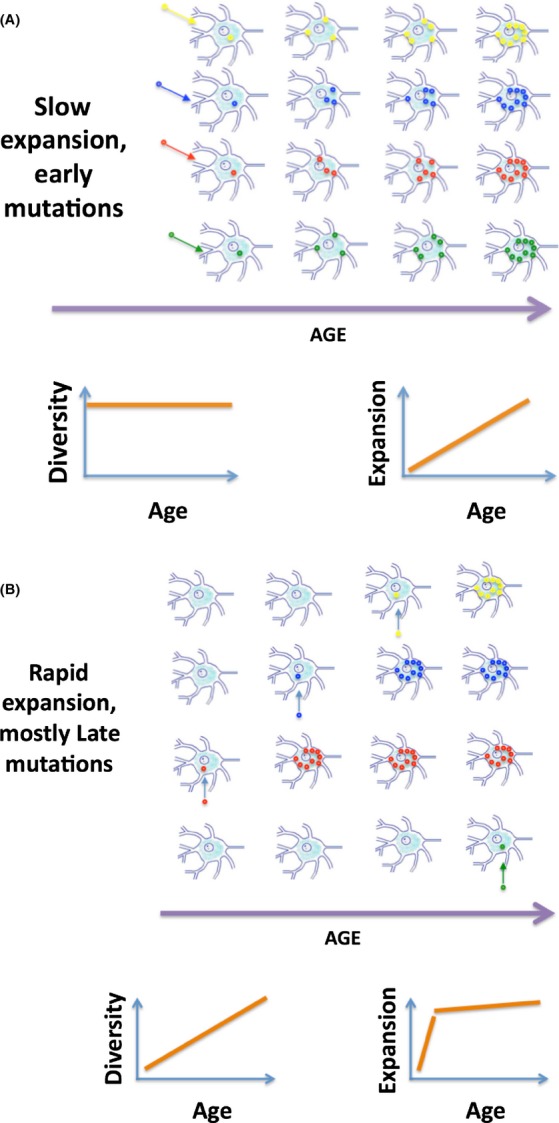
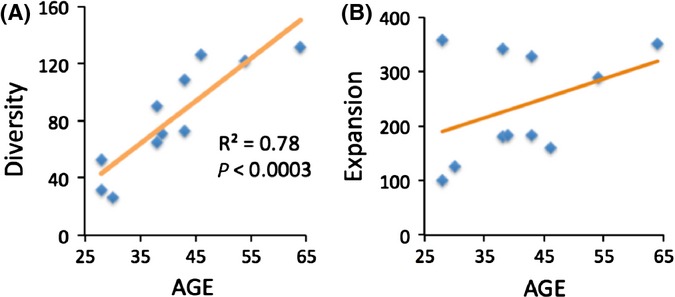
Somatic mtDNA mutations and deletions in particular are known to clonally expand within cells, eventually reaching detrimental intracellular concentrations. The possibility that clonal expansion is a slow process taking a lifetime had prompted an idea that founder mutations of mutant clones that cause mitochondrial dysfunction in the aged tissue might have originated early in life. If, conversely, expansion was fast, founder mutations should predominantly originate later in life. This distinction is important: indeed, from which mutations should we protect ourselves - those of early development/childhood or those happening at old age? Recently, high-resolution data describing the distribution of mtDNA deletions have been obtained using a novel, highly efficient method (Taylor et al., ). These data have been interpreted as supporting predominantly early origin of founder mutations. Re-analysis of the data implies that the data actually better fit mostly late origin of founders, although more research is clearly needed to resolve the controversy.
已知体细胞线粒体DNA突变和缺失会在细胞内进行克隆性扩增,最终达到有害的细胞内浓度。克隆性扩增是一个缓慢的过程,需要一生的时间,这一可能性引发了一种观点,即导致老年组织中线粒体功能障碍的突变克隆的奠基者突变可能在生命早期就已出现。相反,如果扩增速度很快,那么奠基者突变应该主要在生命后期出现。这种区分很重要:实际上,我们应该保护自己免受哪些突变的影响——那些早期发育/儿童期的突变还是老年期发生的突变?最近,使用一种新颖、高效的方法(泰勒等人)获得了描述线粒体DNA缺失分布的高分辨率数据。这些数据被解释为主要支持奠基者突变的早期起源。对这些数据的重新分析表明,这些数据实际上更符合奠基者大多起源于后期的情况,不过显然还需要更多研究来解决这一争议。