Olin Emma, von Schreeb Johan
Global Health/IHCAR, Department of Public Health, Karolinska Institute, Stockholm, Sweden.
Centre for research on health care in disasters, Department of Public Health, Karolinska Institute, Stockholm, Sweden.
PLoS Curr. 2014 May;6. doi: 10.1371/currents.dis.d05f908b179343c8b4705cf44c15dbe9.
International humanitarian assistance is essential for disaster-affected populations, particularly in resource scarce settings. To target such assistance, needs assessments are required. According to internationally endorsed principles, donor governments should provide funding for humanitarian assistance based on need.
The aim of this study is to explore a major donor's use of needs assessment data in decision-making for allocations of funds for health-related humanitarian assistance contributions.
This is a case study of the Swedish International Development Cooperation Agency (Sida), a major and respected international donor of humanitarian assistance.
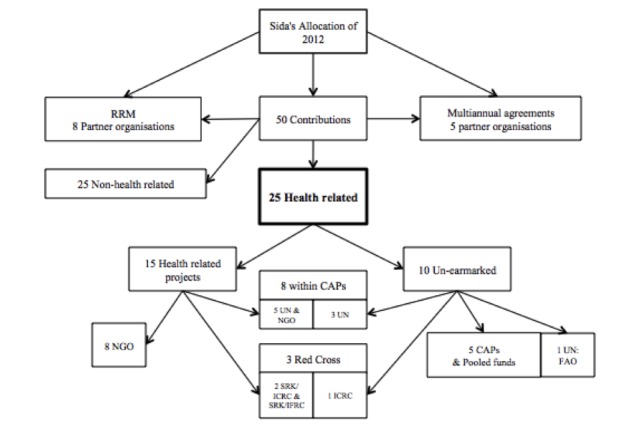
To explore Sida's use of needs assessment data in practice for needs-based allocations, we reviewed all decision documents and assessment memoranda for humanitarian assistance contributions for 2012 using content analysis; this was followed by interviews with key personnel at Sida.
Our document analysis found that needs assessment data was not systematically included in Sida's assessment memoranda and decision documents. In the interviews, we observed various descriptions of the concept of needs assessments, the importance of contextual influences as well as previous collaborations with implementing humanitarian assistance organizations. Our findings indicate that policies guiding funding decisions on humanitarian assistance need to be matched with available needs assessment data and that terminologies and concepts have to be clearly defined.
Based on the document analysis and the interviews, it is unclear how well Sida used needs assessment data for decisions to allocate funds. However, although our observations show that needs assessments are seldom used in decision making, Sida's use of needs assessments has improved compared to a previous study. To improve project funds allocations based on needs assessment data, it will be critical to develop distinct frameworks for allocation distributions based on needs assessment and clear definitions, measurements and interpretations of needs. Key words: Needs assessment, humanitarian assistance, disasters, donor decision-making.
国际人道主义援助对于受灾民众至关重要,尤其是在资源匮乏的地区。为了确定此类援助的目标,需要进行需求评估。根据国际认可的原则,捐助国政府应根据需求为人道主义援助提供资金。
本研究的目的是探讨一个主要捐助方在决策分配与卫生相关的人道主义援助资金时对需求评估数据的使用情况。
这是一项关于瑞典国际开发合作署(Sida)的案例研究,Sida是一个主要且受尊敬的国际人道主义援助捐助方。
为了探究Sida在基于需求的分配中对需求评估数据的实际使用情况,我们采用内容分析法审查了2012年所有人道主义援助捐款的决策文件和评估备忘录;随后对Sida的关键人员进行了访谈。
我们的文件分析发现,需求评估数据并未系统地纳入Sida的评估备忘录和决策文件中。在访谈中,我们观察到对需求评估概念的各种描述、背景影响的重要性以及此前与执行人道主义援助组织的合作情况。我们的研究结果表明,指导人道主义援助资金决策的政策需要与现有的需求评估数据相匹配,并且术语和概念必须明确界定。
基于文件分析和访谈,尚不清楚Sida在资金分配决策中对需求评估数据的使用情况如何。然而,尽管我们的观察表明需求评估在决策中很少被使用,但与之前的研究相比,Sida对需求评估的使用已有改进。为了基于需求评估数据改进项目资金分配,制定基于需求评估的明确分配框架以及对需求进行清晰的定义、衡量和解释至关重要。关键词:需求评估、人道主义援助、灾难、捐助方决策。