Brito Cláudia, Portela Margareth Crisóstomo, Vasconcellos Mauricio Teixeira Leite de
Departamento de Administração e Planejamento em Saúde, Escola Nacional de Saúde Pública Sergio Arouca, Fundação Oswaldo Cruz, Rio de Janeiro, RJ, Brasil.
Escola Nacional de Ciências Estatísticas, Instituto Brasileiro de Geografia e Estatística, Rio de Janeiro, RJ, Brasil.
Rev Saude Publica. 2014 Apr;48(2):284-95. doi: 10.1590/s0034-8910.2014048004799.
To analyze factors associated with persistence to breast cancer hormone therapy in order to contribute to the quality of care improvement.
Retrospective longitudinal study, based on secondary data. A cohort of 5,861 women with breast cancer registered in different datasets of the Brazilian National Cancer Institute and the Brazilian Unified Health System were analyzed. All women were treated at this hospital, which provides free medication, and the follow-up period was from January 2004 to October 2010. Sociodemographic, behavioral, and clinical variables, as well as aspects of lifestyle and health care, were considered in the explanation of variations in the persistence to hormone therapy, applying the Kaplan-Meier method and the Cox proportional hazard model.
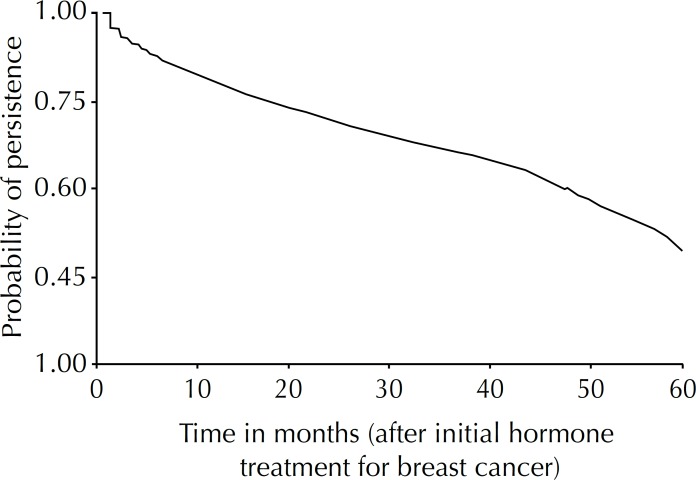
Overall persistence to hormone therapy was 79.0% at the end of the first year, and 31.0% in five years of treatment. The risk of discontinuing hormone therapy was higher among women under 35 years old, with more advanced disease (stages III and IV), alcohol drinkers, those undergoing chemotherapy, and for each additional hospitalization, exam performed, and month between diagnosis and beginning of treatment. In the opposite direction, the risk of discontinuity was lower among women who had at least finished high school, those with partner, with a family history of cancer, those who had undergone breast surgery, and who had outpatient visits to a Mastologist, and a Clinical Oncologist.
The majority of the women with breast cancer (69.0%) do not persist with hormone treatment for the five years recommended, increasing the risk of inadequate clinical results. The results show aspects of care that can provide better results.
分析与乳腺癌激素治疗持续性相关的因素,以促进护理质量的提高。
基于二手数据的回顾性纵向研究。对在巴西国家癌症研究所和巴西统一卫生系统的不同数据集中登记的5861名乳腺癌女性队列进行了分析。所有女性均在这家提供免费药物的医院接受治疗,随访期为2004年1月至2010年10月。在解释激素治疗持续性的差异时,考虑了社会人口学、行为和临床变量以及生活方式和医疗保健方面,应用了Kaplan-Meier方法和Cox比例风险模型。
激素治疗的总体持续性在第一年结束时为79.0%,在五年治疗期内为31.0%。35岁以下、疾病进展更严重(III期和IV期)、饮酒者、接受化疗的女性以及每增加一次住院、进行一次检查以及诊断与开始治疗之间的间隔月份,停止激素治疗的风险更高。相反,至少完成高中学业、有伴侣、有癌症家族史、接受过乳房手术以及拜访过乳腺科医生和临床肿瘤学家的女性,停止治疗的风险较低。
大多数乳腺癌女性(69.0%)未坚持进行推荐的五年激素治疗,增加了临床效果不佳的风险。结果显示了可以提供更好结果的护理方面。