Pourabbas Tahvildari Babak, Erfani Mohammad-Ali, Nouraei Hormoz, Sadeghian Mohammad
Department of Orthopedic Surgery, Chamran Hospital, Shiraz University of Medical Sciences, Shiraz, Iran.
Clin Orthop Surg. 2014 Jun;6(2):180-4. doi: 10.4055/cios.2014.6.2.180. Epub 2014 May 16.
Several reports have suggested low bone mineral density (BMD) in patients with adolescent idiopathic scoliosis (AIS). We determined bone mineral status in patients with AIS to evaluate the effect of brace treatment on BMD.
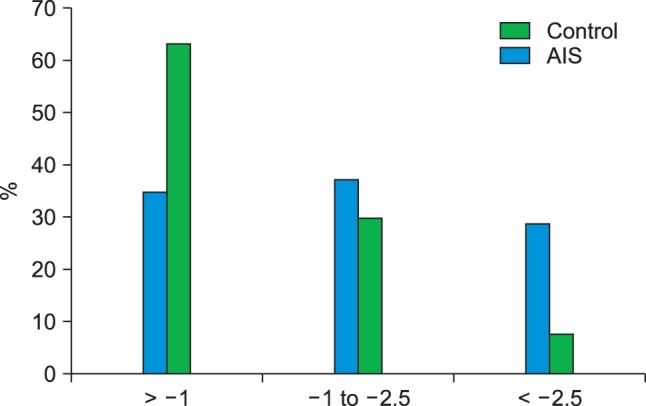
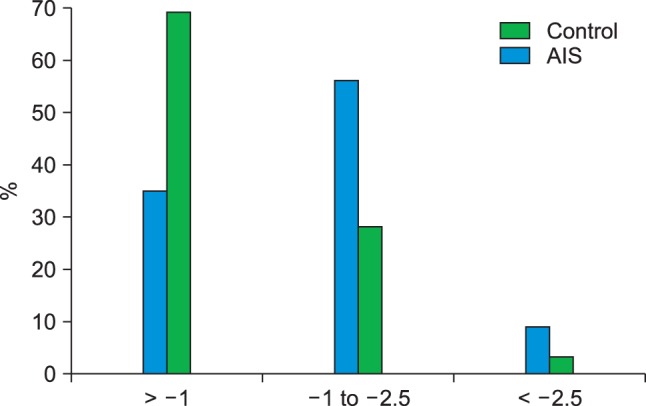
BMD was measured in 46 patients (mean age, 17.8 ± 4.9 years) with AIS (17 with brace and 29 without brace) by dual-energy X-ray absorptiometry scan and compared the results to an age-matched (mean age, 16.6 ± 3.9 years) control group (n = 54).
The AIS group had significantly lower bone mass at the lumbar spine (Z-score, -1.500 vs. -0.832) and hip (Z-score, -1.221 vs. -0.754) except at the femoral neck. No difference in BMD was found between patients with AIS who used a brace and those who did not.
The results confirmed that BMD was low in AIS patients and it was not affected by brace treatment.
多项报告提示青少年特发性脊柱侧凸(AIS)患者骨矿物质密度(BMD)较低。我们测定了AIS患者的骨矿物质状况,以评估支具治疗对BMD的影响。
采用双能X线吸收法扫描测量46例AIS患者(平均年龄17.8±4.9岁,其中17例使用支具,29例未使用支具)的BMD,并将结果与年龄匹配的对照组(平均年龄16.6±3.9岁,n=54)进行比较。
除股骨颈外,AIS组腰椎(Z值,-1.500对-0.832)和髋部(Z值,-1.221对-0.754)的骨量显著较低。使用支具的AIS患者与未使用支具的患者之间BMD无差异。
结果证实AIS患者的BMD较低,且不受支具治疗的影响。