Schmidt Manuel A, Mennecke Angelika, Michelson Georg, Doerfler Arnd, Engelhorn Tobias
Department of Neuroradiology, Friedrich-Alexander-University Erlangen-Nuremberg, Erlangen, Germany.
Department of Ophthalmology, Friedrich-Alexander-University Erlangen-Nuremberg, Erlangen, Germany.
PLoS One. 2014 Jun 5;9(6):e99344. doi: 10.1371/journal.pone.0099344. eCollection 2014.
Tract-based spatial statistics (TBSS) has been used to assess the integrity of the visual pathway in glaucoma patients. TBSS uses the subjects' FA data to create a mean FA skeleton of white matter tracts before running voxel-wise cross-subject statistics. We compared four different approaches of registration of FA maps to create the skeleton and evaluated alignment and subsequently the impact of the chosen registration on voxel-wise statistics.
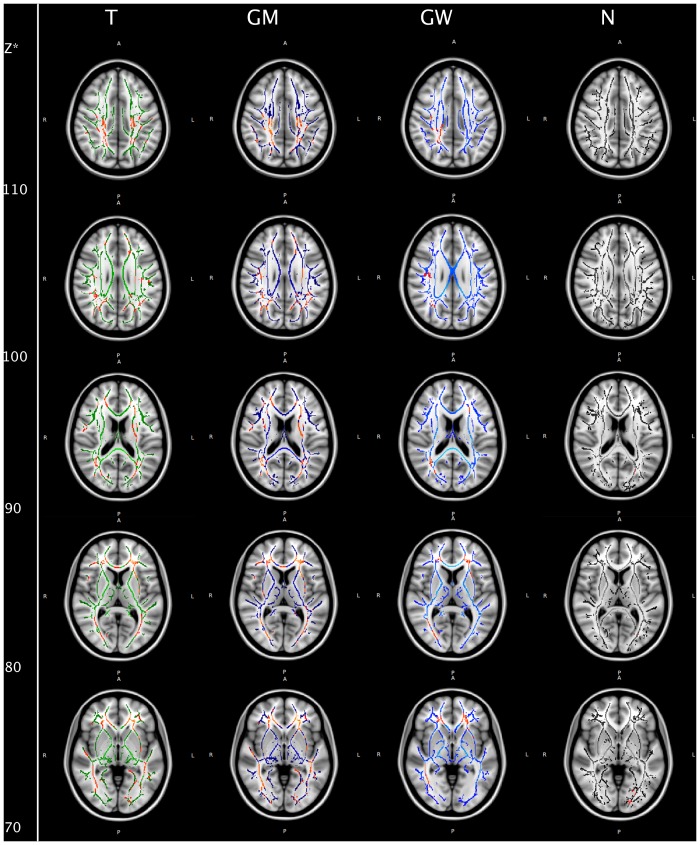
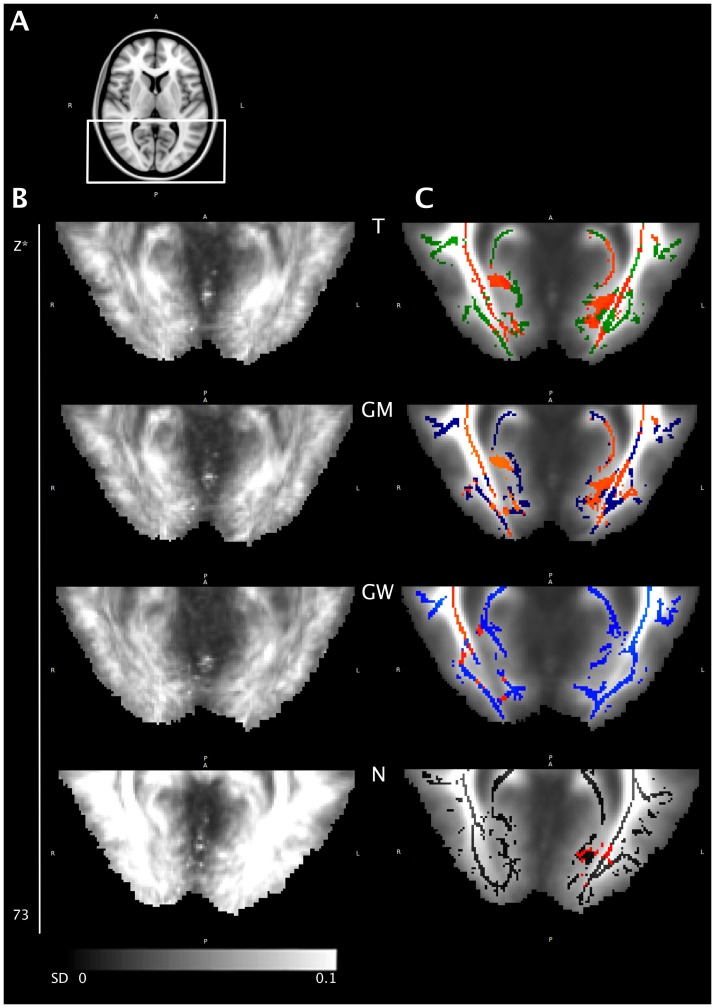
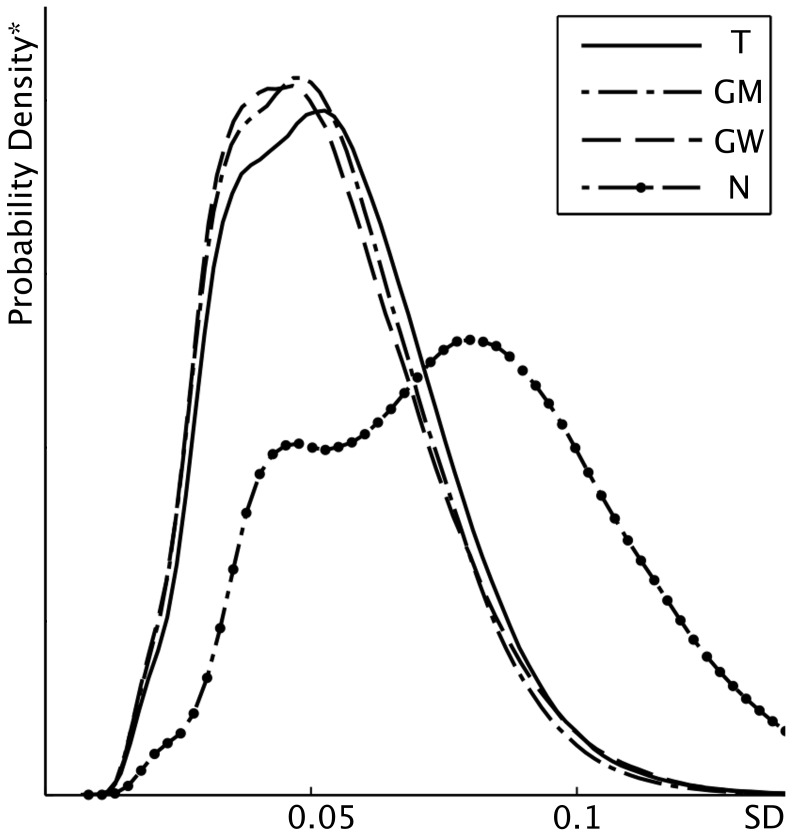
Our study comprised 69 subjects, i.e. 46 patients with primary open angle glaucoma (POAG) and a healthy, age-matched control group of 23 subjects. Mean FA skeletons were created using the following registration approaches: registration to a standard template (T), registration to the group mean (GM), registration to a group-wise atlas (GW) and registration to the most typical subject (N). Subsequently, maps of standard deviation of the 4D images were created to assess the alignment. Voxel-wise statistics for each registration approach were performed.
We found distinct differences in voxel-wise statistics depending on the chosen registration approach. Best alignment results were achieved by registration to a study specific template, i.e. to the group mean (GM) or to a group-wise atlas (GW). Overall alignment did not differ between these two approaches. However, voxel-wise statistics showed clusters of significantly decreased FA values in the T and GM approach, which were not significant after GW registration. These voxels of significantly decreased FA values after T and GM registration did not represent white matter tracts and correlated with higher standard deviation in FA maps across subjects, thus implying registration errors, especially in the optic radiation.
Registration to a study-specific template, i.e. to the group mean or a group-wise atlas seems to be the method of choice in TBSS-analysis of glaucoma patients as it shows better alignment of the optic radiation and helps to rule out registration errors due to misalignment.
基于纤维束的空间统计学(TBSS)已被用于评估青光眼患者视觉通路的完整性。TBSS在进行体素级别的跨受试者统计之前,使用受试者的FA数据创建白质纤维束的平均FA骨架。我们比较了四种不同的FA图配准方法以创建骨架,并评估了配准情况以及所选配准对体素级统计的影响。
我们的研究包括69名受试者,即46例原发性开角型青光眼(POAG)患者和23名年龄匹配的健康对照组。使用以下配准方法创建平均FA骨架:配准到标准模板(T)、配准到组均值(GM)、配准到组水平图谱(GW)和配准到最典型受试者(N)。随后,创建4D图像的标准差图以评估配准情况。对每种配准方法进行体素级统计。
我们发现,根据所选配准方法的不同,体素级统计存在明显差异。通过配准到研究特定模板,即配准到组均值(GM)或配准到组水平图谱(GW),可获得最佳配准结果。这两种方法的总体配准情况没有差异。然而,体素级统计显示,在T和GM方法中,FA值显著降低的聚类在GW配准后不显著。T和GM配准后FA值显著降低的这些体素并不代表白质纤维束,并且与跨受试者FA图中较高的标准差相关,这意味着存在配准错误,尤其是在视辐射中。
在青光眼患者的TBSS分析中,配准到研究特定模板,即配准到组均值或组水平图谱似乎是首选方法,因为它显示出视辐射的配准更好,并有助于排除因配准不齐导致的配准错误。