Belo Luís, Nascimento Henrique, Kohlova Michaela, Bronze-da-Rocha Elsa, Fernandes João, Costa Elísio, Catarino Cristina, Aires Luísa, Mansilha Helena Ferreira, Rocha-Pereira Petronila, Quintanilha Alexandre, Rêgo Carla, Santos-Silva Alice
Departamento de Ciências Biológicas, Faculdade de Farmácia, Universidade do Porto, Porto, Portugal; Instituto de Biologia Molecular e Celular (IBMC), Universidade do Porto, Porto, Portugal.
Institute for Biomedical Imaging and Life Science (IBILI), Faculdade de Medicina, Universidade de Coimbra, Coimbra, Portugal.
PLoS One. 2014 Jun 5;9(6):e98467. doi: 10.1371/journal.pone.0098467. eCollection 2014.
Bilirubin has potential antioxidant and anti-inflammatory properties. The UGT1A1*28 polymorphism (TA repeats in the promoter region) is a major determinant of bilirubin levels and recent evidence suggests that raised adiposity may also be a contributing factor. We aimed to study the interaction between UGT1A1 polymorphism, hematological and anthropometric variables with total bilirubin levels in young individuals.
350 obese (mean age of 11.6 years; 52% females) and 79 controls (mean age of 10.5 years; 59% females) were included. Total bilirubin and C-reactive protein (CRP) plasma levels, hemogram, anthropometric data and UGT1A1 polymorphism were determined. In a subgroup of 74 obese and 40 controls body composition was analyzed by dual-energy X-ray absorptiometry.
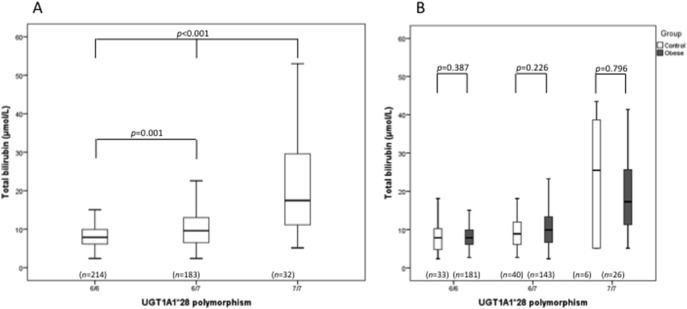
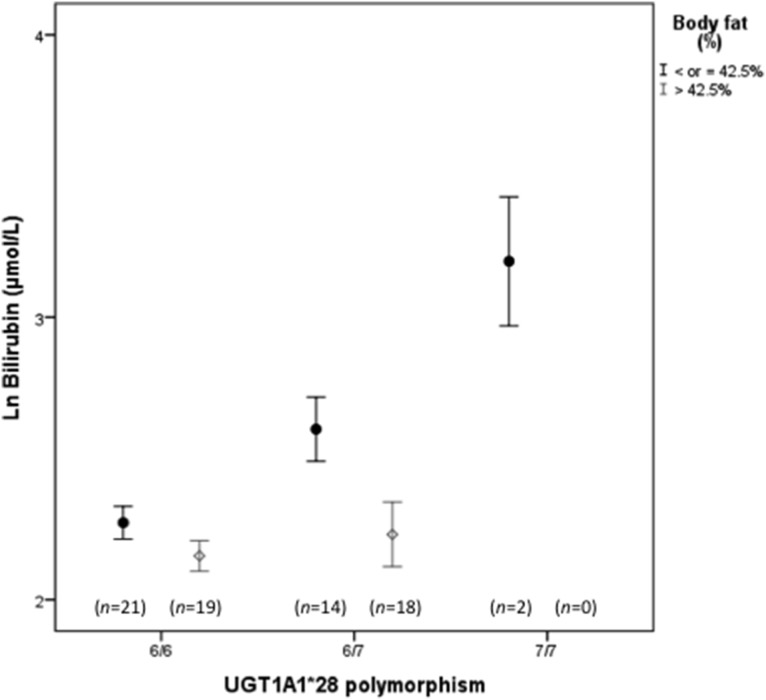
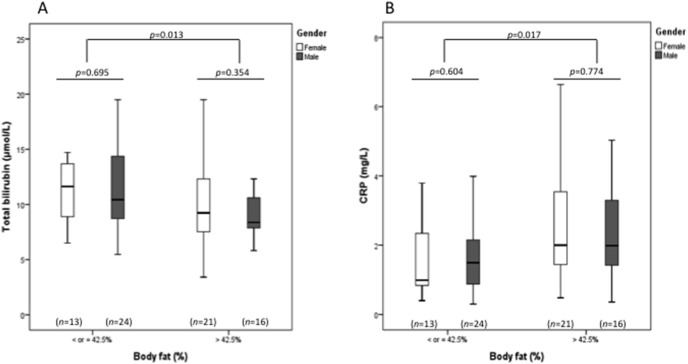
The UGT1A1 genotype frequencies were 49.9%, 42.7% and 7.5% for 6/6, 6/7 and 7/7 genotypes, respectively. Patients with 7/7 genotype presented the highest total bilirubin levels, followed by 6/7 and 6/6 genotypes. Compared to controls, obese patients presented higher erythrocyte count, hematocrit, hemoglobin and CRP levels, but no differences in bilirubin or in UGT1A1 genotype distribution. Body fat percentage was inversely correlated with bilirubin in obese patients but not in controls. This inverse association was observed either in 6/7 or 6/6 genotype obese patients. UGT1A1 polymorphism and body fat percentage were the main factors affecting bilirubin levels within obese patients (linear regression analysis).
In obese children and adolescents, body fat composition and UGT1A1 polymorphism are independent determinants of total bilirubin levels. Obese individuals with 6/6 UGT1A1 genotype and higher body fat mass may benefit from a closer clinical follow-up.
胆红素具有潜在的抗氧化和抗炎特性。UGT1A1*28多态性(启动子区域的TA重复序列)是胆红素水平的主要决定因素,最近的证据表明,肥胖程度增加也可能是一个促成因素。我们旨在研究UGT1A1多态性、血液学和人体测量学变量与年轻个体总胆红素水平之间的相互作用。
纳入350名肥胖者(平均年龄11.6岁;52%为女性)和79名对照者(平均年龄10.5岁;59%为女性)。测定总胆红素和C反应蛋白(CRP)血浆水平、血常规、人体测量数据和UGT1A1多态性。在74名肥胖者和40名对照者的亚组中,通过双能X线吸收法分析身体成分。
6/6、6/7和7/7基因型的UGT1A1基因型频率分别为49.9%、42.7%和7.5%。7/7基因型患者的总胆红素水平最高,其次是6/7和6/6基因型。与对照者相比,肥胖患者的红细胞计数、血细胞比容、血红蛋白和CRP水平更高,但胆红素或UGT1A1基因型分布无差异。肥胖患者的体脂百分比与胆红素呈负相关,而对照者中未观察到这种相关性。在6/7或6/6基因型肥胖患者中均观察到这种负相关。UGT1A1多态性和体脂百分比是影响肥胖患者胆红素水平的主要因素(线性回归分析)。
在肥胖儿童和青少年中,身体脂肪组成和UGT1A1多态性是总胆红素水平的独立决定因素。具有6/6 UGT1A1基因型和更高体脂量的肥胖个体可能受益于更密切的临床随访。