1. Department of Medical Microbiology, Faculty of Medicine, University of Malaya, 50603 Kuala Lumpur.
2. Department of Biomedical Science, Faculty of Medicine, University of Malaya, 50603 Kuala Lumpur.
Int J Med Sci. 2014 May 14;11(7):732-41. doi: 10.7150/ijms.7768. eCollection 2014.
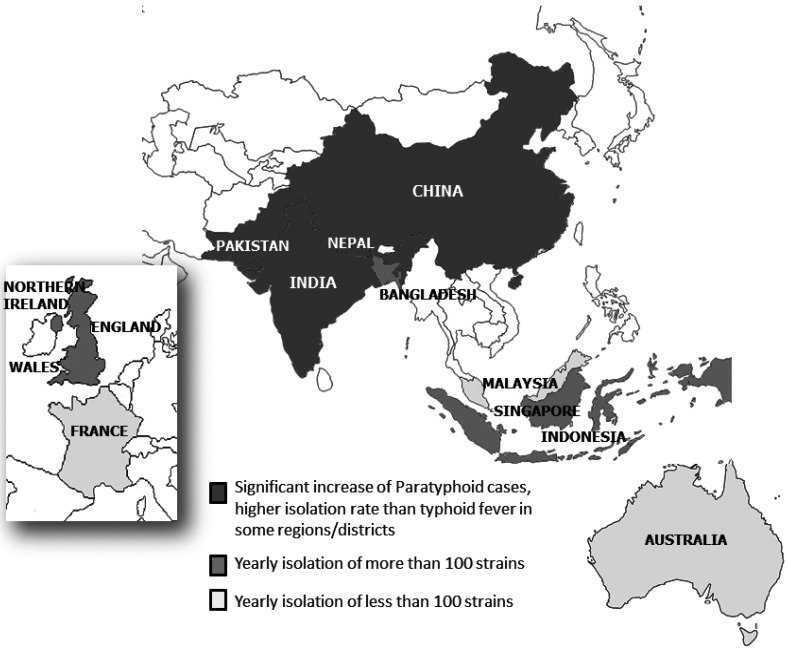
The incidence of enteric fever caused by Salmonella enterica serovar Paratyphi A (S. Paratyphi A) is increasing in many parts of the world. Although there is no major outbreak of paratyphoid fever in recent years, S. Paratyphi A infection still remains a public health problem in many tropical countries. Therefore, surveillance studies play an important role in monitoring infections and the emergence of multidrug resistance, especially in endemic countries such as India, Nepal, Pakistan and China. In China, enteric fever was caused predominantly by S. Paratyphi A rather than by Salmonella enterica serovar Typhi (S. Typhi). Sometimes, S. Paratyphi A infection can evolve into a carrier state which increases the risk of transmission for travellers. Hence, paratyphoid fever is usually classified as a "travel-associated" disease. To date, diagnosis of paratyphoid fever based on the clinical presentation is not satisfactory as it resembles other febrile illnesses, and could not be distinguished from S. Typhi infection. With the availability of Whole Genome Sequencing technology, the genomes of S. Paratyphi A could be studied in-depth and more specific targets for detection will be revealed. Hence, detection of S. Paratyphi A with Polymerase Chain Reaction (PCR) method appears to be a more reliable approach compared to the Widal test. On the other hand, due to increasing incidence of S. Paratyphi A infections worldwide, the need to produce a paratyphoid vaccine is essential and urgent. Hence various vaccine projects that involve clinical trials have been carried out. Overall, this review provides the insights of S. Paratyphi A, including the bacteriology, epidemiology, management and antibiotic susceptibility, diagnoses and vaccine development.
甲型副伤寒沙门氏菌(S. Paratyphi A)引起的肠热病发病率在世界许多地区正在上升。尽管近年来没有发生大规模副伤寒疫情,但在许多热带国家,S. Paratyphi A 感染仍然是一个公共卫生问题。因此,监测研究在监测感染和多药耐药性的出现方面发挥着重要作用,特别是在印度、尼泊尔、巴基斯坦和中国等流行国家。在中国,肠热病主要由 S. Paratyphi A 引起,而不是由伤寒沙门氏菌(S. Typhi)引起。有时,S. Paratyphi A 感染会演变成带菌状态,增加旅行者传播的风险。因此,副伤寒通常被归类为“旅行相关”疾病。迄今为止,基于临床表现诊断副伤寒并不令人满意,因为它类似于其他发热性疾病,并且无法与 S. Typhi 感染区分开来。随着全基因组测序技术的出现,可以深入研究 S. Paratyphi A 的基因组,并揭示更具体的检测目标。因此,与肥达氏试验相比,用聚合酶链反应(PCR)方法检测 S. Paratyphi A 似乎是一种更可靠的方法。另一方面,由于全球 S. Paratyphi A 感染的发病率不断上升,因此生产副伤寒疫苗是必要和紧迫的。因此,已经开展了各种涉及临床试验的疫苗项目。总的来说,本综述提供了 S. Paratyphi A 的见解,包括细菌学、流行病学、管理和抗生素敏感性、诊断和疫苗开发。