IHS Life Sciences, Washington, DC, USA.
Rollins School of Public Health, Emory University, Atlanta, GA, USA.
Popul Health Metr. 2014 May 7;12:12. doi: 10.1186/1478-7954-12-12. eCollection 2014.
Screening to detect prediabetes and diabetes enables early prevention and intervention. This study describes the number and characteristics of asymptomatic, undiagnosed adults in the United States who could be detected with prediabetes and type 2 diabetes using the American Diabetes Association (ADA) guidelines compared to the United States Preventive Services Task Force (USPSTF) guidelines.
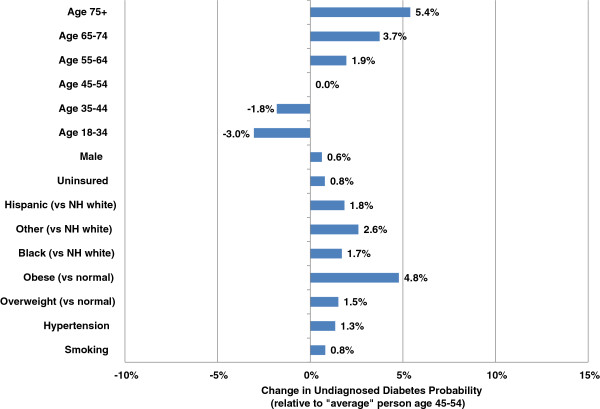
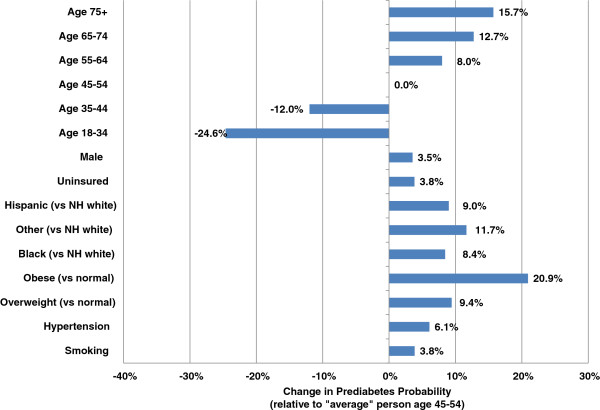
We developed predictive models for undiagnosed diabetes and prediabetes using polytomous logistic regression from data on risk factors in the 2003-2010 National Health and Nutrition Examination Survey (n = 19,056). We applied these predictive models to the 2010 Medical Expenditure Panel Survey, which contains health care use data, to generate probabilities of undiagnosed diabetes and undetected prediabetes for each adult. We summed individual probabilities to estimate the number of adults who would be detected with prediabetes and/or type 2 diabetes if screened under ADA or USPSTF guidelines. We analyzed health care use patterns of people at high risk for diabetes.
In 2010, 59.1 million adults met the USPSTF screening criteria including 24.4 million people with undetected prediabetes and 3.7 million people with undiagnosed diabetes. In comparison, among the 86.3 million people who met the ADA screening criteria, there were 33.9 million with undetected prediabetes and 4.6 million with undiagnosed type 2 diabetes. The ADA guidelines detected 38.9% more cases of prediabetes and 24.3% more cases of type 2 diabetes compared to the USPSTF guidelines. Subgroup analysis showed that ADA guidelines would detect 78% more cases of diabetes among the age 54 and younger population, in 40% more blacks, and in more than twice as many Hispanics than USPSTF guidelines. Only 58% of adults meeting ADA guidelines and 70% meeting USPSTF guidelines had ≥ 1 primary care office visit in 2010.
Compared to USPSTF guidelines, ADA guidelines would screen more people and detect more cases of both prediabetes and type 2 diabetes, though a substantial percentage of patients with undetected cases had no contact with a primary care provider in 2010. Addressing the problem of large numbers of undetected prediabetes and type 2 diabetes cases will require new strategies for screening.
通过筛查发现前驱糖尿病和糖尿病,有助于早期预防和干预。本研究描述了根据美国糖尿病协会(ADA)指南与美国预防服务工作组(USPSTF)指南,使用多分类逻辑回归方法,从危险因素数据中发现美国无症状、未经诊断的成年人数量和特征,这些成年人可能被诊断为前驱糖尿病和 2 型糖尿病。
我们使用 2003-2010 年全国健康与营养调查(n=19056)中的危险因素数据,开发了未诊断糖尿病和前驱糖尿病的预测模型。我们将这些预测模型应用于 2010 年医疗支出面板调查,该调查包含医疗保健使用数据,为每位成年人生成未诊断糖尿病和未检测到的前驱糖尿病的概率。我们将个体概率相加,以估计如果根据 ADA 或 USPSTF 指南进行筛查,将会发现多少患有前驱糖尿病和/或 2 型糖尿病的成年人。我们分析了糖尿病高危人群的医疗保健使用模式。
2010 年,5910 万成年人符合 USPSTF 筛查标准,其中 2440 万人患有未检测到的前驱糖尿病,370 万人患有未诊断的糖尿病。相比之下,在符合 ADA 筛查标准的 8630 万人中,有 3390 万人患有未检测到的前驱糖尿病,460 万人患有未诊断的 2 型糖尿病。ADA 指南比 USPSTF 指南多发现 38.9%的前驱糖尿病病例和 24.3%的 2 型糖尿病病例。亚组分析显示,ADA 指南在 54 岁及以下人群中会多发现 78%的糖尿病病例,在黑人中会多发现 40%的病例,在西班牙裔中会多发现两倍以上的病例。只有 58%符合 ADA 指南标准的成年人和 70%符合 USPSTF 指南标准的成年人在 2010 年至少进行了一次初级保健门诊就诊。
与 USPSTF 指南相比,ADA 指南会筛查更多的人,并发现更多的前驱糖尿病和 2 型糖尿病病例,尽管 2010 年仍有相当一部分未检出病例的患者没有与初级保健提供者接触。要解决大量未检出的前驱糖尿病和 2 型糖尿病病例的问题,需要有新的筛查策略。