Janssen Pharmaceutical Research and Development, LLC San Diego, USA.
Front Neurosci. 2014 May 20;8:107. doi: 10.3389/fnins.2014.00107. eCollection 2014.
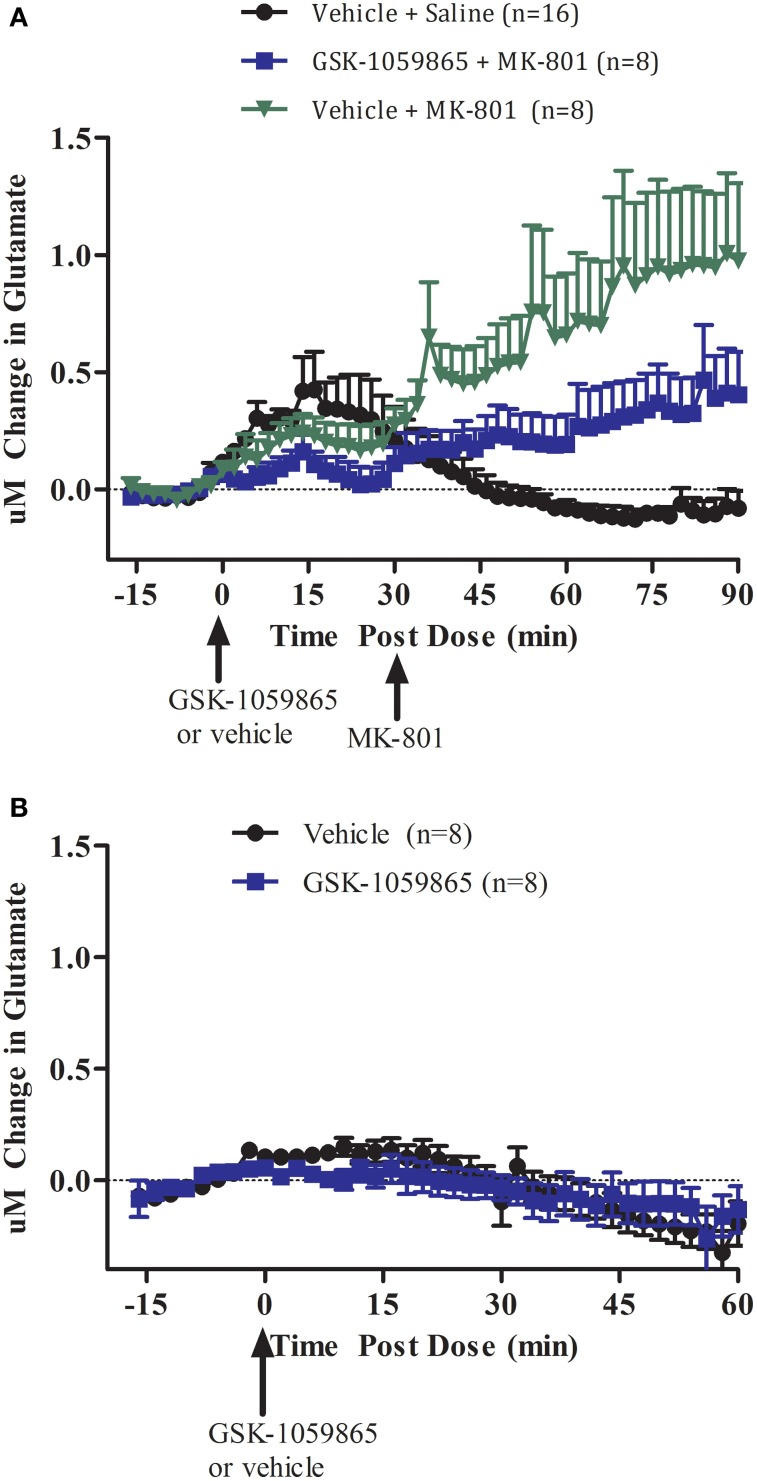
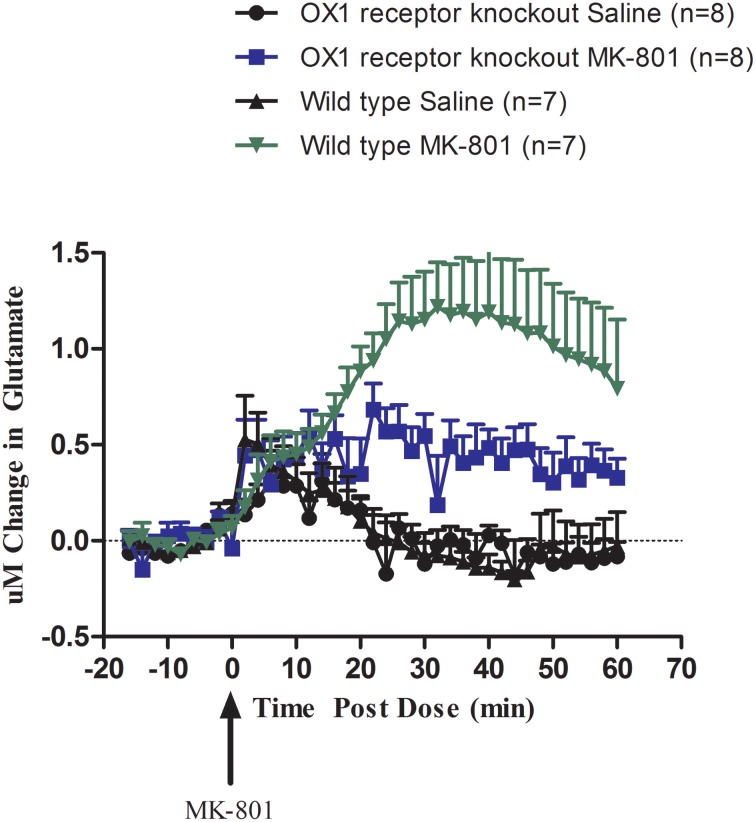
The orexin/hypocretin neuropeptides are produced by a cluster of neurons within the lateral posterior hypothalamus and participate in neuronal regulation by activating their receptors (OX1 and OX2 receptors). The orexin system projects widely through the brain and functions as an interface between multiple regulatory systems including wakefulness, energy balance, stress, reward, and emotion. Recent studies have demonstrated that orexins and glutamate interact at the synaptic level and that orexins facilitate glutamate actions. We tested the hypothesis that orexins modulate glutamate signaling via OX1 receptors by monitoring levels of glutamate in frontal cortex of freely moving mice using enzyme coated biosensors under inhibited OX1 receptor conditions. MK-801, an NMDA receptor antagonist, was administered subcutaneously (0.178 mg/kg) to indirectly disinhibit pyramidal neurons and therefore increase cortical glutamate release. In wild-type mice, pretreatment with the OX1 receptor antagonist GSK-1059865 (10 mg/kg S.C.) which had no effect by itself, significantly attenuated the cortical glutamate release elicited by MK-801. OX1 receptor knockout mice had a blunted glutamate release response to MK-801 and exhibited about half of the glutamate release observed in wild-type mice in agreement with the data obtained with transient blockade of OX1 receptors. These results indicate that pharmacological (transient) or genetic (permanent) inhibition of the OX1 receptor similarly interfere with glutamatergic function in the cortex. Selectively targeting the OX1 receptor with an antagonist may normalize hyperglutamatergic states and thus may represent a novel therapeutic strategy for the treatment of various psychiatric disorders associated with hyperactive states.
食欲素/下丘脑泌素神经肽由外侧下丘脑后部的一簇神经元产生,并通过激活其受体(OX1 和 OX2 受体)参与神经元调节。食欲素系统在大脑中广泛投射,作为多个调节系统之间的接口,包括觉醒、能量平衡、应激、奖励和情绪。最近的研究表明,食欲素和谷氨酸在突触水平相互作用,并且食欲素促进谷氨酸的作用。我们通过在抑制 OX1 受体的条件下使用酶包被的生物传感器监测自由移动小鼠的额皮质中的谷氨酸水平,测试了食欲素通过 OX1 受体调节谷氨酸信号的假设。MK-801,一种 NMDA 受体拮抗剂,被皮下给予(0.178mg/kg)以间接抑制锥体神经元,从而增加皮质谷氨酸释放。在野生型小鼠中,OX1 受体拮抗剂 GSK-1059865(10mg/kg S.C.)预处理本身没有作用,但显著减弱了 MK-801 引起的皮质谷氨酸释放。OX1 受体敲除小鼠对 MK-801 的谷氨酸释放反应迟钝,并且与用 OX1 受体瞬时阻断获得的数据一致,显示出野生型小鼠观察到的谷氨酸释放的一半左右。这些结果表明,药理学(瞬时)或遗传学(永久)抑制 OX1 受体相似地干扰皮质中的谷氨酸能功能。用拮抗剂选择性地靶向 OX1 受体可能使过度活跃的状态下的谷氨酸正常化,因此可能代表治疗与过度活跃状态相关的各种精神障碍的新的治疗策略。