Griffiths Kristi R, Morris Richard W, Balleine Bernard W
Behavioural Neuroscience Laboratory, Brain and Mind Research Institute, University of Sydney Camperdown, Sydney, NSW, Australia.
Front Syst Neurosci. 2014 May 26;8:101. doi: 10.3389/fnsys.2014.00101. eCollection 2014.
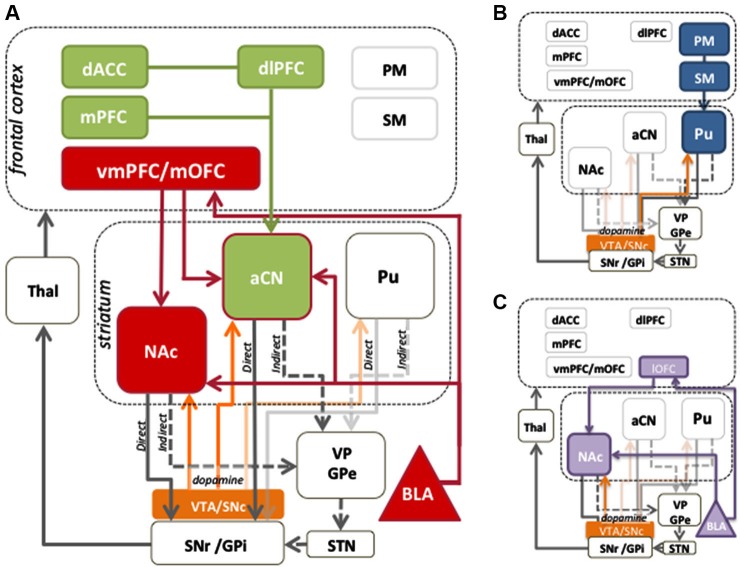
The ability to learn contingencies between actions and outcomes in a dynamic environment is critical for flexible, adaptive behavior. Goal-directed actions adapt to changes in action-outcome contingencies as well as to changes in the reward-value of the outcome. When networks involved in reward processing and contingency learning are maladaptive, this fundamental ability can be lost, with detrimental consequences for decision-making. Impaired decision-making is a core feature in a number of psychiatric disorders, ranging from depression to schizophrenia. The argument can be developed, therefore, that seemingly disparate symptoms across psychiatric disorders can be explained by dysfunction within common decision-making circuitry. From this perspective, gaining a better understanding of the neural processes involved in goal-directed action, will allow a comparison of deficits observed across traditional diagnostic boundaries within a unified theoretical framework. This review describes the key processes and neural circuits involved in goal-directed decision-making using evidence from animal studies and human neuroimaging. Select studies are discussed to outline what we currently know about causal judgments regarding actions and their consequences, action-related reward evaluation, and, most importantly, how these processes are integrated in goal-directed learning and performance. Finally, we look at how adaptive decision-making is impaired across a range of psychiatric disorders and how deepening our understanding of this circuitry may offer insights into phenotypes and more targeted interventions.
在动态环境中学习行动与结果之间的偶发关系的能力,对于灵活、适应性行为至关重要。目标导向行为会适应行动-结果偶发关系的变化以及结果奖励价值的变化。当参与奖励处理和偶发学习的神经网络出现适应不良时,这种基本能力可能会丧失,从而对决策产生不利影响。决策受损是从抑郁症到精神分裂症等多种精神疾病的核心特征。因此,可以提出这样的观点,即精神疾病中看似不同的症状可以用共同决策回路的功能障碍来解释。从这个角度来看,更好地理解目标导向行为所涉及的神经过程,将有助于在统一的理论框架内比较跨越传统诊断界限所观察到的缺陷。本综述利用动物研究和人类神经成像的证据,描述了目标导向决策中涉及的关键过程和神经回路。讨论了一些精选研究,以概述我们目前对行动及其后果的因果判断、与行动相关的奖励评估,以及最重要的是,这些过程如何在目标导向学习和表现中整合的了解。最后,我们探讨了在一系列精神疾病中适应性决策是如何受损的,以及加深我们对这一回路的理解如何可能为表型和更有针对性的干预提供见解。