• 文献检索
  • 文档翻译
  • 深度研究
  • 学术资讯
  • Suppr Zotero 插件Zotero 插件
  • 邀请有礼
  • 套餐&价格
  • 历史记录
应用&插件
Suppr Zotero 插件Zotero 插件浏览器插件Mac 客户端Windows 客户端微信小程序
定价
高级版会员购买积分包购买API积分包
服务
文献检索文档翻译深度研究API 文档MCP 服务
关于我们
关于 Suppr公司介绍联系我们用户协议隐私条款
关注我们

Suppr 超能文献

核心技术专利:CN118964589B侵权必究
粤ICP备2023148730 号-1Suppr @ 2026

文献检索

告别复杂PubMed语法,用中文像聊天一样搜索,搜遍4000万医学文献。AI智能推荐,让科研检索更轻松。

立即免费搜索

文件翻译

保留排版,准确专业,支持PDF/Word/PPT等文件格式,支持 12+语言互译。

免费翻译文档

深度研究

AI帮你快速写综述,25分钟生成高质量综述,智能提取关键信息,辅助科研写作。

立即免费体验

在回合结束预期中,语义和句法不和谐对预备电位的影响。

Influences of semantic and syntactic incongruence on readiness potential in turn-end anticipation.

机构信息

Experimental Neurolinguistics Group, Collaborative Research Center "Alignment in Communication" (SFB 673), Bielefeld University Bielefeld, Germany.

出版信息

Front Hum Neurosci. 2014 May 27;8:296. doi: 10.3389/fnhum.2014.00296. eCollection 2014.

DOI:10.3389/fnhum.2014.00296
PMID:24904349
原文链接:https://pmc.ncbi.nlm.nih.gov/articles/PMC4034500/
Abstract

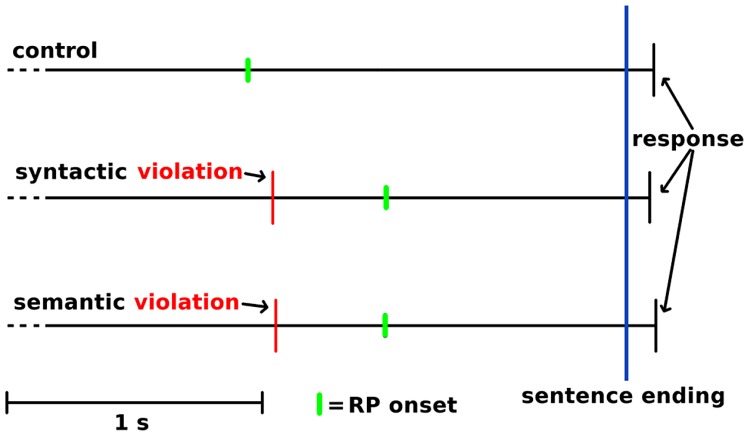
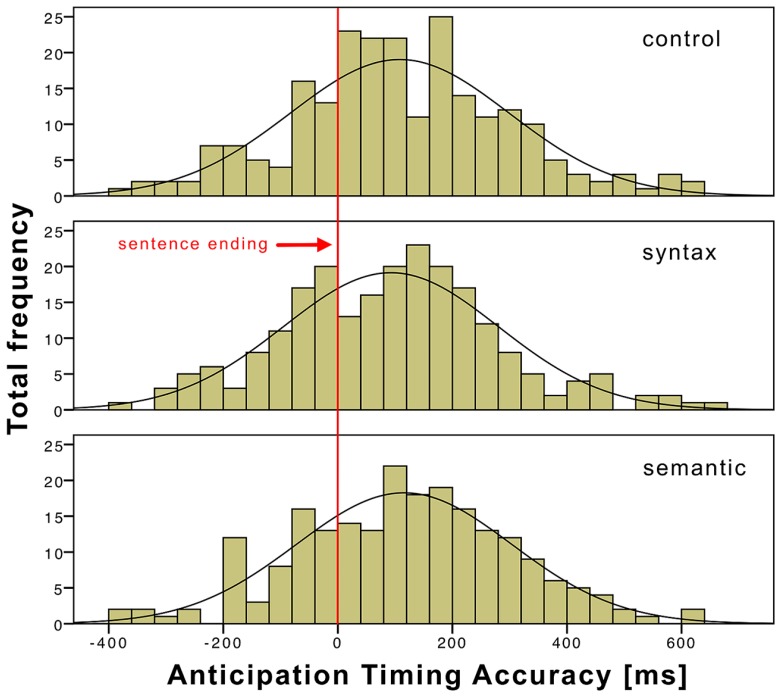
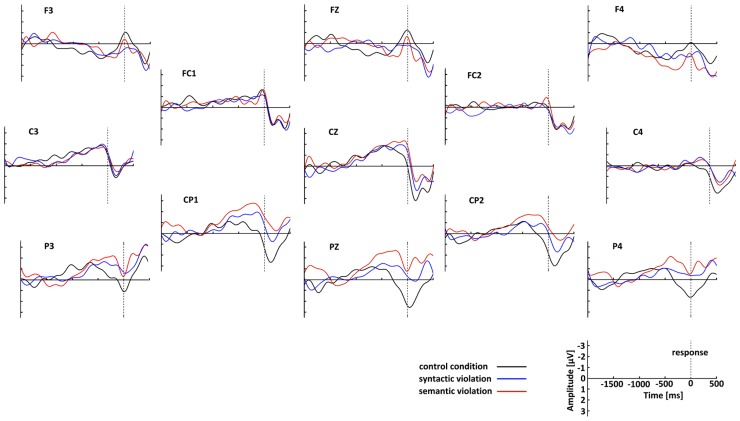
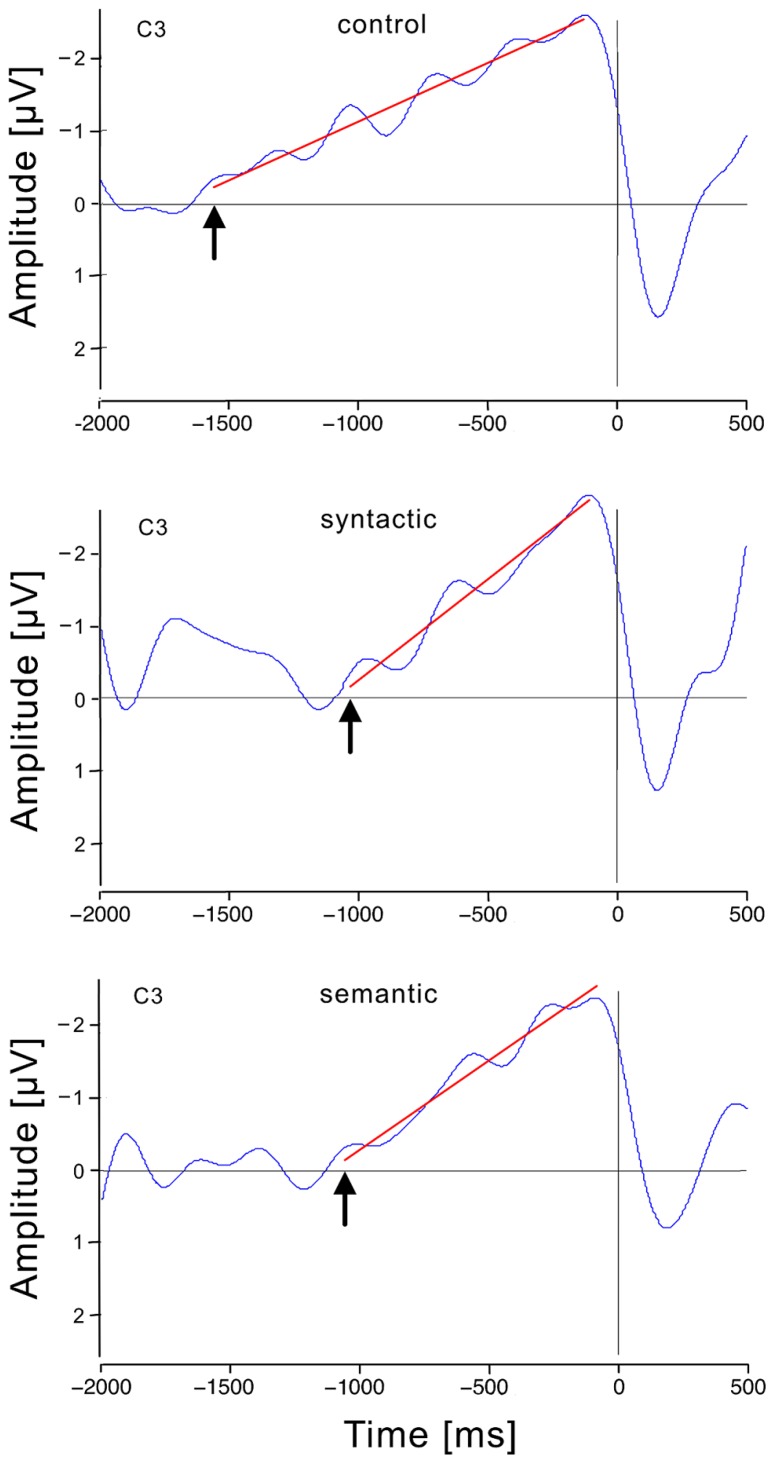
Knowing when it is convenient to take a turn in a conversation is an important task for dialog partners. As it appears that this decision is made before the transition point has been reached, it seems to involve anticipation. There are a variety of studies in the literature that provide possible explanations for turn-end anticipation. This study particularly focuses on how turn-end anticipation relies on syntactic and/or semantic information during utterance processing, as tested with syntactically and semantically violated sentences. With a combination reaction time and EEG experiment, we used the onset latencies of the readiness potential (RP) to uncover possible differences in response preparation. Although the mean anticipation timing accuracy (ATA) values of the behavioral test were all within a similar time range (control sentences: 108 ms, syntactically violated sentences: 93 ms and semantically violated sentences: 116 ms), we found evidence that response preparation is indeed different for syntactically and semantically violated sentences in comparison with control sentences. Our preconscious EEG data, in the form of RP results, indicated a response preparation onset to sentence end interval of 1452 ms in normal sentences, 937 ms in sentences with syntactic violations and 944 ms in sentences with semantic violations. Compared with control sentences, these intervals resulted in a significant RP interruption for both sentence types and indicate an interruption of preconscious response preparation. However, the behavioral response to sentence types occurred at comparable time points.

摘要

知道何时方便在对话中转换角色是对话伙伴的一项重要任务。由于似乎在到达转换点之前就做出了这个决定,因此这似乎涉及到预期。文献中有许多研究为角色转换的预期提供了可能的解释。本研究特别关注在话语处理过程中,角色转换的预期如何依赖于句法和/或语义信息,方法是使用句法和语义违反的句子进行测试。通过组合反应时和 EEG 实验,我们利用准备电位(RP)的起始潜伏期来揭示可能在反应准备方面的差异。尽管行为测试的平均预期时间准确性(ATA)值都在相似的时间范围内(控制句子:108ms,句法违反句子:93ms,语义违反句子:116ms),但我们发现证据表明,与控制句子相比,句法和语义违反句子的反应准备确实不同。我们的无意识 EEG 数据(以 RP 结果的形式)表明,正常句子的句子结尾间隔的反应准备起始时间为 1452ms,句法违反句子为 937ms,语义违反句子为 944ms。与控制句子相比,这两种句子类型的 RP 中断都导致了显著的反应准备中断,并表明无意识反应准备的中断。然而,对句子类型的行为反应发生在可比的时间点。
https://cdn.ncbi.nlm.nih.gov/pmc/blobs/92dc/4034500/0f51ecf71f02/fnhum-08-00296-g005.jpg
https://cdn.ncbi.nlm.nih.gov/pmc/blobs/92dc/4034500/afb600f86d67/fnhum-08-00296-g001.jpg
https://cdn.ncbi.nlm.nih.gov/pmc/blobs/92dc/4034500/258e7ff399a4/fnhum-08-00296-g002.jpg
https://cdn.ncbi.nlm.nih.gov/pmc/blobs/92dc/4034500/6b848929ba78/fnhum-08-00296-g003.jpg
https://cdn.ncbi.nlm.nih.gov/pmc/blobs/92dc/4034500/67870c3a0890/fnhum-08-00296-g004.jpg
https://cdn.ncbi.nlm.nih.gov/pmc/blobs/92dc/4034500/0f51ecf71f02/fnhum-08-00296-g005.jpg
https://cdn.ncbi.nlm.nih.gov/pmc/blobs/92dc/4034500/afb600f86d67/fnhum-08-00296-g001.jpg
https://cdn.ncbi.nlm.nih.gov/pmc/blobs/92dc/4034500/258e7ff399a4/fnhum-08-00296-g002.jpg
https://cdn.ncbi.nlm.nih.gov/pmc/blobs/92dc/4034500/6b848929ba78/fnhum-08-00296-g003.jpg
https://cdn.ncbi.nlm.nih.gov/pmc/blobs/92dc/4034500/67870c3a0890/fnhum-08-00296-g004.jpg
https://cdn.ncbi.nlm.nih.gov/pmc/blobs/92dc/4034500/0f51ecf71f02/fnhum-08-00296-g005.jpg

相似文献

1
Influences of semantic and syntactic incongruence on readiness potential in turn-end anticipation.在回合结束预期中,语义和句法不和谐对预备电位的影响。
Front Hum Neurosci. 2014 May 27;8:296. doi: 10.3389/fnhum.2014.00296. eCollection 2014.
2
Using the readiness potential of button-press and verbal response within spoken language processing.在口语处理过程中利用按键准备电位和言语反应。
J Neurosci Methods. 2014 Jul 30;232:24-9. doi: 10.1016/j.jneumeth.2014.04.030. Epub 2014 May 6.
3
Differential task effects on semantic and syntactic processes as revealed by ERPs.事件相关电位揭示的任务对语义和句法加工的差异效应。
Brain Res Cogn Brain Res. 2002 May;13(3):339-56. doi: 10.1016/s0926-6410(01)00127-6.
4
Distinct Neural Processes for Memorizing Form and Meaning Within Sentences.句子中记忆形式和意义的不同神经过程。
Front Hum Neurosci. 2019 Dec 5;13:412. doi: 10.3389/fnhum.2019.00412. eCollection 2019.
5
Mandarin Chinese L1 and L2 complex sentence reading reveals a consistent electrophysiological pattern of highly interactive syntactic and semantic processing: An ERP study.普通话第一语言和第二语言复杂句子阅读揭示了句法和语义高度交互处理的一致电生理模式:一项ERP研究。
Front Psychol. 2023 Apr 19;14:1143062. doi: 10.3389/fpsyg.2023.1143062. eCollection 2023.
6
Building up linguistic context in schizophrenia: evidence from self-paced reading.精神分裂症中语言语境构建:来自自定步速阅读的证据
Neuropsychology. 2006 Jul;20(4):442-52. doi: 10.1037/0894-4105.20.4.442.
7
Frequency-based Segregation of Syntactic and Semantic Unification during Online Sentence Level Language Comprehension.在线句子层面语言理解过程中句法和语义统一基于频率的分离
J Cogn Neurosci. 2015 Nov;27(11):2095-107. doi: 10.1162/jocn_a_00829. Epub 2015 Jun 4.
8
What's left if the Jabberwock gets the semantics? An ERP investigation into semantic and syntactic processes during auditory sentence comprehension.如果炸脖龙掌握了语义会怎样?一项关于听觉句子理解过程中语义和句法过程的事件相关电位研究。
Brain Res Cogn Brain Res. 2001 Apr;11(2):199-212. doi: 10.1016/s0926-6410(00)00071-9.
9
Turn-taking: From perception to speech preparation.
Neurosci Lett. 2015 Nov 16;609:147-51. doi: 10.1016/j.neulet.2015.10.033. Epub 2015 Oct 23.
10
Interplay between syntax and semantics during sentence comprehension: ERP effects of combining syntactic and semantic violations.句子理解过程中句法与语义的相互作用:句法和语义违反相结合的事件相关电位效应
J Cogn Neurosci. 2003 Aug 15;15(6):883-99. doi: 10.1162/089892903322370807.

本文引用的文献

1
Prediction of turn-ends based on anticipation of upcoming words.基于对即将到来的单词的预测来预测转折词。
Front Psychol. 2012 Oct 1;3:376. doi: 10.3389/fpsyg.2012.00376. eCollection 2012.
2
The real-time link between person perception and action: brain potential evidence for dynamic continuity.人与知觉和行为之间的实时联系:大脑电位证据表明动态连续性。
Soc Neurosci. 2011;6(2):139-55. doi: 10.1080/17470919.2010.490674. Epub 2010 Jul 2.
3
Universals and cultural variation in turn-taking in conversation.对话中轮流发言的普遍性与文化差异。
Proc Natl Acad Sci U S A. 2009 Jun 30;106(26):10587-92. doi: 10.1073/pnas.0903616106. Epub 2009 Jun 24.
4
Electrophysiological evidence of functional integration between the language and motor systems in the brain: a study of the speech Bereitschaftspotential.大脑中语言与运动系统功能整合的电生理证据:一项关于言语准备电位的研究。
Clin Neurophysiol. 2009 Feb;120(2):275-84. doi: 10.1016/j.clinph.2008.10.159. Epub 2008 Dec 23.
5
Do people use language production to make predictions during comprehension?人们在理解过程中会运用语言生成来进行预测吗?
Trends Cogn Sci. 2007 Mar;11(3):105-10. doi: 10.1016/j.tics.2006.12.002. Epub 2007 Jan 24.
6
An oscillator model of the timing of turn-taking.轮流发言时机的振荡器模型。
Psychon Bull Rev. 2005 Dec;12(6):957-68. doi: 10.3758/bf03206432.
7
Anticipating upcoming words in discourse: evidence from ERPs and reading times.预测语篇中即将出现的单词:来自事件相关电位和阅读时间的证据。
J Exp Psychol Learn Mem Cogn. 2005 May;31(3):443-67. doi: 10.1037/0278-7393.31.3.443.
8
Event-related potentials suggest early interaction between syntax and semantics during on-line sentence comprehension.事件相关电位表明,在句子在线理解过程中,句法和语义之间存在早期交互作用。
Neurosci Lett. 2005 Aug 26;384(3):222-7. doi: 10.1016/j.neulet.2005.04.076.
9
Toward a mechanistic psychology of dialogue.迈向对话的机械心理学。
Behav Brain Sci. 2004 Apr;27(2):169-90; discussion 190-226. doi: 10.1017/s0140525x04000056.
10
EEGLAB: an open source toolbox for analysis of single-trial EEG dynamics including independent component analysis.EEGLAB:一个用于分析单次试验脑电图动态(包括独立成分分析)的开源工具箱。
J Neurosci Methods. 2004 Mar 15;134(1):9-21. doi: 10.1016/j.jneumeth.2003.10.009.