Royal Ottawa Health Care Group, Mind, Brain Imaging and Neuroethics, Institute of Mental Health Research, University of Ottawa Ottawa, ON, Canada ; Taipei Medical University-Shuang Ho Hospital, Brain and Consciousness Research Center New Taipei City, Taiwan.
Royal Ottawa Health Care Group, Mind, Brain Imaging and Neuroethics, Institute of Mental Health Research, University of Ottawa Ottawa, ON, Canada.
Front Hum Neurosci. 2014 May 21;8:330. doi: 10.3389/fnhum.2014.00330. eCollection 2014.
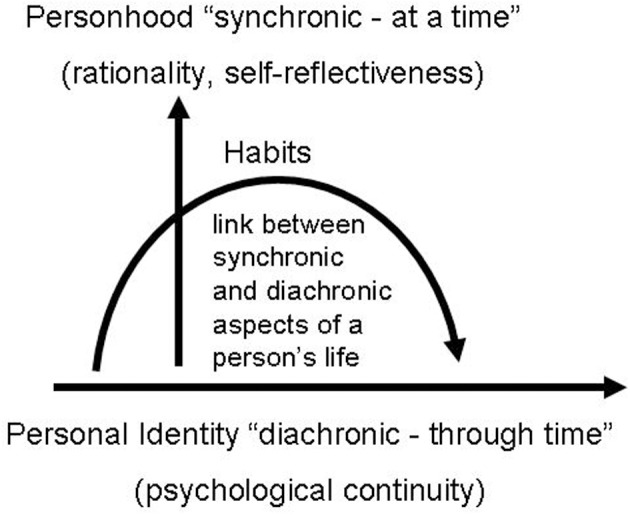
In philosophy, the criteria for personhood (PH) at a specific point in time (synchronic), and the necessary and sufficient conditions of personal identity (PI) over time (diachronic) are traditionally separated. Hence, the transition between both timescales of a person's life remains largely unclear. Personal habits reflect a decision-making (DM) process that binds together synchronic and diachronic timescales. Despite the fact that the actualization of habits takes place synchronically, they presuppose, for the possibility of their generation, time in a diachronic sense. The acquisition of habits therefore rests upon PI over time; that is, the temporal extension of personal decisions is the necessary condition for the possible development of habits. Conceptually, habits can thus be seen as a bridge between synchronic and diachronic timescales of a person's life. In order to investigate the empirical mediation of this temporal linkage, we draw upon the neuronal mechanisms underlying DM; in particular on the distinction between internally and externally guided DM. Externally guided DM relies on external criteria at a specific point in time (synchronic); on a neural level, this has been associated with lateral frontal and parietal brain regions. In contrast, internally guided DM is based on the person's own preferences that involve a more longitudinal and thus diachronic timescale, which has been associated with the brain's intrinsic activity. Habits can be considered to reflect a balance between internally and externally guided DM, which implicates a particular temporal balance between diachronic and synchronic elements, thus linking two different timescales. Based on such evidence, we suggest a habit-based neurophilosophical approach of PH and PI by focusing on the empirically-based linkage between the synchronic and diachronic elements of habits. By doing so, we propose to link together what philosophically has been described and analyzed separately as PH and PI.
在哲学中,特定时间点的人格标准(PH)和随时间推移的个人身份认同的必要和充分条件(PI)传统上是分开的。因此,一个人生命的这两个时间尺度之间的过渡在很大程度上仍然不清楚。个人习惯反映了一种决策(DM)过程,它将同步和历时时间尺度联系在一起。尽管习惯的实现是同步发生的,但它们为其产生的可能性预设了历时意义上的时间。因此,习惯的获得依赖于随时间推移的 PI;也就是说,个人决策的时间延伸是习惯发展的必要条件。从概念上讲,习惯可以被视为一个人生命的同步和历时时间尺度之间的桥梁。为了研究这种时间联系的经验中介,我们借鉴了 DM 的神经机制;特别是内部和外部引导的 DM 之间的区别。外部引导的 DM 依赖于特定时间点的外部标准(同步);在神经水平上,这与额侧和顶侧大脑区域有关。相比之下,内部引导的 DM 基于个人自己的偏好,涉及更纵向的,因此是历时的时间尺度,这与大脑的内在活动有关。习惯可以被认为反映了内部和外部引导的 DM 之间的平衡,这意味着历时和同步元素之间存在特定的时间平衡,从而将两个不同的时间尺度联系起来。基于这样的证据,我们建议通过关注习惯的同步和历时元素之间基于经验的联系,采用基于习惯的神经哲学方法来研究 PH 和 PI。通过这样做,我们提出将哲学上分别描述和分析的 PH 和 PI 联系起来。