Nakao Takashi, Ohira Hideki, Northoff Georg
Mind, Brain Imaging and Neuroethics, Institute of Mental Health Research, Royal Ottawa Health Care Group, University of Ottawa Ottawa, ON, Canada.
Front Neurosci. 2012 Mar 5;6:31. doi: 10.3389/fnins.2012.00031. eCollection 2012.
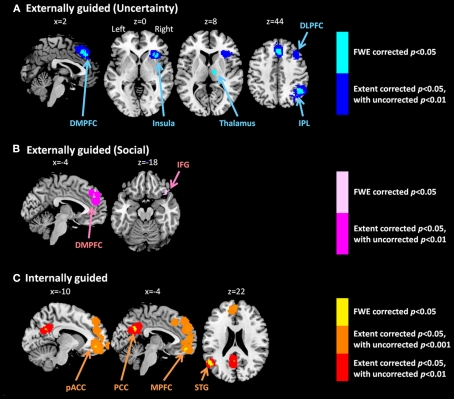
Most experimental studies of decision-making have specifically examined situations in which a single less-predictable correct answer exists (externally guided decision-making under uncertainty). Along with such externally guided decision-making, there are instances of decision-making in which no correct answer based on external circumstances is available for the subject (internally guided decision-making). Such decisions are usually made in the context of moral decision-making as well as in preference judgment, where the answer depends on the subject's own, i.e., internal, preferences rather than on external, i.e., circumstantial, criteria. The neuronal and psychological mechanisms that allow guidance of decisions based on more internally oriented criteria in the absence of external ones remain unclear. This study was undertaken to compare decision-making of these two kinds empirically and theoretically. First, we reviewed studies of decision-making to clarify experimental-operational differences between externally guided and internally guided decision-making. Second, using multi-level kernel density analysis, a whole-brain-based quantitative meta-analysis of neuroimaging studies was performed. Our meta-analysis revealed that the neural network used predominantly for internally guided decision-making differs from that for externally guided decision-making under uncertainty. This result suggests that studying only externally guided decision-making under uncertainty is insufficient to account for decision-making processes in the brain. Finally, based on the review and results of the meta-analysis, we discuss the differences and relations between decision-making of these two types in terms of their operational, neuronal, and theoretical characteristics.
大多数决策的实验研究都特别考察了存在单一难以预测的正确答案的情况(不确定性下的外部引导决策)。除了这种外部引导决策外,还存在一些决策情况,即对于主体而言,不存在基于外部环境的正确答案(内部引导决策)。这类决策通常在道德决策以及偏好判断的背景下做出,其答案取决于主体自身的,即内部的偏好,而非外部的,即环境的标准。在没有外部标准的情况下,允许基于更多内部导向标准来引导决策的神经和心理机制仍不清楚。本研究旨在从实证和理论两方面比较这两种决策。首先,我们回顾了决策研究,以阐明外部引导决策和内部引导决策在实验操作上的差异。其次,使用多层次核密度分析,对神经影像学研究进行了基于全脑的定量荟萃分析。我们的荟萃分析表明,主要用于内部引导决策的神经网络与不确定性下的外部引导决策所使用的神经网络不同。这一结果表明,仅研究不确定性下的外部引导决策不足以解释大脑中的决策过程。最后,基于综述和荟萃分析的结果,我们从操作、神经和理论特征方面讨论了这两种决策类型之间的差异和关系。