Department of Public Health, Central Institute of Science and Technology, Pokhara University, Kathmandu, Nepal.
James P. Grant School of Public Health, BRAC University, Dhaka, Bangladesh.
Int Breastfeed J. 2014 May 29;9:7. doi: 10.1186/1746-4358-9-7. eCollection 2014.
Exclusive breastfeeding (EBF) means that the infant receives only breast milk for the first six months of life after birth. In Bangladesh, the prevalence of EBF remained largely unchanged for nearly two decades and was 43% in 2007. However, in 2011, a prevalence of 64% was reported, an increase by 21 percentage points. The reasons for this large change remain speculative at this point. Thus to investigate the issue further, this study was conducted. The objective was to assess the prevalence of EBF and associated factors among mothers having children aged 0-6 months in rural Bangladesh.
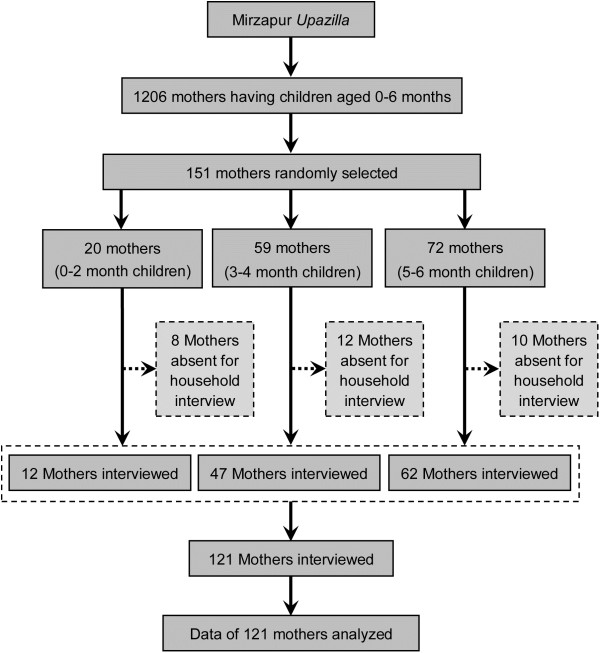
A cross-sectional study was conducted in Mirzapur Upazilla (sub district) among 121 mothers of infants aged 0-6 months. Eligible mothers were identified and randomly selected using the demographic surveillance system's computerized database that is updated weekly. A semi-structured questionnaire was used for interviews that inquired information on socio-demographic characteristics, obstetric, health service, breastfeeding related factors (initiation of breastfeeding, prelacteal feeding and colostrum feeding) and economic factors. EBF prevalence was calculated using 24 hour recall method. In multivariate analysis, a logistic regression model was developed using stepwise modeling to analyze the factors associated with EBF.
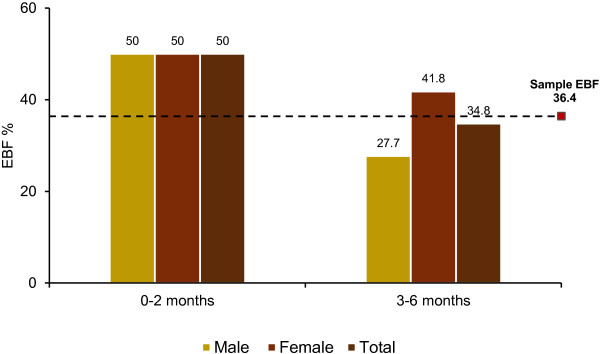
The prevalence of EBF in the last 24 hours preceding the survey was 36%. Bivariate and multivariate analysis revealed no significant association between EBF and its possible predictors at 0.05 level of alpha. However, there was some evidence of an association between EBF and having a caesarean delivery (OR = 0.47, 95% CI: 0.21, 1.06). In multivariate analysis, type of delivery: caesarean (AOR = 0.45, 95% CI: 0.19, 1.03) and wealth quintile: richer (AOR = 2.40, 95% CI: 0.94, 6.16) also showed some evidence of an association with EBF.
The prevalence of EBF in Mirzapur (36%) is lower than the national figure (64%). Prelacteal feeding was not uncommon. These findings suggest that there is a need for breastfeeding support provided by health services. Hence, promotion of EBF during the first six months of life needs to be addressed and future breastfeeding promotion programmes should give special attention to those women who are not practicing EBF.
纯母乳喂养(EBF)是指婴儿在出生后头 6 个月仅接受母乳。在孟加拉国,近二十年来,EBF 的流行率基本保持不变,2007 年为 43%。然而,2011 年的报告显示,这一比例上升了 21 个百分点,达到 64%。造成这一巨大变化的原因目前仍在推测之中。因此,为了进一步调查这一问题,进行了这项研究。本研究的目的是评估孟加拉国农村地区 0-6 个月龄儿童母亲中纯母乳喂养的流行率及其相关因素。
在米尔扎布尔分区(次区)进行了一项横断面研究,共纳入 121 名 0-6 个月龄婴儿的母亲。使用人口监测系统的计算机数据库,每周更新一次,识别并随机选择符合条件的母亲。使用半结构式问卷进行访谈,询问社会人口统计学特征、产科、卫生服务、母乳喂养相关因素(开始母乳喂养、开奶前喂养和初乳喂养)和经济因素。使用 24 小时回忆法计算 EBF 流行率。在多变量分析中,采用逐步建模的逻辑回归模型分析与 EBF 相关的因素。
调查前 24 小时 EBF 的流行率为 36%。单变量和多变量分析显示,在 0.05 水平的 α 值下,EBF 与其可能的预测因子之间无显著关联。然而,EBF 与剖宫产分娩之间存在一定的关联(OR=0.47,95%CI:0.21,1.06)。多变量分析显示,分娩方式:剖宫产(AOR=0.45,95%CI:0.19,1.03)和财富五分位数:更富裕(AOR=2.40,95%CI:0.94,6.16)也与 EBF 存在一定关联。
米尔扎布尔(36%)的 EBF 流行率低于全国水平(64%)。开奶前喂养并不罕见。这些发现表明,需要提供卫生服务来支持母乳喂养。因此,需要解决生命最初 6 个月内的 EBF 推广问题,未来的母乳喂养推广计划应特别关注那些未进行 EBF 的妇女。