Hosseini Jahromi Seyed Abbas, Sadeghi Poor Sadegh, Hosseini Valami Seyedeh Masoumeh, Javadi Amir
Department of Anesthesiology, Qazvin University of Medical Sciences, Shahid Rajaee Hospital, Qazvin, Iran.
Department of Surgery, Qazvin University of Medical Sciences, Qazvin, Iran.
Anesth Pain Med. 2012 Spring;1(4):243-7. doi: 10.5812/aapm.3551. Epub 2012 Apr 1.
The control of postoperative pain is important in children, and poor pain control leads to organ dysfunction and behavioral problems.
We compared the analgesic effects of suppository acetaminophen, bupivacaine wound infiltration, and caudal block with bupivacaine on postoperative pain in pediatric inguinal herniorrhaphy.
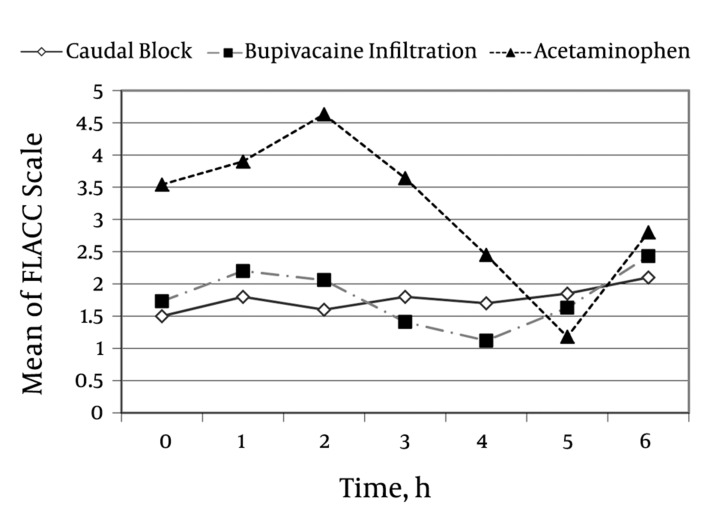
In this double-blinded, randomized controlled clinical trial, 90 children of American Society of Anesthesiologists (ASA) grade I-II, aged between 3 months and 7 years, and scheduled for elective unilateral inguinal herniorrhaphy under general anesthesia were assigned to three equal groups. Patients in the first group received 20 mg/kg of suppository acetaminophen. In the second group, 2 mg/kg of 0.5% bupivacaine was infiltrated in the incisional site, and in the third group, a caudal block was performed with 0.75 mL/kg of 0.25% bupivacaine. The Face, Legs, Activity, Cry, Consolability (FLACC) pain scale was applied 30 minutes after operation. Thereafter, the FLACC score was obtained every hour during the next 6 hours. If the FLACC score was 4 or over, we administered 0.5 mg/kg of intravenous meperidine. The data was transferred to SPSS-10 software and analyzed statistically with chi-square and analysis of variance tests. P < 0.05 was considered significant.
The mean analgesic duration in the acetaminophen, bupivacaine infiltration, and caudal block groups was 4.07, 5.40, and 5.37 hours, respectively. Significant differences were not observed between the bupivacaine infiltration and caudal block groups (P = 0.9), but the differences between the bupivacaine infiltration and acetaminophen groups (P = 0.034) and the caudal block and acetaminophen groups (P = 0.039) were significant. With regard to meperidine administration, significant differences were not observed between the bupivacaine infiltration and caudal block groups (P = 0.848), but significant differences were observed between these two groups and the acetaminophen group (P < 0.05).
Patients in the bupivacaine infiltration and caudal block groups had less postoperative pain than those in the acetaminophen group and received lower amount of meperidine. We concluded that in children, bupivacaine infiltration and caudal block with bupivacaine produce better analgesia than suppository acetaminophen. It seems that bupivacaine infiltration is better than caudal block because of its simplicity, lower incidence of complications, and failure rate.
术后疼痛控制在儿童中很重要,疼痛控制不佳会导致器官功能障碍和行为问题。
我们比较了对乙酰氨基酚栓剂、布比卡因伤口浸润和布比卡因骶管阻滞对小儿腹股沟疝修补术后疼痛的镇痛效果。
在这项双盲、随机对照临床试验中,90例美国麻醉医师协会(ASA)I-II级、年龄在3个月至7岁之间、计划在全身麻醉下进行择期单侧腹股沟疝修补术的儿童被分为三组,每组人数相等。第一组患者接受20mg/kg的对乙酰氨基酚栓剂。第二组,在切口部位浸润2mg/kg的0.5%布比卡因,第三组,用0.75mL/kg的0.25%布比卡因进行骶管阻滞。术后30分钟应用面部、腿部、活动、哭闹、安慰(FLACC)疼痛量表。此后,在接下来的6小时内每小时获取一次FLACC评分。如果FLACC评分达到4分或更高,我们给予0.5mg/kg的静脉注射哌替啶。数据被录入SPSS-10软件,并采用卡方检验和方差分析进行统计学分析。P<0.05被认为具有统计学意义。
对乙酰氨基酚组、布比卡因浸润组和骶管阻滞组的平均镇痛持续时间分别为4.07小时、5.40小时和5.37小时。布比卡因浸润组和骶管阻滞组之间未观察到显著差异(P = 0.9),但布比卡因浸润组与对乙酰氨基酚组之间的差异(P = 0.034)以及骶管阻滞组与对乙酰氨基酚组之间的差异(P = 0.