Goyal Vigya, Kubre Jyotsna, Radhakrishnan Krishnaprabha
Department of Anaesthesiology and Critical Care, AIIMS, Bhopal, Madhya Pradesh, India.
Department of Anaesthesiology, GMERS Medical College, Sola Civil Hospital, Ahmedabad, India.
Anesth Essays Res. 2016 May-Aug;10(2):227-32. doi: 10.4103/0259-1162.174468.
Postoperative pain management is becoming an integral part of anesthesia care. Various techniques of pediatric pain relief have been designed among which the most commonly practiced is caudal epidural block. Several adjuvants have been used to prolong the duration of caudal analgesia such as clonidine, neostigmine, ketamine, opioids, and ephedrine. We have designed the study using dexmedetomidine as an adjuvant to assess analgesic efficacy, duration of postoperative analgesia, hemodynamic stability, postoperative sedation, and any adverse effects in children.
The aim is to study the effects of dexmedetomidine as an adjuvant to bupivacaine in caudal analgesia in pediatric patients posted for infraumbilical surgeries.
This is a randomized, double-blind study in which effect of dexmedetomidine is studied when added to bupivacaine in the caudal epidural block. The observations are made intraoperatively for hemodynamic stability and postoperatively for the duration of analgesia.
This study was conducted in 100 children of American Society of Anesthesiologists physical status I and II, aged 2-10 years, undergoing elective infraumbilical surgeries. They were divided into two groups as follows: Group A: (0.25%) bupivacaine 1 ml/kg + normal saline (NS) 1 ml. Group B: (0.25%) bupivacaine 1 ml/kg + 1 μg/kg dexmedetomidine in 1 ml NS. As this study was double-blind, patients were randomly assigned to receive either (bupivacaine + saline) or (bupivacaine + dexmedetomidine) in each group. The patients were observed for hemodynamic stability, respiratory depression, and postoperative pain using face, legs, activity, cry, consolability (FLACC) pain scale for 24 h postoperatively.
Unpaired Student's t-test.
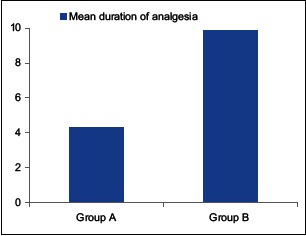
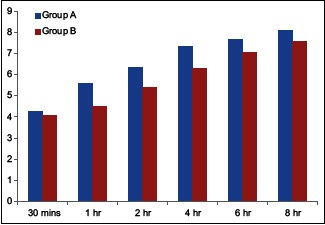
The mean duration of effective analgesia in Group A patients was 4.33 ± 0.98 h versus 9.88 ± 0.90 h in Group B patients. Likewise, the difference in mean FLACC score of both the groups was also statistically significant, 7.21 ± 0.76 and 6.49 ± 1.72 in Group A and Group B, respectively.
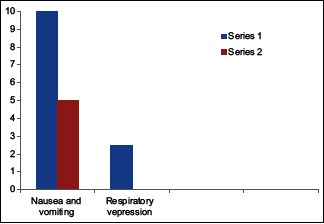
Dexmedetomidine as adjuvant to Bupivacaine increases duration of caudal analgesia and improves hemodynamic stability without an increase in adverse effects in children undergoing infraumbilical surgeries.
术后疼痛管理正成为麻醉护理的一个重要组成部分。已经设计了多种小儿疼痛缓解技术,其中最常用的是骶管硬膜外阻滞。已经使用了几种佐剂来延长骶管镇痛的持续时间,如可乐定、新斯的明、氯胺酮、阿片类药物和麻黄碱。我们设计了这项研究,使用右美托咪定作为佐剂,以评估其在儿童中的镇痛效果、术后镇痛持续时间、血流动力学稳定性、术后镇静及任何不良反应。
本研究旨在探讨右美托咪定作为布比卡因佐剂在接受脐下手术的小儿患者骶管镇痛中的作用。
这是一项随机、双盲研究,研究在骶管硬膜外阻滞中右美托咪定添加到布比卡因中的效果。术中观察血流动力学稳定性,术后观察镇痛持续时间。
本研究纳入100例美国麻醉医师协会身体状况I级和II级、年龄2至10岁、接受择期脐下手术的儿童。他们被分为两组:A组:(0.25%)布比卡因1 ml/kg + 生理盐水(NS)1 ml。B组:(0.25%)布比卡因1 ml/kg + 1 μg/kg右美托咪定溶于1 ml NS中。由于本研究为双盲研究,每组患者随机分配接受(布比卡因 + 生理盐水)或(布比卡因 + 右美托咪定)。术后24小时使用面部、腿部、活动、哭闹、安慰度(FLACC)疼痛量表观察患者的血流动力学稳定性、呼吸抑制和术后疼痛情况。
非配对学生t检验。
A组患者有效镇痛的平均持续时间为4.33 ± 0.98小时,而B组患者为9.88 ± 0.90小时。同样,两组的平均FLACC评分差异也具有统计学意义,A组和B组分别为7.21 ± 0.76和6.49 ± 1.72。
右美托咪定作为布比卡因的佐剂可延长骶管镇痛的持续时间,并改善血流动力学稳定性,且在接受脐下手术的儿童中不会增加不良反应。