Southern Cross Plant Science, Southern Cross University, Lismore, New South Wales, Australia; Division of Genetics, Indian Agricultural Research Institute, New Delhi, India.
Southern Cross Plant Science, Southern Cross University, Lismore, New South Wales, Australia.
PLoS One. 2014 Jun 6;9(6):e98843. doi: 10.1371/journal.pone.0098843. eCollection 2014.
Rice is a major source of human food with a predominantly Asian production base. Domestication involved selection of traits that are desirable for agriculture and to human consumers. Wild relatives of crop plants are a source of useful variation which is of immense value for crop improvement. Australian wild rices have been isolated from the impacts of domestication in Asia and represents a source of novel diversity for global rice improvement. Oryza rufipogon is a perennial wild progenitor of cultivated rice. Oryza meridionalis is a related annual species in Australia.
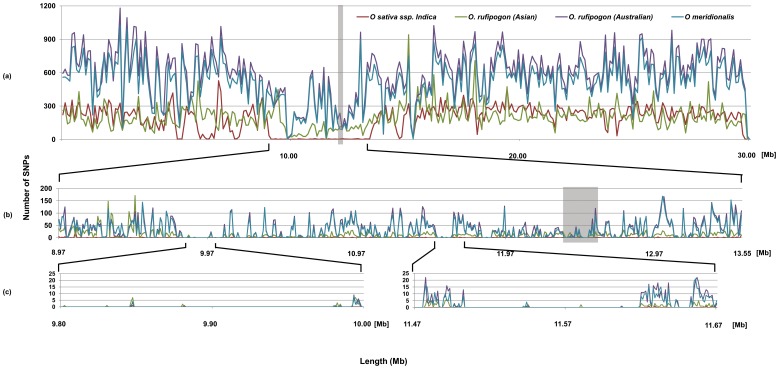
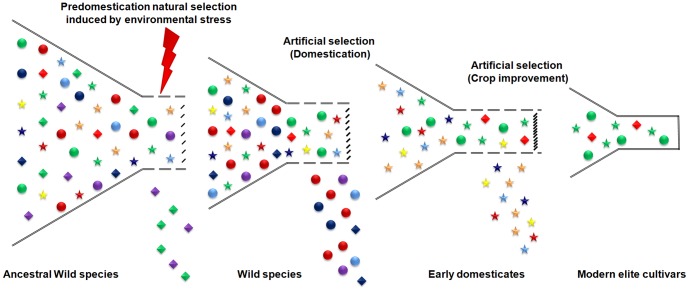
We have examined the sequence of the genomes of AA genome wild rices from Australia that are close relatives of cultivated rice through whole genome re-sequencing. Assembly of the resequencing data to the O. sativa ssp. japonica cv. Nipponbare shows that Australian wild rices possess 2.5 times more single nucleotide polymorphisms than in the Asian wild rice and cultivated O. sativa ssp. indica. Analysis of the genome of domesticated rice reveals regions of low diversity that show very little variation (polymorphism deserts). Both the perennial and annual wild rice from Australia show a high degree of conservation of sequence with that found in cultivated rice in the same 4.58 Mbp region on chromosome 5, which suggests that some of the 'polymorphism deserts' in this and other parts of the rice genome may have originated prior to domestication due to natural selection.
Analysis of genes in the 'polymorphism deserts' indicates that this selection may have been due to biotic or abiotic stress in the environment of early rice relatives. Despite having closely related sequences in these genome regions, the Australian wild populations represent an invaluable source of diversity supporting rice food security.
稻米是人类的主要食物来源,其主要产地在亚洲。驯化过程中选择了对农业和人类消费者有价值的特征。作物植物的野生近缘种是有用变异的来源,对作物改良具有巨大价值。澳大利亚野生稻种与亚洲驯化的影响相隔绝,代表了全球水稻改良的新颖多样性来源。长粒野生稻是栽培稻的多年生野生祖先,而短粒野生稻是澳大利亚的相关一年生种。
我们通过全基因组重测序,研究了与栽培稻密切相关的澳大利亚 AA 基因组野生稻的基因组序列。将重测序数据组装到粳稻 Nipponbare 上,结果表明,澳大利亚野生稻比亚洲野生稻和籼稻栽培品种具有多 2.5 倍的单核苷酸多态性。对驯化稻基因组的分析揭示了低多样性区域,这些区域的变异很小(多态性荒漠)。来自澳大利亚的长、短粒野生稻在 5 号染色体上的 4.58 Mbp 相同区域与栽培稻具有高度的序列保守性,这表明这些和其他水稻基因组区域的一些“多态性荒漠”可能是由于自然选择,在驯化之前就已经起源。
对“多态性荒漠”中的基因进行分析表明,这种选择可能是由于早期水稻亲缘环境中的生物或非生物胁迫所致。尽管这些基因组区域具有密切相关的序列,但澳大利亚野生种群是支持水稻粮食安全的宝贵多样性来源。