Yu Hang, Shahid Muhammad Qasim, Li Rongbai, Li Wei, Liu Wen, Ghouri Fozia, Liu Xiangdong
1State Key Laboratory for Conservation and Utilization of Subtropical Agro-Bioresources, South China Agricultural University, Guangzhou, 510642 China.
2State Key Laboratory for Conservation and Utilization of Subtropical Agro-Bioresources, Guangxi University, Nanning, 530004 China.
Plant Mol Biol Report. 2018;36(4):618-630. doi: 10.1007/s11105-018-1103-1. Epub 2018 Jul 22.
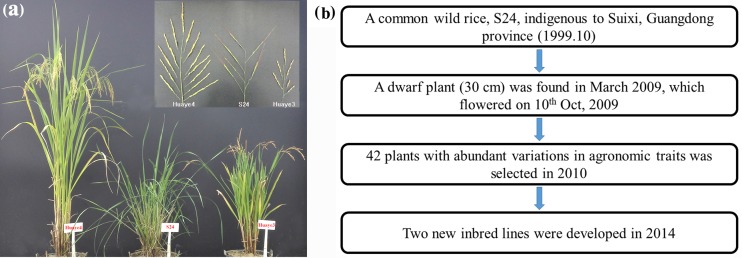
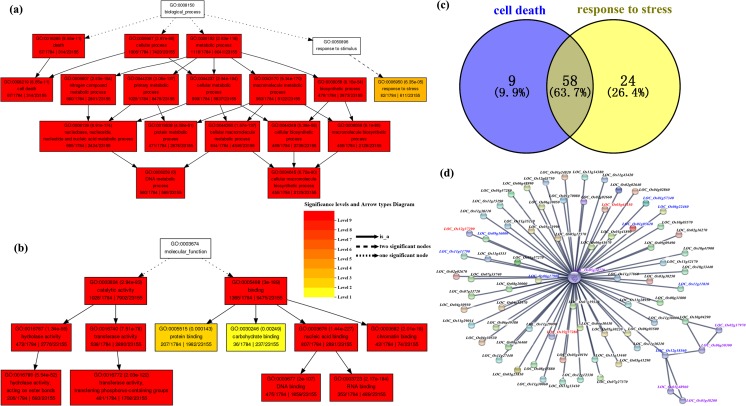
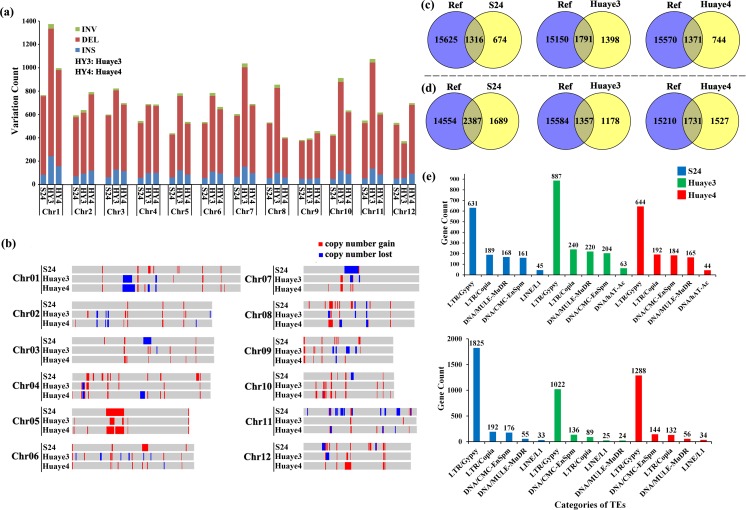
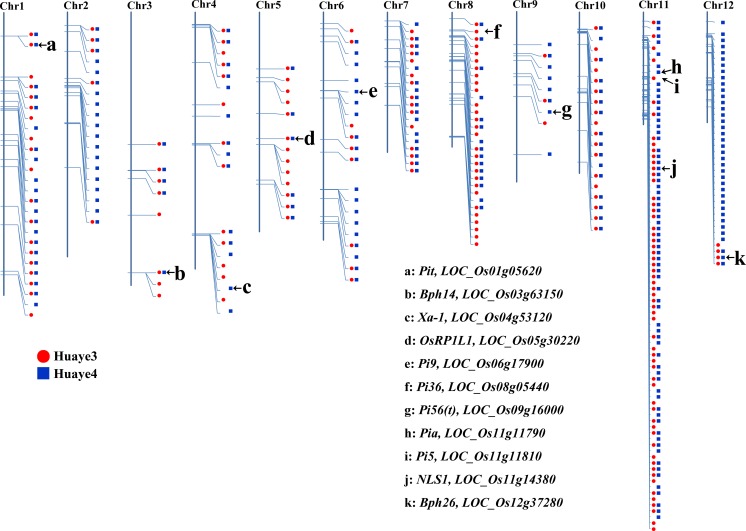
Common wild rice ( Griff.) is invaluable genetic resource for rice resistance breeding. Whole-genome re-sequencing was conducted to systematically analyze the variations in two new inbred lines (Huaye 3 and Huaye 4) developed from a common wild rice. A total of 4,841,127 SNPs, 1,170,479 InDels, 24,080 structural variations (SVs), and 298 copy number variations (CNVs) were identified in three materials. Approximately 16.24 and 5.64% of the total SNPs and InDels of Huaye 3 and Huaye 4 were located in genic regions, respectively. Together, 12,486 and 15,925 large-effect SNPs, and 12,417 and 14,513 large-effect InDels, which affect the integrity of the encoded protein, were identified in Huaye 3 and Huaye 4, respectively. The distribution map of 194 and 245 NBS-LRR encoding homologs was constructed across 12 rice chromosomes. Further, GO enrichment analysis of the homologs with identical genotype variations in Huaye 3 and Huaye 4 revealed 67, 82, and 58 homologs involved in cell death, response to stress, and both terms, respectively. Comparative analysis displayed that 550 out of 652 SNPs and 129 out of 147 InDels were present in a widely used blast-susceptible rice variety (LTH). Protein-protein interaction analysis revealed a strong interaction between NBS-LRR candidates and several known R genes. One homolog of disease resistance protein (RPM1) was involved in the plant-pathogen interaction pathway. Artificial inoculation of disease/insect displayed resistance phenotypes against rice blast and brown planthopper in two lines. The results will provide allele-specific markers for rice molecular breeding.
普通野生稻(Griff.)是水稻抗性育种中极其宝贵的遗传资源。对由普通野生稻培育出的两个新自交系(华野3号和华野4号)进行了全基因组重测序,以系统分析其变异情况。在三种材料中总共鉴定出4,841,127个单核苷酸多态性(SNP)、1,170,479个插入缺失(InDel)、24,080个结构变异(SV)和298个拷贝数变异(CNV)。华野3号和华野4号的SNP和InDel总数中分别约有16.24%和5.64%位于基因区域。华野3号和华野4号分别鉴定出12,486个和15,925个影响编码蛋白质完整性的大效应SNP,以及12,417个和14,513个大效应InDel。构建了194个和245个NBS-LRR编码同源物在12条水稻染色体上的分布图。此外,对华野3号和华野4号中具有相同基因型变异的同源物进行基因本体(GO)富集分析,分别发现67个、82个和58个同源物参与细胞死亡、应激反应以及这两个方面。比较分析表明,在一个广泛使用的感稻瘟病水稻品种(LTH)中存在652个SNP中的550个和147个InDel中的129个。蛋白质-蛋白质相互作用分析揭示了NBS-LRR候选物与几个已知R基因之间的强相互作用。一个抗病蛋白(RPM1)同源物参与了植物-病原体相互作用途径。对两个品系进行病害/虫害人工接种,它们对稻瘟病和褐飞虱表现出抗性表型。这些结果将为水稻分子育种提供等位基因特异性标记。