Mathew Sweety, Krug Susanne, Skurk Thomas, Halama Anna, Stank Antonia, Artati Anna, Prehn Cornelia, Malek Joel A, Kastenmüller Gabi, Römisch-Margl Werner, Adamski Jerzy, Hauner Hans, Suhre Karsten
Department of Physiology and Biophysics, Weill Cornell Medical College - Qatar, Doha, Qatar.
J Transl Med. 2014 Jun 6;12:161. doi: 10.1186/1479-5876-12-161.
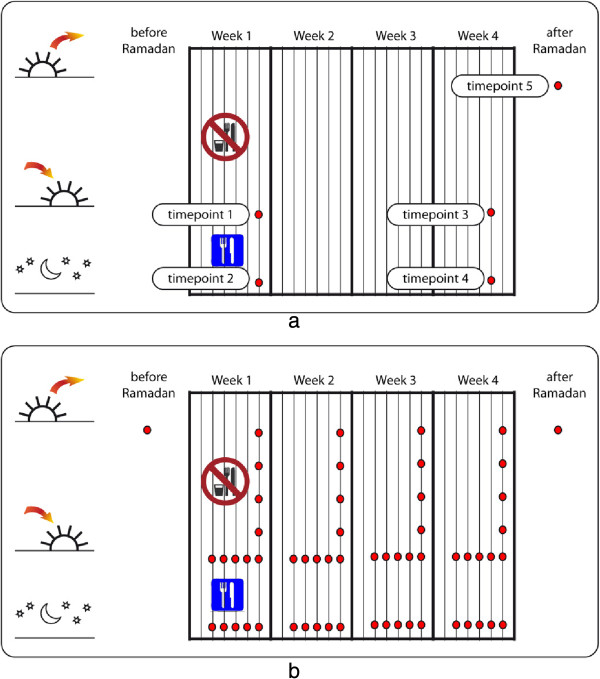
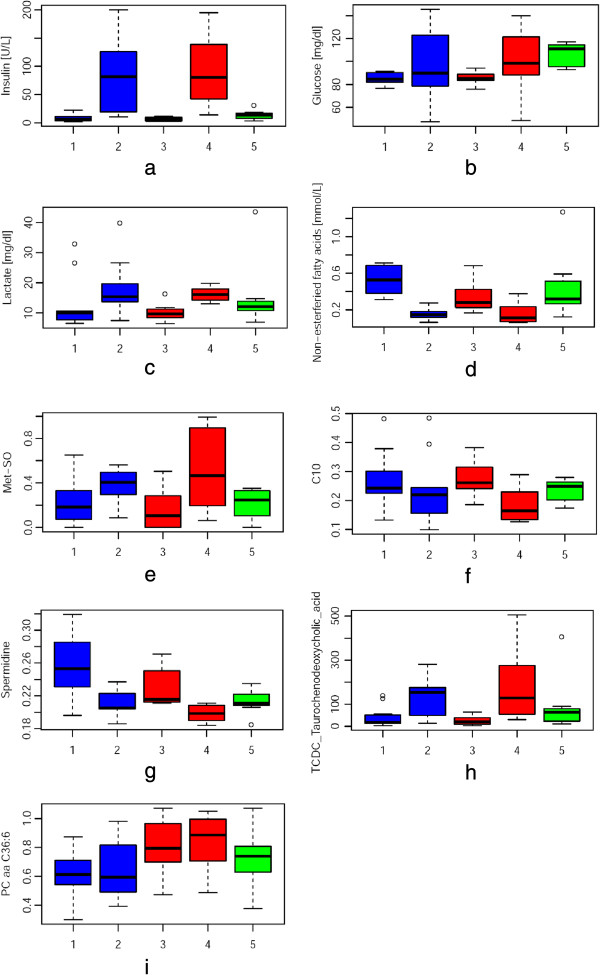
High-throughput screening techniques that analyze the metabolic endpoints of biological processes can identify the contributions of genetic predisposition and environmental factors to the development of common diseases. Studies applying controlled physiological challenges can reveal dysregulation in metabolic responses that may be predictive for or associated with these diseases. However, large-scale epidemiological studies with well controlled physiological challenge conditions, such as extended fasting periods and defined food intake, pose logistic challenges. Culturally and religiously motivated behavioral patterns of life style changes provide a natural setting that can be used to enroll a large number of study volunteers. Here we report a proof of principle study conducted within a Muslim community, showing that a metabolomics study during the Holy Month of Ramadan can provide a unique opportunity to explore the pre-prandial and postprandial response of human metabolism to nutritional challenges. Up to five blood samples were obtained from eleven healthy male volunteers, taken directly before and two hours after consumption of a controlled meal in the evening on days 7 and 26 of Ramadan, and after an over-night fast several weeks after Ramadan. The observed increases in glucose, insulin and lactate levels at the postprandial time point confirm the expected physiological response to food intake. Targeted metabolomics further revealed significant and physiologically plausible responses to food intake by an increase in bile acid and amino acid levels and a decrease in long-chain acyl-carnitine and polyamine levels. A decrease in the concentrations of a number of phospholipids between samples taken on days 7 and 26 of Ramadan shows that the long-term response to extended fasting may differ from the response to short-term fasting. The present study design is scalable to larger populations and may be extended to the study of the metabolic response in defined patient groups such as individuals with type 2 diabetes.
分析生物过程代谢终点的高通量筛选技术能够确定遗传易感性和环境因素对常见疾病发展的影响。应用可控生理刺激的研究可以揭示代谢反应中的失调情况,这些失调可能对这些疾病具有预测性或与之相关。然而,进行大规模流行病学研究并控制好生理刺激条件,如延长禁食期和确定食物摄入量,存在后勤方面的挑战。出于文化和宗教动机的生活方式改变行为模式提供了一个自然环境,可用于招募大量研究志愿者。在此,我们报告一项在穆斯林社区进行的原理验证研究,表明斋月期间的代谢组学研究能够提供一个独特机会,来探索人类新陈代谢对营养挑战的餐前和餐后反应。从11名健康男性志愿者身上采集了多达5份血样,分别在斋月第7天和第26天晚上食用一顿控制餐食之前和之后两小时直接采集,以及在斋月结束几周后的一次过夜禁食后采集。在餐后时间点观察到的葡萄糖、胰岛素和乳酸水平升高证实了对食物摄入的预期生理反应。靶向代谢组学进一步揭示了对食物摄入的显著且符合生理常理的反应,即胆汁酸和氨基酸水平升高,长链酰基肉碱和多胺水平降低。斋月第7天和第26天采集的样本之间多种磷脂浓度的降低表明,对长期禁食的反应可能与对短期禁食的反应不同。本研究设计可扩展至更大规模人群,并且可能扩展到对特定患者群体(如2型糖尿病患者)代谢反应的研究。