Smalley Sarah, Chalmers Anthony J, Morley Simon J
Department of Biochemistry, School of Life Sciences, University of Sussex, Brighton BN1 9QG, UK.
Mol Cancer. 2014 Jun 8;13:144. doi: 10.1186/1476-4598-13-144.
Glioblastoma multiforme (GBM), the most common and most aggressive type of primary adult brain tumour, responds poorly to conventional treatment. Temozolomide (TMZ) chemotherapy remains the most commonly used treatment, despite a large proportion of tumours displaying TMZ resistance. 60% of GBM tumours have unmethylated MGMT promoter regions, resulting in an overexpression of the DNA repair protein O6-methylguanine-DNA methyltransferase (MGMT), which is responsible for tumour resistance to TMZ chemotherapy. Tumours also often exhibit hyperactive PI3-kinase/mTOR signalling, which enables them to resynthesise proteins quickly. Since MGMT is a suicide protein that is degraded upon binding to and repairing TMZ-induced O6-methylguanine adducts, it has been hypothesized that inhibition of translation via the mTOR signalling pathway could generate a tumour-specific reduction in MGMT protein and increase TMZ sensitivity.
MGMT was monitored at the post-transcriptional, translational and protein levels, to determine what effect mTOR inhibition was having on MGMT protein expression in vitro.
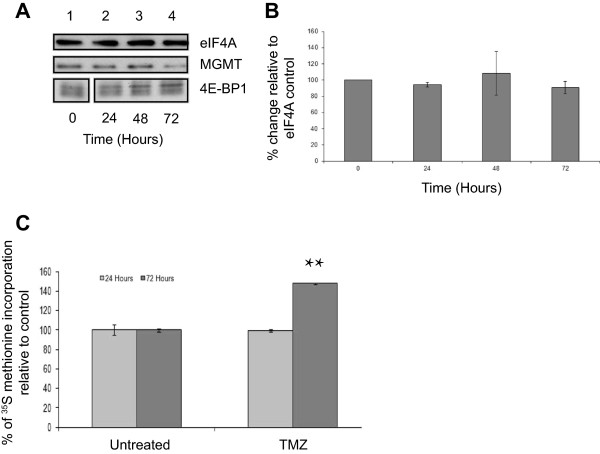
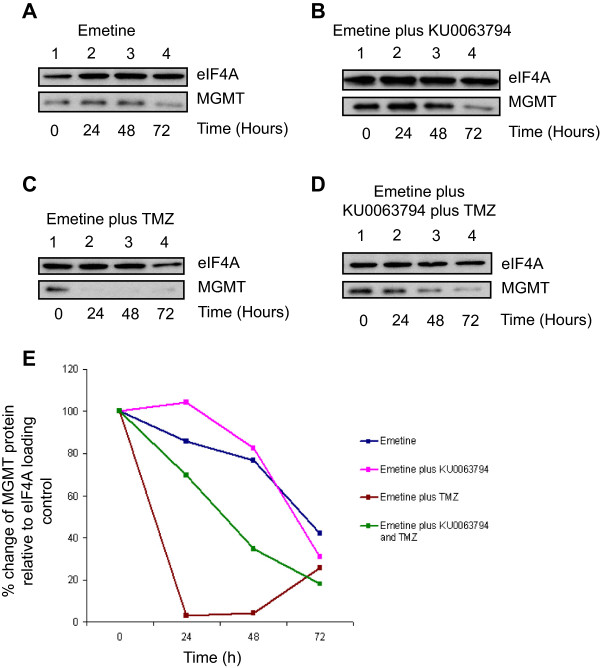
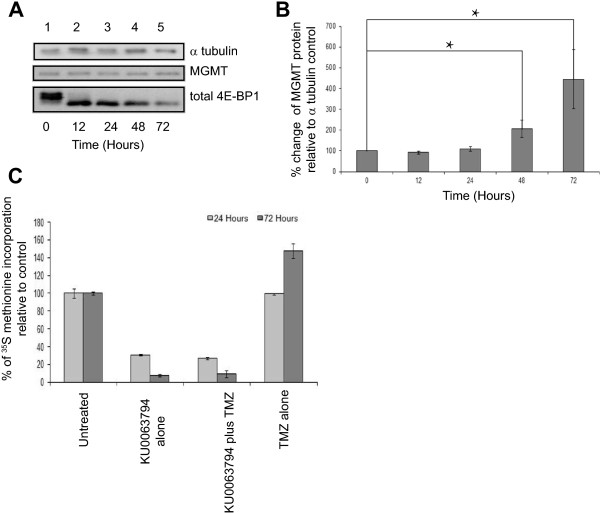
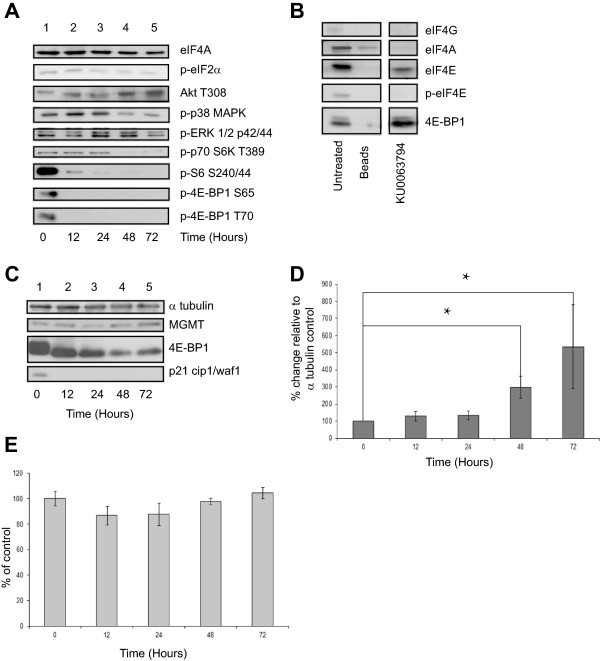
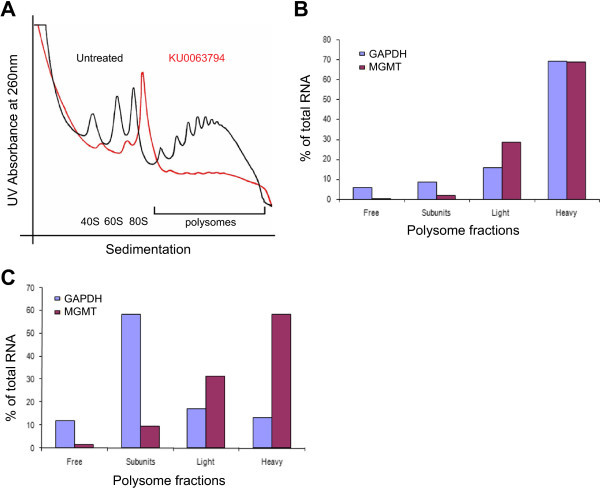
We show that inhibiting mTOR signalling is indeed associated with acute inhibition of protein synthesis. Western blots show that despite this, relative to loading control proteins, steady state levels of MGMT protein increased and MGMT mRNA was retained in heavy polysomes. Whilst TMZ treatment resulted in maintained MGMT protein levels, concomitant treatment of T98G cells with TMZ and KU0063794 resulted in increased MGMT protein levels without changes in total mRNA levels.
These in vitro data suggest that, counterintuitively, mTOR inhibition may not be a useful adjunct to TMZ therapy and that more investigation is needed before applying mTOR inhibitors in a clinical setting.
多形性胶质母细胞瘤(GBM)是成人原发性脑肿瘤中最常见且侵袭性最强的类型,对传统治疗反应不佳。替莫唑胺(TMZ)化疗仍是最常用的治疗方法,尽管很大一部分肿瘤表现出对TMZ的耐药性。60%的GBM肿瘤具有未甲基化的MGMT启动子区域,导致DNA修复蛋白O6-甲基鸟嘌呤-DNA甲基转移酶(MGMT)过度表达,该蛋白负责肿瘤对TMZ化疗的耐药性。肿瘤还经常表现出PI3激酶/mTOR信号通路过度活跃,这使其能够快速重新合成蛋白质。由于MGMT是一种自杀蛋白,在与TMZ诱导的O6-甲基鸟嘌呤加合物结合并修复后会降解,因此有人推测通过mTOR信号通路抑制翻译可能会使肿瘤特异性降低MGMT蛋白并增加TMZ敏感性。
在转录后、翻译和蛋白质水平监测MGMT,以确定mTOR抑制在体外对MGMT蛋白表达有何影响。
我们表明,抑制mTOR信号确实与蛋白质合成的急性抑制有关。蛋白质印迹显示,尽管如此,相对于上样对照蛋白,MGMT蛋白的稳态水平增加,且MGMT mRNA保留在重多核糖体中。虽然TMZ治疗导致MGMT蛋白水平维持不变,但T98G细胞同时用TMZ和KU0063794处理导致MGMT蛋白水平增加,而总mRNA水平没有变化。
这些体外数据表明,与直觉相反,mTOR抑制可能不是TMZ治疗的有用辅助手段,在临床环境中应用mTOR抑制剂之前需要进行更多研究。