Salje Jeanne
Harvard Medical School, 200 Longwood Avenue, Boston, Massachusetts, 02115.
Microbiologyopen. 2014 Aug;3(4):426-36. doi: 10.1002/mbo3.176. Epub 2014 Jun 7.
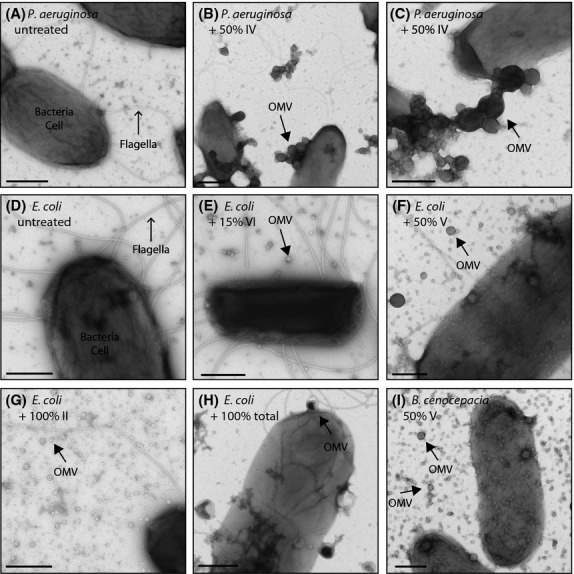
Bacteria cells exist in close proximity to other cells of both the same and different species. Bacteria secrete a large number of different chemical species, and the local concentrations of these compounds at the surfaces of nearby cells may reach very high levels. It is fascinating to imagine how individual cells might sense and respond to the complex mix of signals at their surface. However, it is difficult to measure exactly what the local environmental composition looks like, or what the effects of individual compounds on nearby cells are. Here, an electron microscopy imaging screen was designed that would detect morphological changes induced by secreted small molecules. This differs from conventional approaches by detecting structural changes in individual cells rather than gene expression or growth rate changes at the population level. For example, one of the changes detected here was an increase in outer membrane vesicle production, which does not necessarily correspond to a change in gene expression. This initial study focussed on Pseudomonas aeruginosa, Escherichia coli, and Burkholderia dolosa, and revealed an intriguing range of effects of secreted small molecules on cells both within and between species.
细菌细胞与同种及不同种的其他细胞紧密相邻。细菌会分泌大量不同的化学物质,这些化合物在附近细胞表面的局部浓度可能会达到很高水平。想象单个细胞如何感知并响应其表面复杂的信号组合,这很有意思。然而,要精确测量局部环境组成是什么样的,或者单个化合物对附近细胞有什么影响,却很困难。在此,设计了一种电子显微镜成像筛选方法,该方法能够检测由分泌的小分子诱导的形态变化。这与传统方法不同,它检测的是单个细胞的结构变化,而非群体水平上的基因表达或生长速率变化。例如,此处检测到的一种变化是外膜囊泡产生增加,这不一定对应基因表达的变化。这项初步研究聚焦于铜绿假单胞菌、大肠杆菌和多洛氏伯克霍尔德菌,并揭示了分泌的小分子对种内和种间细胞产生的一系列有趣影响。