Lonsdorf Elizabeth V, Markham A Catherine, Heintz Matthew R, Anderson Karen E, Ciuk David J, Goodall Jane, Murray Carson M
Department of Psychology and Biological Foundations of Behavior Program, Franklin & Marshall College, Lancaster, Pennsylvania, United States of America; Lester E. Fisher Center for the Study and Conservation of Apes, Lincoln Park Zoo, Chicago, Illinois, United States of America.
Center for the Advanced Study of Hominid Paleobiology, The George Washington University, Washington, DC, United States of America.
PLoS One. 2014 Jun 9;9(6):e99099. doi: 10.1371/journal.pone.0099099. eCollection 2014.
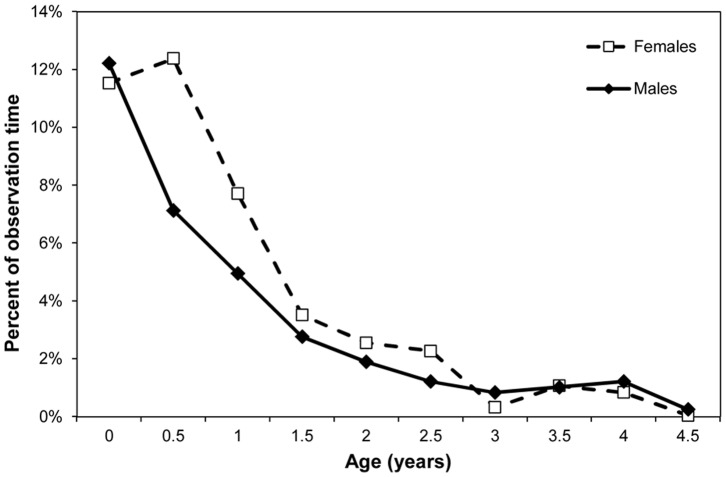
The role of biological and social influences on sex differences in human child development is a persistent topic of discussion and debate. Given their many similarities to humans, chimpanzees are an important study species for understanding the biological and evolutionary roots of sex differences in human development. In this study, we present the most detailed analyses of wild chimpanzee infant development to date, encompassing data from 40 infants from the long-term study of chimpanzees at Gombe National Park, Tanzania. Our goal was to characterize age-related changes, from birth to five years of age, in the percent of observation time spent performing behaviors that represent important benchmarks in nutritional, motor, and social development, and to determine whether and in which behaviors sex differences occur. Sex differences were found for indicators of social behavior, motor development and spatial independence with males being more physically precocious and peaking in play earlier than females. These results demonstrate early sex differentiation that may reflect adult reproductive strategies. Our findings also resemble those found in humans, which suggests that biologically-based sex differences may have been present in the common ancestor and operated independently from the influences of modern sex-biased parental behavior and gender socialization.
生物和社会影响在人类儿童发育性别差异中的作用一直是讨论和辩论的热门话题。由于黑猩猩与人类有许多相似之处,它们是理解人类发育中性别差异的生物学和进化根源的重要研究物种。在本研究中,我们展示了迄今为止对野生黑猩猩幼崽发育最详细的分析,涵盖了来自坦桑尼亚贡贝国家公园对黑猩猩长期研究的40只幼崽的数据。我们的目标是描述从出生到五岁期间,在代表营养、运动和社会发展重要基准的行为上所花费观察时间百分比的年龄相关变化,并确定是否存在性别差异以及在哪些行为中存在性别差异。在社会行为、运动发育和空间独立性指标上发现了性别差异,雄性在身体上更早成熟,玩耍高峰期比雌性更早。这些结果表明早期性别分化可能反映了成年后的繁殖策略。我们的发现也与在人类中发现的结果相似,这表明基于生物学的性别差异可能在共同祖先中就已存在,并且独立于现代性别偏见的父母行为和性别社会化的影响而发挥作用。