Pereira Gavin, Bell Michelle L, Lee Hyung Joo, Koutrakis Petros, Belanger Kathleen
Center for Perinatal Pediatric and Environmental Epidemiology, School of Medicine, Yale University, New Haven, Connecticut, USA.
Environ Health Perspect. 2014 Oct;122(10):1117-22. doi: 10.1289/ehp.1307741. Epub 2014 May 23.
Previous studies have examined fine particulate matter (≤ 2.5 μm; PM2.5) and preterm birth, but there is a dearth of longitudinal studies on this topic and a paucity of studies that have investigated specific sources of this exposure.
Our aim was to assess whether anthropogenic sources are associated with risk of preterm birth, comparing successive pregnancies to the same woman.
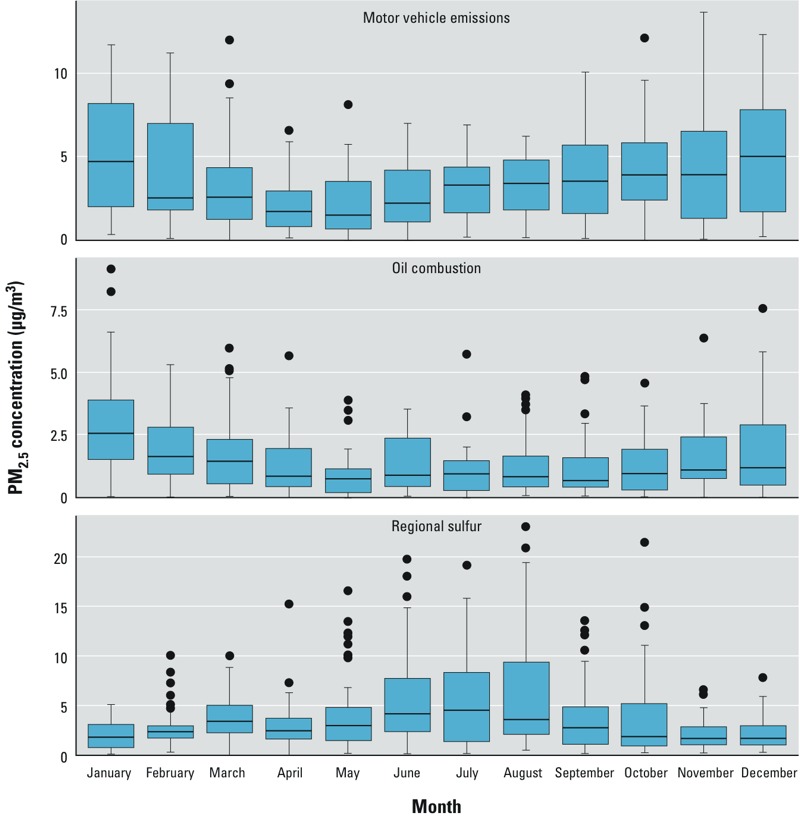
Birth certificates were used to select women who had vaginal singleton live births at least twice in Connecticut during 2000-2006 (n = 23,123 women, n = 48,208 births). We procured 4,085 daily samples of PM2.5 on Teflon filters from the Connecticut Department of Environmental Protection for six cities in Connecticut. Filters were analyzed for chemical composition, and Positive Matrix Factorization was used to determine contributions of PM2.5 sources. Risk estimates were calculated with conditional logistic regression, matching pregnancies to the same women.
Odds ratios of preterm birth per interquartile range increase in whole pregnancy exposure to dust, motor vehicle emissions, oil combustion, and regional sulfur PM2.5 sources were 1.01 (95% CI: 0.93, 1.09), 1.01 (95% CI: 0.92, 1.10), 1.00 (95% CI: 0.89, 1.12), and 1.09 (95% CI: 0.97, 1.22), respectively.
This was the first study of PM2.5 sources and preterm birth, and the first matched analysis, that better addresses individual-level confounding potentially inherent in all past studies. There was insufficient evidence to suggest that sources were statistically significantly associated with preterm birth. However, elevated central estimates and previously observed associations with mass concentration motivate the need for further research. Future studies would benefit from high source exposure settings and longitudinal study designs, such as that adopted in this study.
以往的研究探讨了细颗粒物(≤2.5微米;PM2.5)与早产的关系,但关于该主题的纵向研究匮乏,且对这种暴露的特定来源进行调查的研究也很少。
我们的目的是评估人为来源是否与早产风险相关,将同一女性的连续妊娠进行比较。
利用出生证明选取2000 - 2006年期间在康涅狄格州至少有两次阴道单胎活产的女性(n = 23123名女性,n = 48208次分娩)。我们从康涅狄格州环境保护部获取了该州六个城市的4085份用特氟龙滤膜采集的PM2.5每日样本。对滤膜进行化学成分分析,并使用正定矩阵因子分解法来确定PM2.5来源的贡献。通过条件逻辑回归计算风险估计值,将妊娠情况与同一女性进行匹配。
整个孕期暴露于扬尘、机动车尾气排放、燃油燃烧和区域硫PM2.5来源,每增加一个四分位间距,早产的比值比分别为1.01(95%置信区间:0.93,1.09)、1.01(95%置信区间:0.92,1.10)、1.00(95%置信区间:0.89,1.12)和1.09(95%置信区间:0.97,1.22)。
这是第一项关于PM2.5来源与早产的研究,也是第一项匹配分析,能更好地解决所有既往研究中可能存在的个体层面混杂问题。没有足够证据表明这些来源与早产存在统计学显著关联。然而,中心估计值升高以及之前观察到的与质量浓度的关联促使有必要进行进一步研究。未来的研究将受益于高来源暴露环境和纵向研究设计,比如本研究采用的设计。