Gozdzik Waldemar, Adamik Barbara, Gozdzik Anna, Rachwalik Maciej, Kustrzycki Wojciech, Kübler Andrzej
Department of Anesthesiology and Intensive Therapy, Wroclaw Medical University, Wroclaw, Poland.
Department of Cardiac Surgery, Wroclaw Medical University, Wroclaw, Poland.
PLoS One. 2014 Jun 9;9(6):e98923. doi: 10.1371/journal.pone.0098923. eCollection 2014.
The soluble urokinase plasminogen activator receptor (suPAR) has been recently recognized as a potential biological marker of various disease states, but the impact of a major surgical intervention on the suPAR level has not yet been established. The aim of our study was to investigate if the induction of a systemic inflammatory reaction in response to cardiopulmonary bypass would be accompanied by an increase in the plasma suPAR level.
Patients undergoing coronary artery bypass grafting under cardiopulmonary bypass (CPB) were added. Based on the baseline suPAR level, patients were divided into group 1 (suPAR within normal range) or group 2 (suPAR above range). Blood was collected before the induction of anesthesia and 6 and 24 hours after surgery. Plasma suPAR, IL-6, IL-8, TNF-α, troponin I, NT-proBNP, and NGAL were quantified to assess the impact of surgical trauma on these markers.
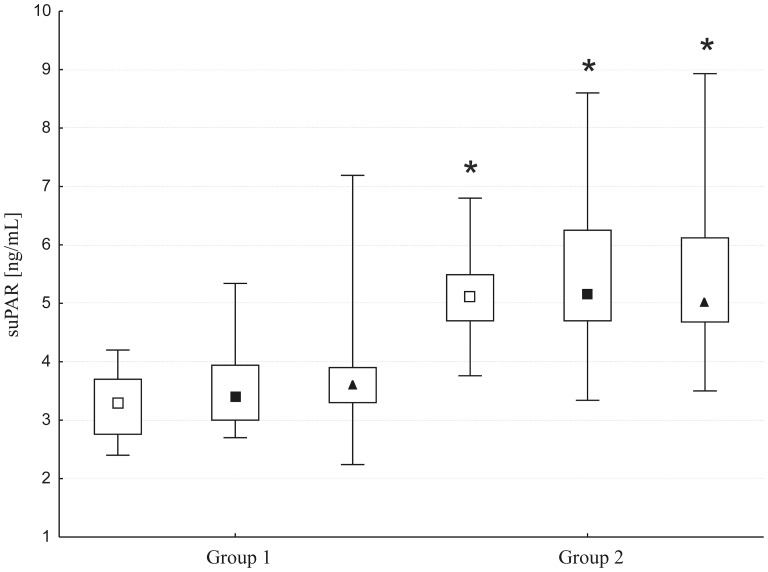
The baseline suPAR level was within the normal range in 31 patients (3.3 ng/mL), and elevated in 29 (5.1 ng/mL) (p<0.001). Baseline mediators of systemic inflammatory reaction concentrations (IL-6, TNF-α, and IL-8) and organ injury indices (troponin I, NT-proBNP, and NGAL) were low and increased after surgery in all patients (p<0.05). The surgery did not cause significant changes in the suPAR level either at 6 or 24 hours after, however the difference between groups observed at baseline remained substantial during the postoperative period.
There was no change in the suPAR level observed in patients subjected to elective cardiac coronary artery bypass surgery and CPB, despite activation of a systemic inflammatory reaction.
可溶性尿激酶型纤溶酶原激活物受体(suPAR)最近被认为是多种疾病状态的潜在生物标志物,但重大手术干预对suPAR水平的影响尚未明确。我们研究的目的是调查体外循环引发的全身炎症反应是否会伴随血浆suPAR水平升高。
纳入在体外循环(CPB)下行冠状动脉搭桥术的患者。根据基线suPAR水平,患者被分为1组(suPAR在正常范围内)或2组(suPAR超出范围)。在麻醉诱导前、术后6小时和24小时采集血液。对血浆suPAR、白细胞介素-6(IL-6)、白细胞介素-8(IL-8)、肿瘤坏死因子-α(TNF-α)、肌钙蛋白I、N末端脑钠肽前体(NT-proBNP)和中性粒细胞明胶酶相关脂质运载蛋白(NGAL)进行定量,以评估手术创伤对这些标志物的影响。
31例患者(3.3 ng/mL)的基线suPAR水平在正常范围内,29例(5.1 ng/mL)升高(p<0.001)。所有患者全身炎症反应浓度的基线介质(IL-6、TNF-α和IL-8)和器官损伤指标(肌钙蛋白I、NT-proBNP和NGAL)较低,术后升高(p<0.05)。术后6小时或24小时,手术均未导致suPAR水平发生显著变化,然而术后期间,基线时观察到的组间差异仍然很大。
尽管发生了全身炎症反应,但在接受择期心脏冠状动脉搭桥手术和CPB的患者中,未观察到suPAR水平发生变化。