Hofmann Stefan G
Boston University.
Behav Ther. 2014 Jul;45(4):576-87. doi: 10.1016/j.beth.2014.03.001. Epub 2014 Mar 14.
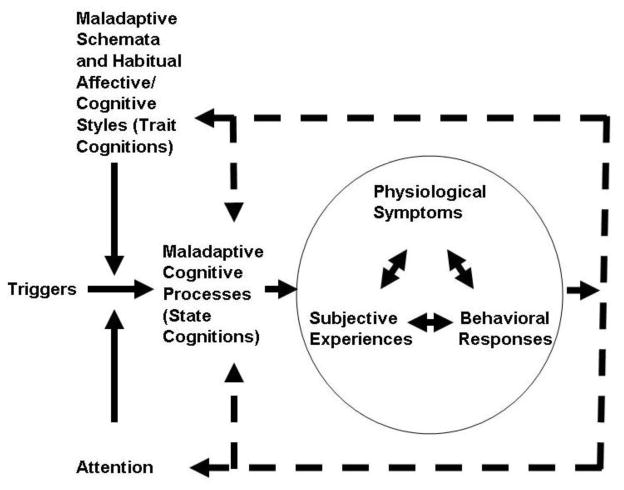
As is true for its predecessors, the recently published DSM-5 uses arbitrary criteria and cutoffs to define categories of mental disorders that are of questionable validity and that provide no guidance for treatment. Recently, the NIMH introduced an alternative classification system, the Research Domain Criteria (RDoC). Both the DSM-5 and the RDoC initiative make the strong assumption that psychological problems are expressions of specific latent disease entities. In contrast, the complex causal network approach conceptualizes psychological problems as mutually interacting, often reciprocally reinforcing, elements of a complex causal network. The cognitive behavioral model offers a classification framework that is compatible with the complex causal network approach and provides a treatment-relevant alternative to the latent disease model that is the basis for the DSM-5 and the RDoC initiative.
与之前的版本一样,最近发布的《精神疾病诊断与统计手册》第五版(DSM - 5)使用任意的标准和临界值来定义精神障碍类别,这些类别有效性存疑,且对治疗没有提供任何指导。最近,美国国立精神卫生研究所(NIMH)引入了一种替代分类系统,即研究领域标准(RDoC)。DSM - 5和RDoC计划都做出了一个强烈假设,即心理问题是特定潜在疾病实体的表现。相比之下,复杂因果网络方法将心理问题概念化为复杂因果网络中相互作用、通常相互强化的元素。认知行为模型提供了一个与复杂因果网络方法兼容的分类框架,并为作为DSM - 5和RDoC计划基础的潜在疾病模型提供了一个与治疗相关的替代方案。