Neuropathic Pain Unit, Department of Neurology and Psychiatry, Sapienza University, viale Università 30, 00185 Roma, Italy.
J Headache Pain. 2014 Jun 9;15(1):34. doi: 10.1186/1129-2377-15-34.
The guidelines on trigeminal neuralgia management that have been agreed and jointly published by the American Academy of Neurology and the European Federation of Neurological Societies recommend carbamazepine (CBZ) and oxcarbazepine (OXC) as the first-choice medical treatments in patients with trigeminal neuralgia (TN). The aim of this retrospective study was to analyze the natural history of classical trigeminal neuralgia in a large cohort of patients, focusing on drug responsiveness, side effects related to CBZ and OXC, and changes in pain characteristics during the course of disease.
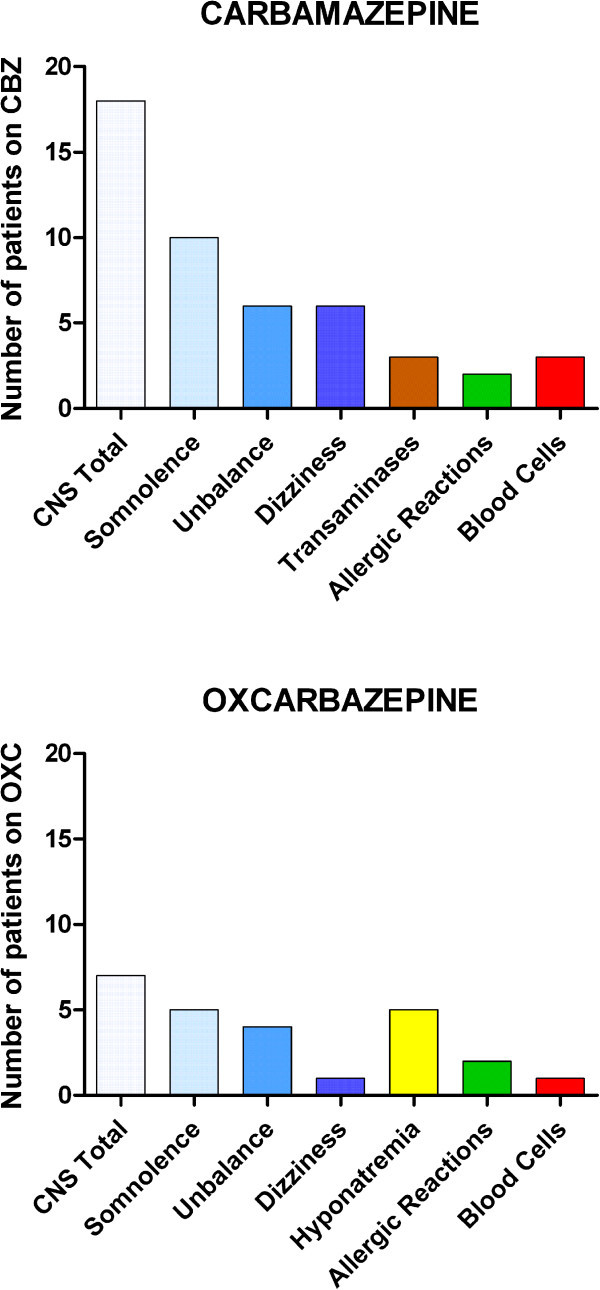
We selected the last 100 consecutive patients with typical TN who began treatment with CBZ and the last 100 with OXC. All had MRI scans and a complete neurophysiological study of trigeminal reflexes. Among them, 22 were excluded on the basis of neuroradiological or neurophysiological investigations, to avoid the inclusion of patients with possible secondary TN. The initial number of responders was 98% with CBZ with a median dose of 600 mg (range 200-1200), and of 94% with OXC, with a median dose of 1200 mg (range 600-1800). In a mean period of 8.6 months, 27% of responders to CBZ incurred in undesired effects to a level that caused interruption of treatment or a dosage reduction to an unsatisfactory level. In a mean period of 13 months, the same occurred to 18% of responders to OXC. Among patients who had a good initial response, only 3 patients with CBZ and 2 with OXC developed late resistance. During the course of disease, paroxysms worsened in intensity in 3% of patients, and paroxysms duration increased in 2%. We did not observe the onset of a clinically manifest sensory deficit at any time in any patient.
Unlike common notion, in our large patient sample the worsening of pain with time and the development of late resistance only occurred in a very small minority of patients. CBZ and OXC were confirmed to be efficacious in a large majority of patients, but the side effects caused withdrawal from treatment in an important percentage of patients. These results suggest the opportunity to develop a better tolerated drug.
美国神经病学学会和欧洲神经病学会联合会联合制定的三叉神经痛管理指南建议卡马西平(CBZ)和奥卡西平(OXC)作为三叉神经痛(TN)患者的首选药物治疗。本回顾性研究旨在分析一大组典型三叉神经痛患者的自然病史,重点关注药物反应性、与 CBZ 和 OXC 相关的副作用以及疾病过程中疼痛特征的变化。
我们选择了最后 100 例开始接受 CBZ 治疗的典型 TN 连续患者和最后 100 例接受 OXC 治疗的患者。所有患者均行 MRI 扫描和三叉神经反射的完整神经生理学研究。其中,22 例患者因神经影像学或神经生理学检查而被排除在外,以避免纳入可能存在继发性 TN 的患者。CBZ 的初始应答者为 98%,中位数剂量为 600mg(范围 200-1200),OXC 为 94%,中位数剂量为 1200mg(范围 600-1800)。在平均 8.6 个月的时间里,27%的 CBZ 应答者出现不良反应,导致治疗中断或剂量减少至不满意水平。在平均 13 个月的时间里,OXC 应答者中有 18%出现同样情况。在初始反应良好的患者中,只有 3 例 CBZ 和 2 例 OXC 出现迟发性耐药。在疾病过程中,3%的患者阵发性疼痛强度恶化,2%的患者阵发性疼痛持续时间延长。我们在任何时候都没有观察到任何患者出现临床明显的感觉缺失。
与普遍观点不同,在我们的大样本患者中,疼痛随时间恶化和迟发性耐药的发展仅发生在极少数患者中。CBZ 和 OXC 在绝大多数患者中被证实有效,但副作用导致相当一部分患者停止治疗。这些结果表明有机会开发一种耐受性更好的药物。