Feng Rentian, Milcarek Christine A, Xie Xiang-Qun
Department of Pharmaceutical Sciences, Computational Chemical Genomics Screening Center, University of Pittsburgh School of Pharmacy, Pittsburgh, PA, USA.
BMC Pharmacol Toxicol. 2014 Jun 9;15:30. doi: 10.1186/2050-6511-15-30.
Cannabinoid receptor 2 (CB2) is expressed predominantly in the immune system, particularly in plasma cells, raising the possibility that targeting the CB2 pathway could yield an immunomodulatory effect. Although the role of CB2 in mediating immunoglobulin class switching has been reported, the effects of targeting the CB2 pathway on immunoglobulin secretion per se remain unclear.
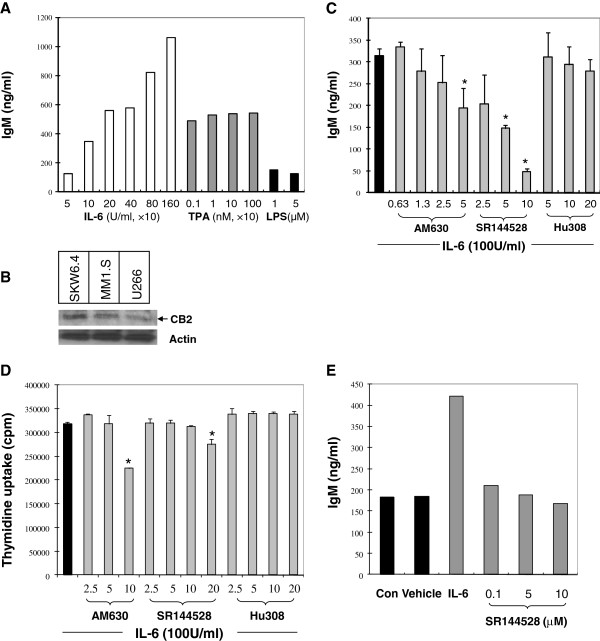
Human B cell line SKW 6.4, which is capable of differentiating into IgM-secreting cells once treated with human IL-6, was employed as the cell model. SKW 6.4 cells were incubated for 4 days with CB2 ligands plus IL-6 (100 U/ml). The amount of secreted IgM was determined by an ELISA. Cell proliferation was determined by the 3H-Thymidine incorporation assay. Signal molecules involved in the modulation of IgM secretion were examined by real-time RT-PCR and Western blot analyses or by using their specific inhibitors.
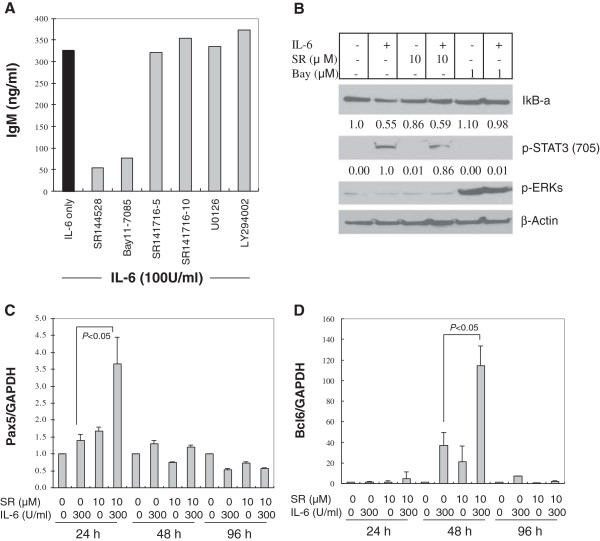
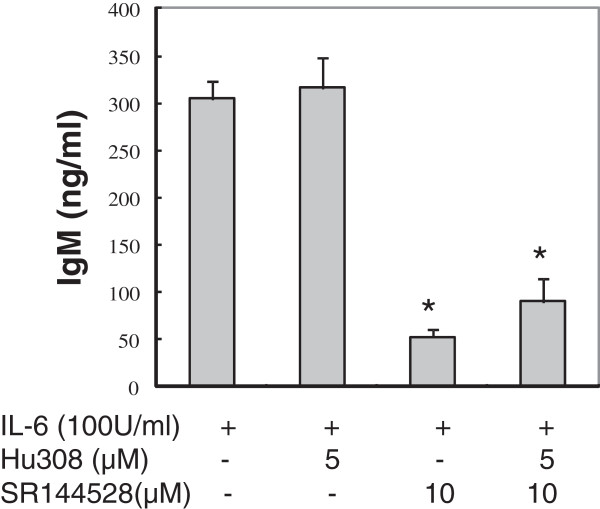
We demonstrated that CB2 inverse agonists SR144528 and AM630, but not CB2 agonist HU308 or CB1 antagonist SR141716, effectively inhibited IL-6-induced secretion of soluble IgM without affecting cell proliferation as measured by thymidine uptake. SR144528 alone had no effects on the basal levels of IgM in the resting cells. These effects were receptor mediated, as pretreatment with CB2 agonist abrogated SR144528-mediated inhibition of IL-6 stimulated IgM secretion. Transcription factors relevant to B cell differentiation, Bcl-6 and PAX5, as well as the protein kinase STAT3 pathway were involved in the inhibition of IL-6-induced IgM by SR144528.
These results uncover a novel function of CB2 antagonists and suggest that CB2 ligands may be potential modulators of immunoglobulin secretion.
大麻素受体2(CB2)主要在免疫系统中表达,尤其是在浆细胞中,这增加了靶向CB2通路可能产生免疫调节作用的可能性。尽管已有报道称CB2在介导免疫球蛋白类别转换中发挥作用,但靶向CB2通路对免疫球蛋白分泌本身的影响仍不清楚。
用人白细胞介素-6(IL-6)处理后能够分化为分泌IgM细胞的人B细胞系SKW 6.4作为细胞模型。将SKW 6.4细胞与CB2配体加IL-6(100 U/ml)孵育4天。通过酶联免疫吸附测定法(ELISA)测定分泌的IgM量。通过3H-胸苷掺入试验测定细胞增殖。通过实时逆转录聚合酶链反应(RT-PCR)和蛋白质免疫印迹分析或使用其特异性抑制剂来检测参与调节IgM分泌的信号分子。
我们证明,CB2反向激动剂SR144528和AM630,而非CB2激动剂HU308或CB1拮抗剂SR141716,能有效抑制IL-6诱导的可溶性IgM分泌,且不影响通过胸苷摄取测定的细胞增殖。单独使用SR144528对静息细胞中IgM的基础水平无影响。这些作用是受体介导的,因为用CB2激动剂预处理可消除SR144528介导的对IL-6刺激的IgM分泌的抑制作用。与B细胞分化相关的转录因子Bcl-6和PAX5以及蛋白激酶信号转导和转录激活因子3(STAT3)通路参与了SR144528对IL-6诱导的IgM的抑制作用。
这些结果揭示了CB2拮抗剂的一种新功能,并表明CB2配体可能是免疫球蛋白分泌的潜在调节剂。