Chen Hai-yan, Ma Xiu-mei, Ye Ming, Hou Yan-li, Xie Hua-ying, Bai Yong-rui
Department of Radiation Oncology, Ren Ji Hospital, School of Medicine, Shanghai Jiao Tong University, Shanghai 200127, China.
Department of Radiation Oncology, Ren Ji Hospital, School of Medicine, Shanghai Jiao Tong University, Shanghai 200127, China
J Radiat Res. 2014 Sep;55(5):940-7. doi: 10.1093/jrr/rru031. Epub 2014 Jun 8.
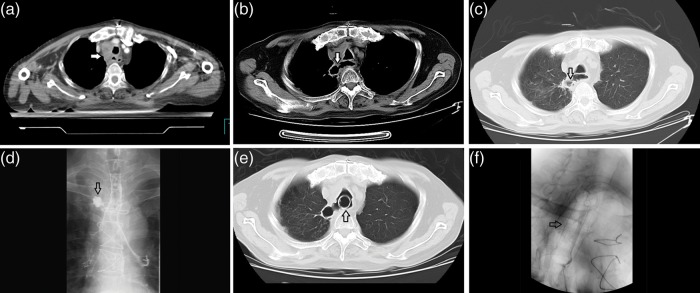
The aim of this study was to analyze the risk factors and prognosis for patients with esophageal perforation occurring during or after radiotherapy for esophageal carcinoma. We retrospectively analyzed 322 patients with esophageal carcinoma. These patients received radiotherapy for unresectable esophageal tumors, residual tumors after operation, or local recurrence. Of these, 12 had radiotherapy to the esophagus before being admitted, 68 patients had concurrent chemoradiotherapy (CRT), and 18 patients had esophageal perforation after RT (5.8%). Covered self-expandable metallic stents were placed in 11 patients. Two patients continued RT after stenting and control of infection; one of these suffered a new perforation, and the other had a massive hemorrhage. The median overall survival was 2 months (0-3 months) compared with 17 months in the non-perforation group. In univariate analysis, the Karnofsky performance status (KPS) being ≤ 70, age younger than 60, T4 stage, a second course of radiotherapy to the esophagus, extracapsular lymph nodes (LN) involving the esophagus, a total dose >100 Gy (biologically effective dose-10), and CRT were risk factors for perforation. In multivariate analysis, age younger than 60, extracapsular LN involving the esophagus, T4 stage, and a second course of radiotherapy to the esophagus were risk factors. In conclusion, patients with T4 stage, extracapsular LN involving the esophagus, and those receiving a second course of RT should be given particular care to avoid perforation. The prognosis after perforation was poor.
本研究旨在分析食管癌放疗期间或放疗后发生食管穿孔患者的危险因素及预后情况。我们回顾性分析了322例食管癌患者。这些患者因不可切除的食管肿瘤、术后残留肿瘤或局部复发接受放疗。其中,12例患者在入院前已接受过食管放疗,68例患者接受同步放化疗(CRT),18例患者放疗后发生食管穿孔(5.8%)。11例患者置入了覆膜自膨式金属支架。2例患者在置入支架并控制感染后继续放疗;其中1例发生新的穿孔,另1例发生大出血。穿孔组患者的中位总生存期为2个月(0 - 3个月),而非穿孔组为17个月。单因素分析显示,卡氏功能状态评分(KPS)≤70、年龄小于60岁、T4期、再次进行食管放疗、食管外膜淋巴结(LN)受累、总剂量>100 Gy(生物等效剂量 - 10)以及同步放化疗是穿孔的危险因素。多因素分析显示,年龄小于60岁、食管外膜LN受累、T4期以及再次进行食管放疗是危险因素。总之,对于T4期、食管外膜LN受累以及接受再次放疗的患者,应特别注意避免穿孔。穿孔后的预后较差。