Department of Radiation Oncology, Lianyungang No 2 People's Hospital, Lianyungang, 222023, China.
Radiat Oncol. 2019 Nov 4;14(1):191. doi: 10.1186/s13014-019-1402-1.
Re-irradiation (re-RT) has the active effect of relieving clinical symptoms and prolonging the survival of patients with recurrent esophageal squamous cell carcinoma (ESCC). However, the optimal re-RT dose is still uncertain. Here, we analyzed the prognostic factors associated with survival and explored the optimal re-RT dose for patients with recurrent ESCC following definitive radiotherapy.
The data of 47 patients with recurrent ESCC who were retreated between 2010 and 2014 were retrospectively analyzed. All patients received a radiation dose > 50 Gy during the primary treatment. The median time to recurrence after primary radiotherapy was 26 months (range 6-120 months). All patients had in-field recurrence in the esophagus. Recurrence within the local site was observed in 37 patients (78.7%), and recurrence in both the local site and regional nodes were observed in 10 patients (21.3%). All patients received 3D conformal re-RT with a median dose of 58 Gy (range 26-64 Gy). Chemotherapy was sequentially used in 27.7% of the patients. Survival curves were constructed according to the Kaplan-Meier method and were compared by log-rank tests. The factors predictive of survival were identified with univariate and multivariate analyses.
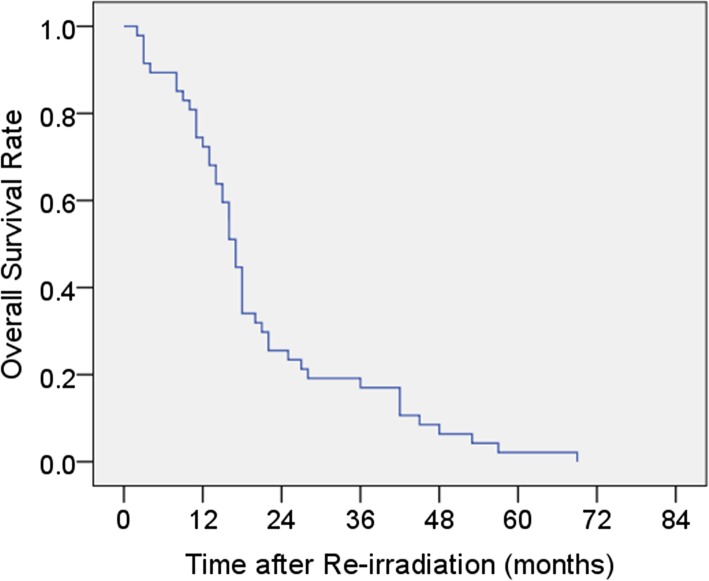
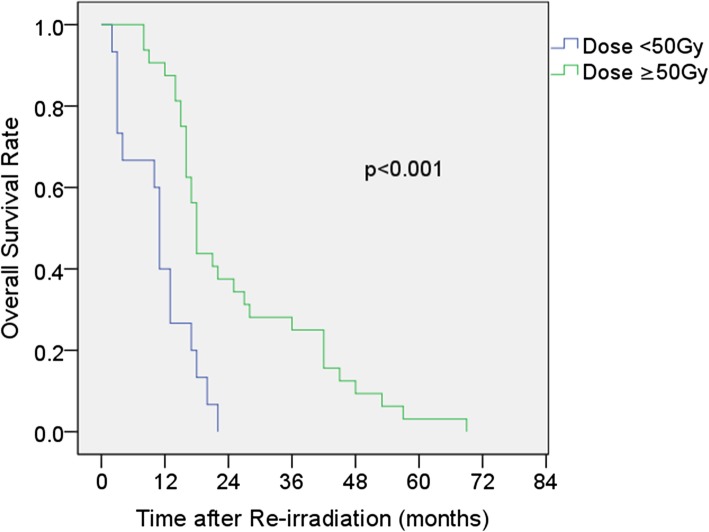
Dysphagia relief after re-RT was achieved in 20 of the 35 symptomatic patients (57.1%). The median survival time (MST) of all patients was 17 months, and the 1-, 2-, 3- and 5-year overall survival (OS) rates were 72.3, 25.5, 17.0 and 2.1%, respectively. In the univariate analysis, an Eastern Cooperative Oncology Group Performance Status (ECOG-PS) of 0-1 (P = 0.014), recurrence at the local site (P = 0.048), time to recurrence ≥24 months (P = 0.006) and re-RT dose ≥50 Gy (P < 0.001) were associated with favorable OS. In the multivariate analysis, only re-RT dose was an independent factor for OS (P = 0.007). Severe complications were observed in 7 patients, two of whom received a re-RT dose > 60 Gy.
Our results demonstrated that patients with recurrent ESCC following definitive radiotherapy had unfavorable OS. Re-RT could be considered a feasible and effective treatment modality. A re-RT dose > 50 Gy could improve the survival outcomes, and a dose > 60 Gy should be administered with caution due to the risk of severe complications.
再放疗(re-RT)具有缓解临床症状和延长复发性食管鳞状细胞癌(ESCC)患者生存时间的积极作用。然而,最佳的再放疗剂量仍不确定。在这里,我们分析了与生存相关的预后因素,并探讨了根治性放疗后复发性 ESCC 患者的最佳再放疗剂量。
回顾性分析了 2010 年至 2014 年间接受治疗的 47 例复发性 ESCC 患者的数据。所有患者在初次治疗期间接受的放射剂量均超过 50Gy。初次放疗后复发的中位时间为 26 个月(范围 6-120 个月)。所有患者均在食管内出现局部复发。37 例(78.7%)患者观察到局部部位复发,10 例(21.3%)患者观察到局部和区域淋巴结均复发。所有患者均接受了三维适形再放疗,中位剂量为 58Gy(范围 26-64Gy)。27.7%的患者序贯使用了化疗。根据 Kaplan-Meier 方法绘制生存曲线,并通过对数秩检验进行比较。采用单因素和多因素分析确定生存的预测因素。
35 例有症状患者中,20 例(57.1%)再放疗后吞咽困难缓解。所有患者的中位总生存期(MST)为 17 个月,1、2、3 和 5 年总生存率(OS)分别为 72.3%、25.5%、17.0%和 2.1%。单因素分析显示,ECOG-PS 评分为 0-1(P=0.014)、局部复发(P=0.048)、复发时间≥24 个月(P=0.006)和再放疗剂量≥50Gy(P<0.001)与较好的 OS 相关。多因素分析显示,仅再放疗剂量是 OS 的独立因素(P=0.007)。7 例患者出现严重并发症,其中 2 例接受再放疗剂量>60Gy。
我们的研究结果表明,根治性放疗后复发性 ESCC 患者的 OS 预后不佳。再放疗可被视为一种可行且有效的治疗方法。再放疗剂量>50Gy 可改善生存结果,但由于严重并发症的风险,剂量>60Gy 应谨慎使用。