Xiong Geng, Zhang Bo, Huang Mu-yun, Zhou Hufeng, Chen Li-zhen, Feng Qi-sheng, Luo Xi, Lin Hui-jia, Zeng Yi-xin
Sun Yat-sen University Cancer Center, State Key Laboratory of Oncology in South China, Collaborative Innovation Center for Cancer Medicine, Guangzhou, P.R. China.
Department of Medical Oncology, Cancer Institute and Hospital, Chinese Academy of Medical Sciences/Peking Union Medical College, Beijing, P.R. China.
PLoS One. 2014 Jun 10;9(6):e99857. doi: 10.1371/journal.pone.0099857. eCollection 2014.
Epstein-Barr Virus (EBV) is a globally prevalent herpesvirus associated with infectious mononucleosis and many malignancies. The survey on EBV prevalence appears to be important to study EBV-related diseases and determine when to administer prophylactic vaccine. The purpose of this retrospective study was to collect baseline information about the prevalence of EBV infection in Chinese children.
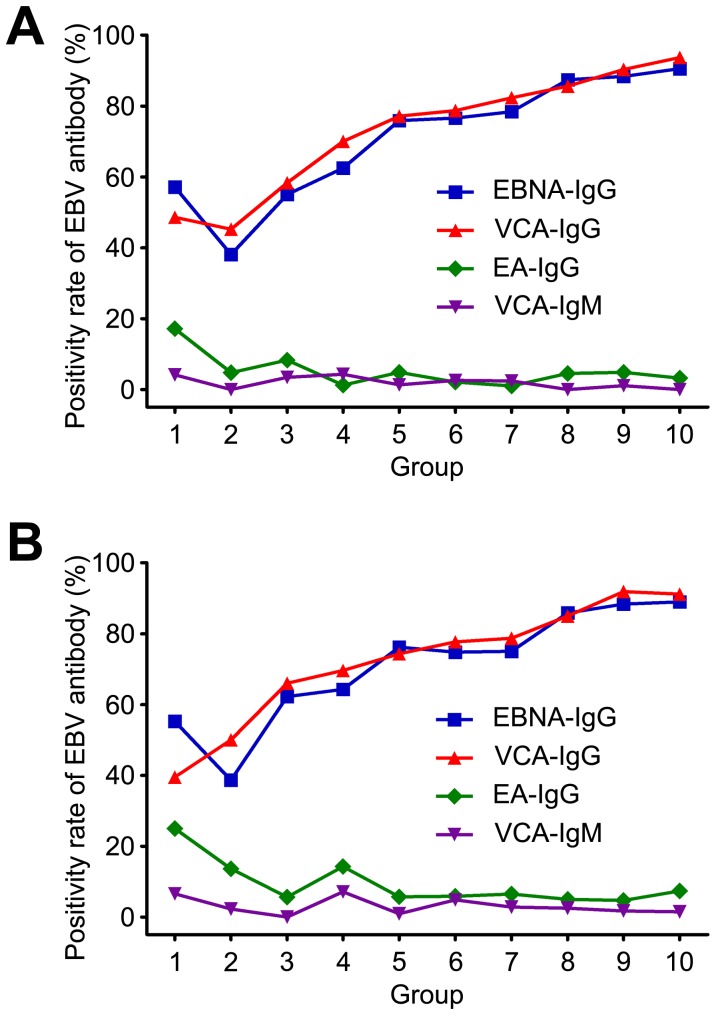
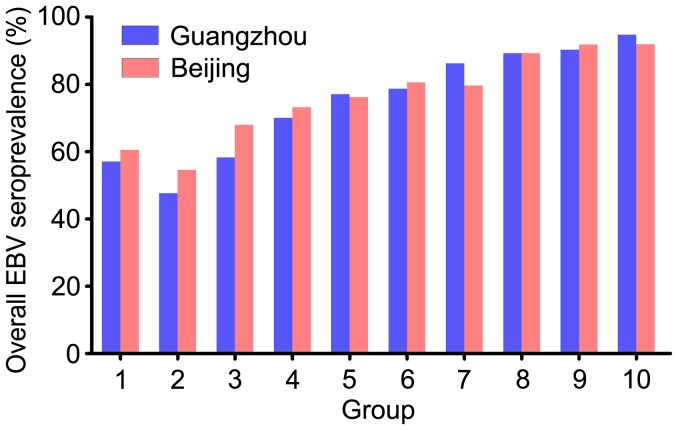
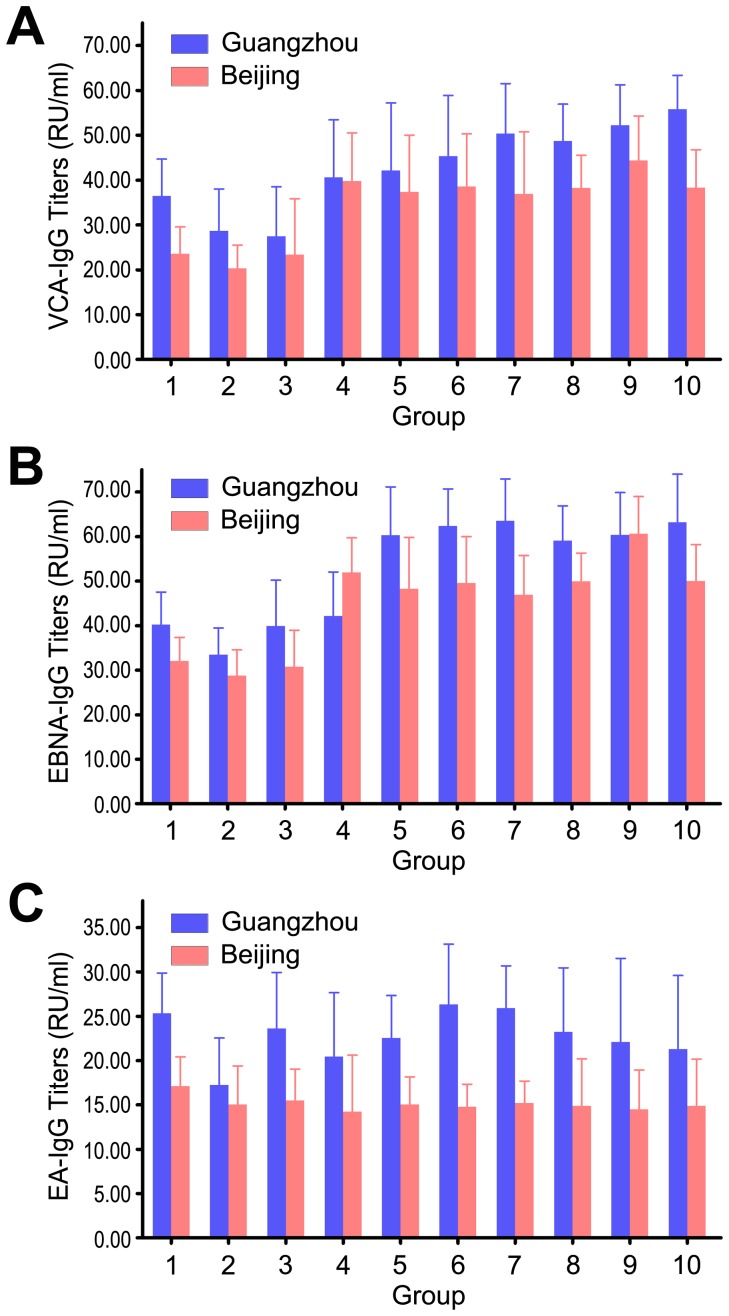
METHODOLOGY/PRINCIPAL FINDING: We collected 1778 serum samples from healthy children aged 0 to 10, who were enrolled in conventional health and nutrition examinations without any EBV-related symptom in 2012 and 2013 in North China (n = 973) and South China (n = 805). We detected four EBV-specific antibodies, i.e., anti-VCA-IgG and IgM, anti-EBNA-IgG and anti-EA-IgG, by ELISA, representing all of the phases of EBV infection. The overall EBV seroprevalence in samples from North and South China were 80.78% and 79.38% respectively. The EBV seropositivity rates dropped slightly at age 2, and then increased gradually with age. The seroprevalence became stabilized at over 90% after age 8. In this study, the seroprevalence trends between North and South China showed no difference (P>0.05), and the trends of average antibody concentrations were similar as well (P>0.05).
CONCLUSIONS/SIGNIFICANCE: EBV seroprevalence became more than 50% before age 3 in Chinese children, and exceed 90% after age 8. This study can be helpful to study the relationship between EBV and EBV-associated diseases, and supportive to EBV vaccine development and implementation.
爱泼斯坦-巴尔病毒(EBV)是一种全球流行的疱疹病毒,与传染性单核细胞增多症及多种恶性肿瘤相关。对EBV感染率的调查对于研究EBV相关疾病以及确定何时接种预防性疫苗似乎至关重要。这项回顾性研究的目的是收集中国儿童EBV感染率的基线信息。
方法/主要发现:我们收集了1778份0至10岁健康儿童的血清样本,这些儿童于2012年和2013年在中国北方(n = 973)和南方(n = 805)参加常规健康与营养检查,且无任何EBV相关症状。我们通过酶联免疫吸附测定法(ELISA)检测了四种EBV特异性抗体,即抗VCA-IgG和IgM、抗EBNA-IgG以及抗EA-IgG,它们代表了EBV感染的所有阶段。中国北方和南方样本中EBV总的血清阳性率分别为80.78%和79.38%。EBV血清阳性率在2岁时略有下降,然后随年龄逐渐上升。8岁后血清阳性率稳定在90%以上。在本研究中,中国北方和南方的血清阳性率趋势无差异(P>0.05),平均抗体浓度趋势也相似(P >0.05)。
结论/意义:中国儿童EBV血清阳性率在3岁前超过50%,8岁后超过90%。本研究有助于研究EBV与EBV相关疾病之间的关系,并为EBV疫苗的研发和应用提供支持。