Loas Andrei, Radford Robert J, Lippard Stephen J
Department of Chemistry, Massachusetts Institute of Technology , Cambridge, Massachusetts 02139, United States.
Inorg Chem. 2014 Jul 7;53(13):6491-3. doi: 10.1021/ic500732z. Epub 2014 Jun 10.
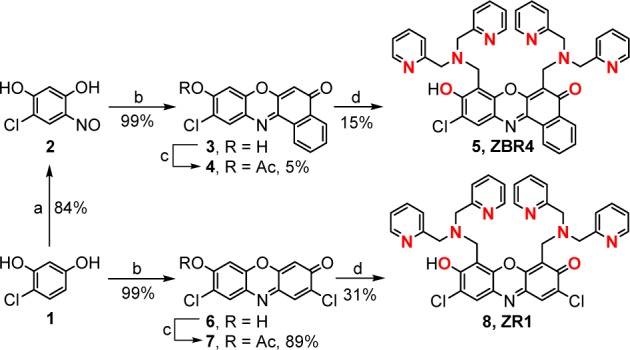
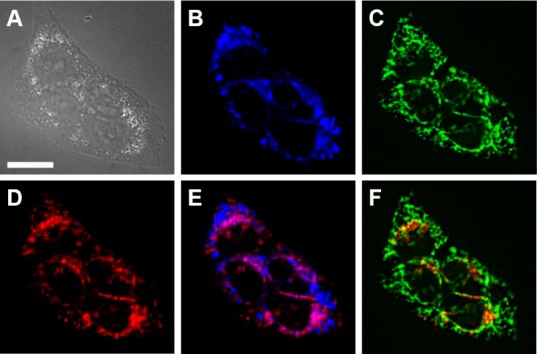
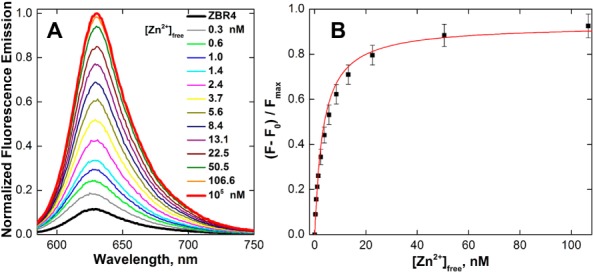
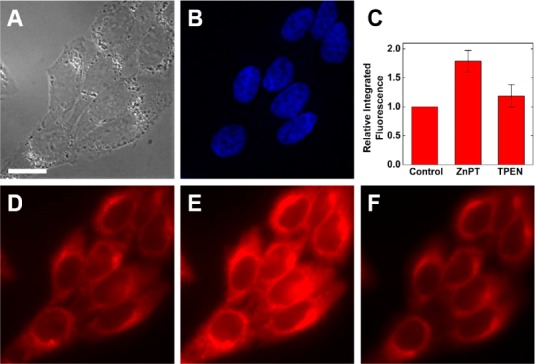
We report the synthesis and photophysical properties of ZBR4 and ZR1, two resorufin-based ditopic probes for mobile zinc. Upon binding Zn(2+), the sensors display 14- and 41-fold enhancements of their red fluorescence emission, respectively. In contrast to ZR1 and other members of the ZBR family, which accumulate in the endoplasmic reticulum, ZBR4 spontaneously localizes to the mitochondria of HeLa cells. The modular approach in designing the constructs facilitates a homologation strategy aimed at tuning the zinc-binding and intracellular targeting properties of future probes.
我们报告了ZBR4和ZR1这两种用于检测游离锌的基于试卤灵的双位点探针的合成及光物理性质。与锌结合后,这两种传感器的红色荧光发射分别增强了14倍和41倍。与在内质网中积累的ZR1及ZBR家族的其他成员不同,ZBR4自发定位于HeLa细胞的线粒体。设计构建体时采用的模块化方法有助于实施一种同源化策略,旨在调节未来探针的锌结合和细胞内靶向特性。