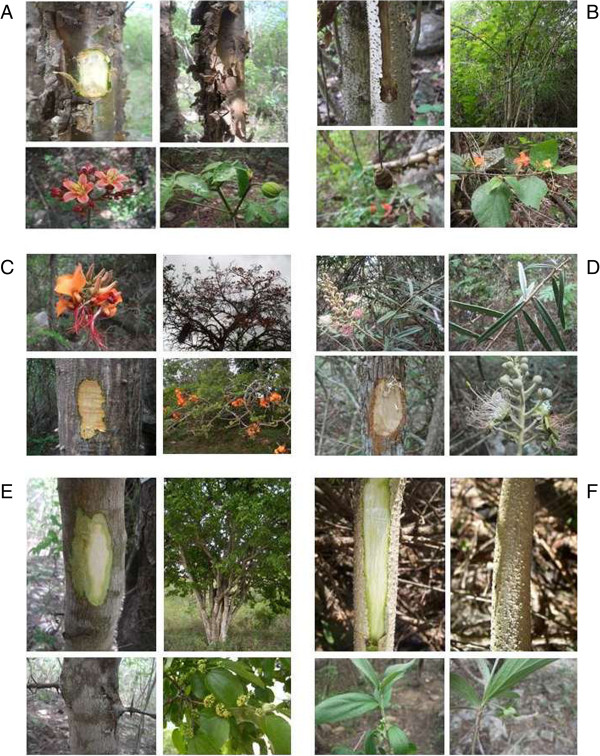
Silva Henrique Costa Hermenegildo, Caraciolo Rinaldo Luiz Ferreira, Marangon Luiz Carlos, Ramos Marcelo Alves, Santos Lucilene Lima, Albuquerque Ulysses Paulino
Department of Biology, Laboratory of Applied and Theoretical Ethnobiology (LEA), Federal Rural University of Pernambuco (UFRPE), Recife, Pernambuco, Brazil.
J Ethnobiol Ethnomed. 2014 Jun 10;10:48. doi: 10.1186/1746-4269-10-48.
This study compares the efficiency of identifying the plants in an area of semi-arid Northeast Brazil by methods that a) access the local knowledge used in ethnobotanical studies using semi-structured interviews conducted within the entire community, an inventory interview conducted with two participants using the previously collected vegetation inventory, and a participatory workshop presenting exsiccates and photographs to 32 people and b) inventory the vegetation (phytosociology) in locations with different histories of disturbance using rectangular plots and quadrant points.
The proportion of species identified using each method was then compared with Cochran's Q test. We calculated the use value (UV) of each species using semi-structured interviews; this quantitative index was correlated against values of the vegetation's structural importance obtained from the sample plot method and point-centered quarter method applied in two areas with different historical usage. The analysis sought to correlate the relative importance of plants to the local community (use value-UV) with the ecological importance of the plants in the vegetation structure (importance value-IV; relative density-RD) by using different sampling methods to analyze the two areas.
With regard to the methods used for accessing the local knowledge, a difference was observed among the ethnobotanical methods of surveying species (Q=13.37, df=2, p=0.0013): 44 species were identified in the inventory interview, 38 in the participatory workshop and 33 in the semi-structured interviews with the community. There was either no correlation between the UV, relative density (RD) and importance value (IV) of some species, or this correlation was negative.
It was concluded that the inventory interview was the most efficient method for recording species and their uses, as it allowed more plants to be identified in their original environment. To optimize researchers' time in future studies, the use of the point-centered quarter method rather than the sample plot method is recommended.
本研究比较了通过以下方法在巴西东北部半干旱地区识别植物的效率:a)利用民族植物学研究中使用的当地知识,通过在整个社区内进行半结构化访谈、与两名参与者使用先前收集的植被清单进行清单访谈以及向32人展示标本和照片的参与式研讨会;b)使用矩形样地和象限点在具有不同干扰历史的地点对植被进行清查(植物社会学)。
然后使用 Cochr an Q检验比较每种方法识别出的物种比例。我们使用半结构化访谈计算了每个物种的使用价值(UV);该定量指标与通过应用于两个具有不同历史用途地区的样地法和点中心四分法获得的植被结构重要性值相关。该分析旨在通过使用不同的采样方法分析这两个地区,将植物对当地社区的相对重要性(使用价值 - UV)与植物在植被结构中的生态重要性(重要性值 - IV;相对密度 - RD)相关联。
关于获取当地知识所使用的方法,在调查物种的民族植物学方法之间观察到差异(Q = 13.37,自由度 = 2,p = 0.0013):在清单访谈中识别出44种物种,在参与式研讨会中识别出38种,在与社区的半结构化访谈中识别出33种。一些物种的UV、相对密度(RD)和重要性值(IV)之间要么没有相关性,要么这种相关性为负。
得出的结论是,清单访谈是记录物种及其用途的最有效方法,因为它能在其原始环境中识别出更多植物。为了在未来研究中优化研究人员的时间,建议使用点中心四分法而不是样地法。