Offerman Kristy, Carulei Olivia, van der Walt Anelda Philine, Douglass Nicola, Williamson Anna-Lise
Division of Medical Virology, Department of Clinical Laboratory Sciences, University of Cape Town, Cape Town, South Africa.
BMC Genomics. 2014 Jun 12;15:463. doi: 10.1186/1471-2164-15-463.
Two novel avipoxviruses from South Africa have been sequenced, one from a Feral Pigeon (Columba livia) (FeP2) and the other from an African penguin (Spheniscus demersus) (PEPV). We present a purpose-designed bioinformatics pipeline for analysis of next generation sequence data of avian poxviruses and compare the different avipoxviruses sequenced to date with specific emphasis on their evolution and gene content.
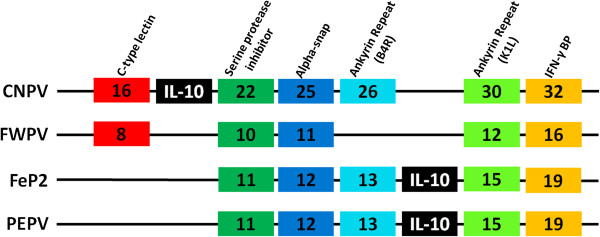
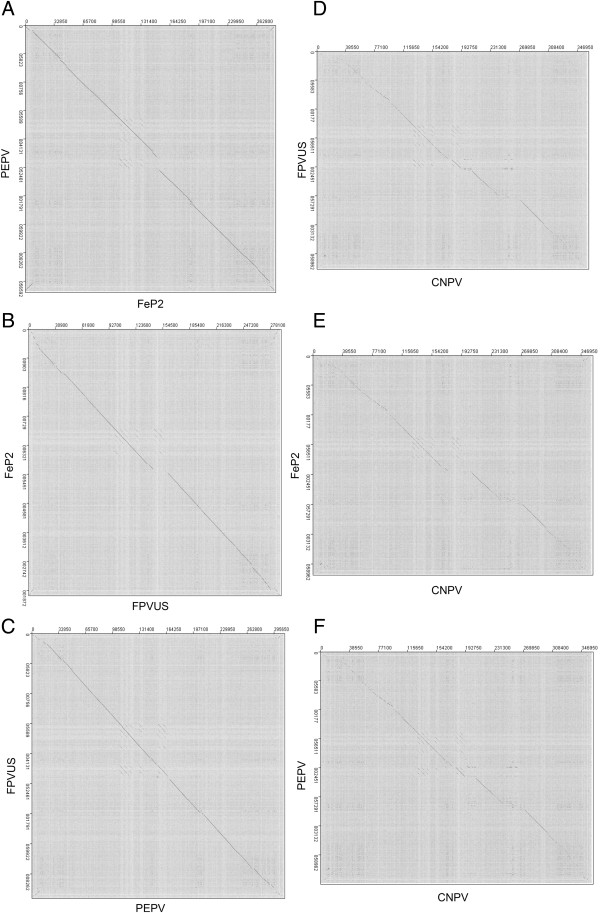
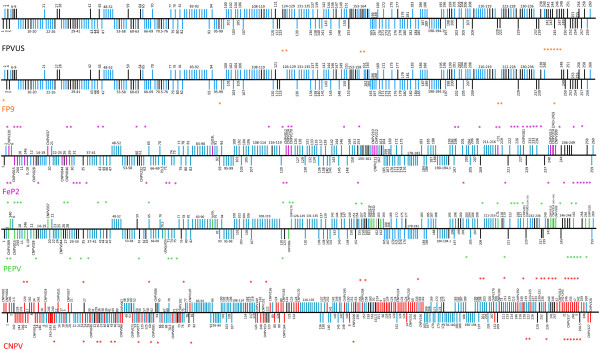
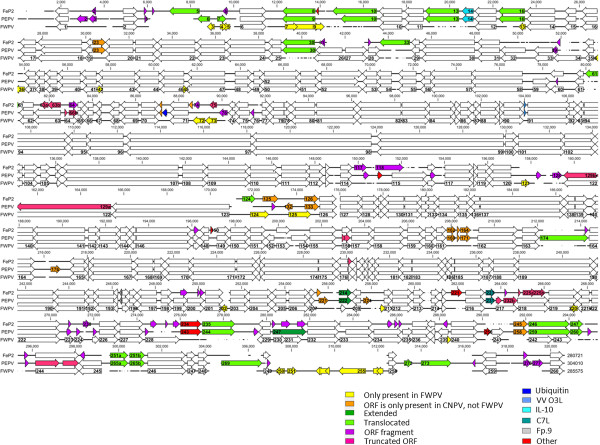
The FeP2 (282 kbp) and PEPV (306 kbp) genomes encode 271 and 284 open reading frames respectively and are more closely related to one another (94.4%) than to either fowlpox virus (FWPV) (85.3% and 84.0% respectively) or Canarypox virus (CNPV) (62.0% and 63.4% respectively). Overall, FeP2, PEPV and FWPV have syntenic gene arrangements; however, major differences exist throughout their genomes. The most striking difference between FeP2 and the FWPV-like avipoxviruses is a large deletion of ~16 kbp from the central region of the genome of FeP2 deleting a cc-chemokine-like gene, two Variola virus B22R orthologues, an N1R/p28-like gene and a V-type Ig domain family gene. FeP2 and PEPV both encode orthologues of vaccinia virus C7L and Interleukin 10. PEPV contains a 77 amino acid long orthologue of Ubiquitin sharing 97% amino acid identity to human ubiquitin.
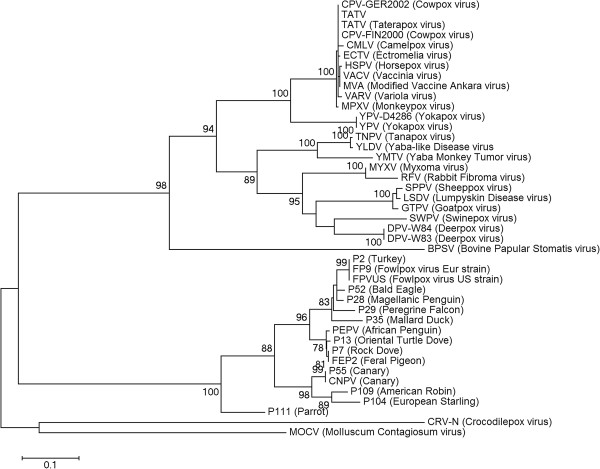
The genome sequences of FeP2 and PEPV have greatly added to the limited repository of genomic information available for the Avipoxvirus genus. In the comparison of FeP2 and PEPV to existing sequences, FWPV and CNPV, we have established insights into African avipoxvirus evolution. Our data supports the independent evolution of these South African avipoxviruses from a common ancestral virus to FWPV and CNPV.
已对来自南非的两种新型禽痘病毒进行了测序,一种来自野生家鸽(Columba livia)(FeP2),另一种来自非洲企鹅(Spheniscus demersus)(PEPV)。我们提出了一种专门设计的生物信息学流程,用于分析禽痘病毒的下一代序列数据,并比较了迄今为止测序的不同禽痘病毒,特别强调了它们的进化和基因内容。
FeP2(282 kbp)和PEPV(306 kbp)基因组分别编码271个和284个开放阅读框,彼此之间的亲缘关系比与禽痘病毒(FWPV)(分别为85.3%和84.0%)或金丝雀痘病毒(CNPV)(分别为62.0%和63.4%)更密切(94.4%)。总体而言,FeP2、PEPV和FWPV具有共线性基因排列;然而,它们的基因组中存在重大差异。FeP2与FWPV样禽痘病毒之间最显著的差异是FeP2基因组中心区域有一个约16 kbp的大片段缺失,缺失了一个cc趋化因子样基因、两个天花病毒B22R直系同源物、一个N1R/p28样基因和一个V型免疫球蛋白结构域家族基因。FeP2和PEPV都编码痘苗病毒C7L和白细胞介素10的直系同源物。PEPV包含一个77个氨基酸长的泛素直系同源物,与人类泛素的氨基酸同一性为97%。
FeP2和PEPV的基因组序列极大地增加了禽痘病毒属有限的基因组信息库。在将FeP2和PEPV与现有序列FWPV和CNPV进行比较时,我们对非洲禽痘病毒的进化有了深入了解。我们的数据支持这些南非禽痘病毒从共同的祖先病毒独立进化为FWPV和CNPV。