Hahn Martin W, Koll Ulrike, Jezberová Jitka, Camacho Antonio
Research Institute for Limnology, University of Innsbruck, Mondseestrasse 9, A-5310, Mondsee, Austria.
Environ Microbiol. 2015 Mar;17(3):829-40. doi: 10.1111/1462-2920.12532. Epub 2014 Jul 15.
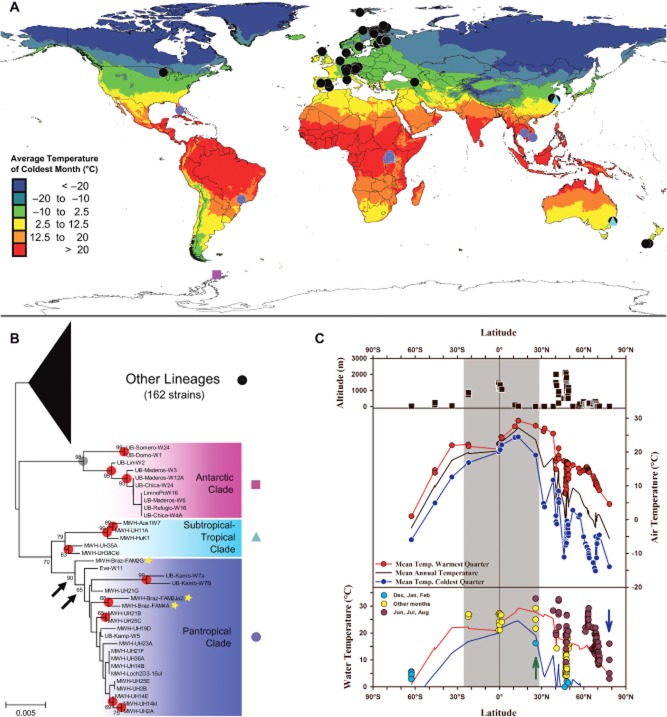
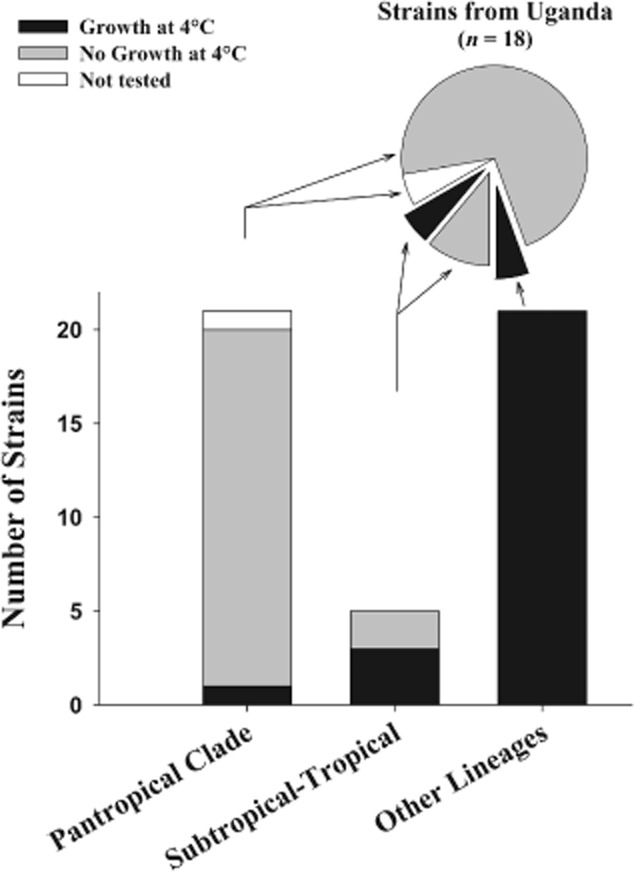
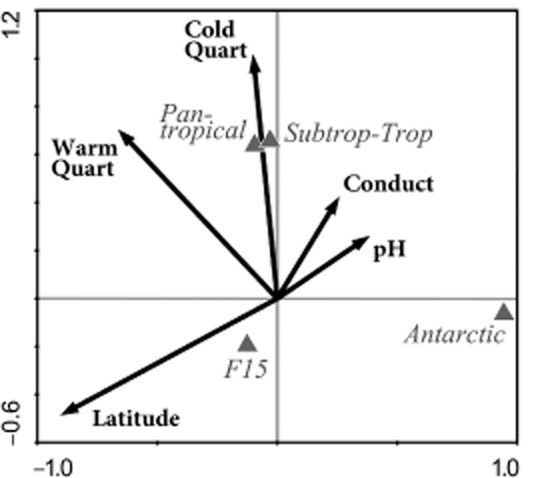
The free-living planktonic freshwater bacterium Polynucleobacter necessarius subspecies asymbioticus (> 99% 16S rRNA similarity) represents a taxon with a cosmopolitan distribution and apparently ubiquitous occurrence in lentic freshwater habitats. We tested for intra-taxon biogeographic patterns by combining cultivation-independent and cultivation methods. A culture collection of 204 strains isolated from globally distributed freshwater habitats (Arctic to Antarctica) was investigated for phylogeographic patterns based on sequences of two markers, the 16S-23S internal transcribed spacers and the glutamine synthetase gene (glnA). Genetic distance between isolates showed significant geographic distance-decay patterns for both markers, suggesting that an isolation-by-distance mechanism influences the global phylogeography. Furthermore, a couple of subgroups showed restricted geographic distributions. Strains of one subgroup were exclusively obtained from tropical sites on four continents (pantropical subgroup). Cultivation-independent methods were used to confirm the restricted geographic distributions of two subgroups. The pantropical taxon could be detected in 63% of investigated tropical habitats but not in any of 121 European freshwater samples. Physiological tests indicated that almost all strains of the pantropical subgroup failed to grow at temperatures of 4°C, while strains affiliated with other subgroups showed good growth at this temperature. This suggests that thermal adaptation is involved in phylogeographic structuring of the global Polynucleobacter population.
自由生活的浮游淡水细菌多聚核杆菌不对称亚种(16S rRNA相似度>99%)是一个分类单元,分布于全球,在静水淡水生境中显然普遍存在。我们通过结合非培养方法和培养方法来测试分类单元内的生物地理模式。对从全球分布的淡水生境(从北极到南极)分离出的204株菌株的培养物进行了研究,基于两个标记物(16S-23S内部转录间隔区和谷氨酰胺合成酶基因(glnA))的序列分析其系统发育地理模式。分离株之间的遗传距离在两个标记物上均呈现出显著的地理距离衰减模式,这表明距离隔离机制影响了全球系统发育地理学。此外,有几个亚组呈现出受限的地理分布。其中一个亚组的菌株仅从四大洲的热带地区获得(泛热带亚组)。使用非培养方法来证实两个亚组的地理分布受限。在63%的被调查热带生境中可检测到泛热带分类单元,但在121个欧洲淡水样本中均未检测到。生理测试表明,泛热带亚组的几乎所有菌株在4°C时均无法生长,而其他亚组的菌株在此温度下生长良好。这表明热适应性参与了全球多聚核杆菌种群的系统发育地理结构形成。