Ayoglu Burcu, Chaouch Amina, Lochmüller Hanns, Politano Luisa, Bertini Enrico, Spitali Pietro, Hiller Monika, Niks Eric H, Gualandi Francesca, Pontén Fredrik, Bushby Kate, Aartsma-Rus Annemieke, Schwartz Elena, Le Priol Yannick, Straub Volker, Uhlén Mathias, Cirak Sebahattin, 't Hoen Peter A C, Muntoni Francesco, Ferlini Alessandra, Schwenk Jochen M, Nilsson Peter, Al-Khalili Szigyarto Cristina
Affinity Proteomics, SciLifeLab, School of Biotechnology KTH-Royal Institute of Technology, Stockholm, Sweden.
Institute of Genetic Medicine, Newcastle University, Newcastle upon Tyne, UK.
EMBO Mol Med. 2014 Jul;6(7):918-36. doi: 10.15252/emmm.201303724.
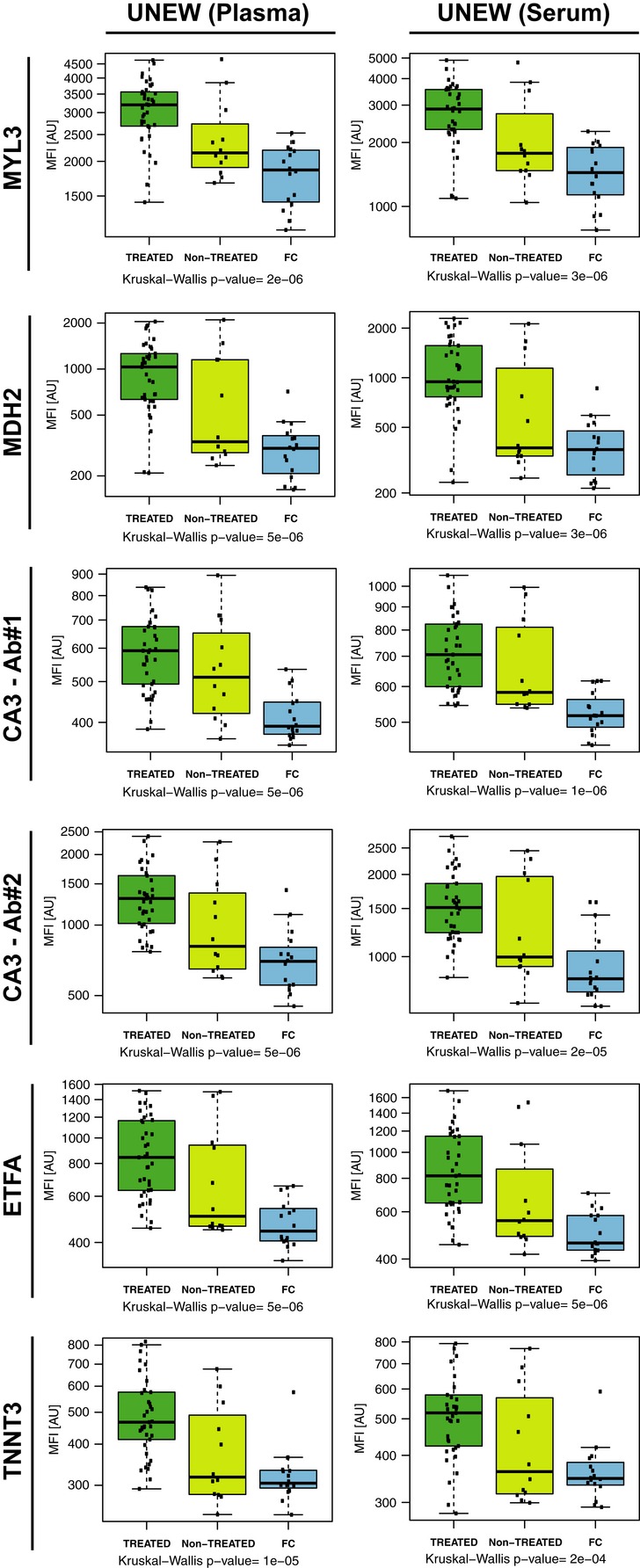
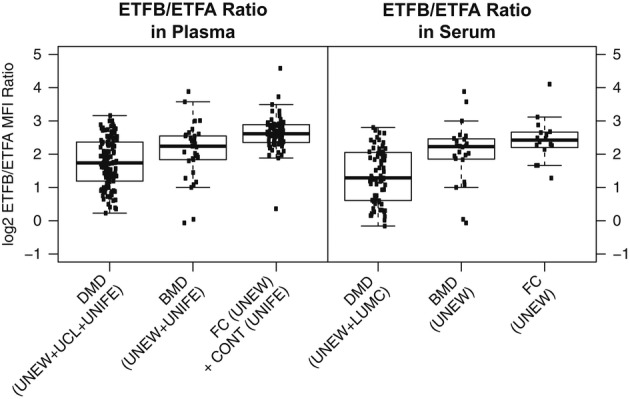
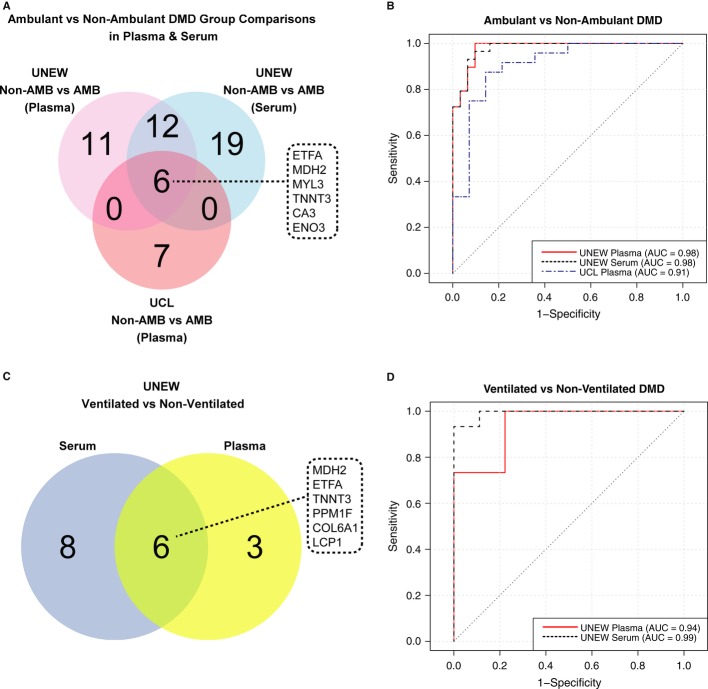
Despite the recent progress in the broad-scaled analysis of proteins in body fluids, there is still a lack in protein profiling approaches for biomarkers of rare diseases. Scarcity of samples is the main obstacle hindering attempts to apply discovery driven protein profiling in rare diseases. We addressed this challenge by combining samples collected within the BIO-NMD consortium from four geographically dispersed clinical sites to identify protein markers associated with muscular dystrophy using an antibody bead array platform with 384 antibodies. Based on concordance in statistical significance and confirmatory results obtained from analysis of both serum and plasma, we identified eleven proteins associated with muscular dystrophy, among which four proteins were elevated in blood from muscular dystrophy patients: carbonic anhydrase III (CA3) and myosin light chain 3 (MYL3), both specifically expressed in slow-twitch muscle fibers and mitochondrial malate dehydrogenase 2 (MDH2) and electron transfer flavoprotein A (ETFA). Using age-matched sub-cohorts, 9 protein profiles correlating with disease progression and severity were identified, which hold promise for the development of new clinical tools for management of dystrophinopathies.
尽管近期在体液蛋白质的大规模分析方面取得了进展,但针对罕见病生物标志物的蛋白质谱分析方法仍然匮乏。样本稀缺是阻碍在罕见病中应用探索性蛋白质谱分析的主要障碍。我们通过整合BIO-NMD联盟从四个地理位置分散的临床站点收集的样本,利用一个含有384种抗体的抗体珠阵列平台来鉴定与肌肉萎缩症相关的蛋白质标志物,从而应对了这一挑战。基于血清和血浆分析获得的统计显著性和验证结果的一致性,我们鉴定出了11种与肌肉萎缩症相关的蛋白质,其中四种蛋白质在肌肉萎缩症患者的血液中升高:碳酸酐酶III(CA3)和肌球蛋白轻链3(MYL3),二者均在慢肌纤维中特异性表达,以及线粒体苹果酸脱氢酶2(MDH2)和电子传递黄素蛋白A(ETFA)。利用年龄匹配的亚队列,我们鉴定出了9种与疾病进展和严重程度相关的蛋白质谱,这为开发用于杜氏肌营养不良症管理的新临床工具带来了希望。