III Medical Department, Technische Universität München, Munich, Germany.
Department of Nuclear Medicine, Technische Universität München, Munich, Germany.
Onco Targets Ther. 2014 May 23;7:789-98. doi: 10.2147/OTT.S59314. eCollection 2014.
Dual phosphatidylinositol-3-kinase (PI3K)/mammalian target of rapamycin (mTOR) inhibition offers an attractive therapeutic strategy in anaplastic large cell lymphoma depending on oncogenic nucleophosmin-anaplastic lymphoma kinase (NPM-ALK) signaling. We tested the efficacy of a novel dual PI3K/mTOR inhibitor, NVP-BGT226 (BGT226), in two anaplastic large cell lymphoma cell lines in vitro and in vivo and performed an early response evaluation with positron emission tomography (PET) imaging using the standard tracer, 2-deoxy-2-[(18)F]fluoro-D-glucose (FDG) and the thymidine analog, 3'-deoxy-3'-[(18)F] fluorothymidine (FLT).
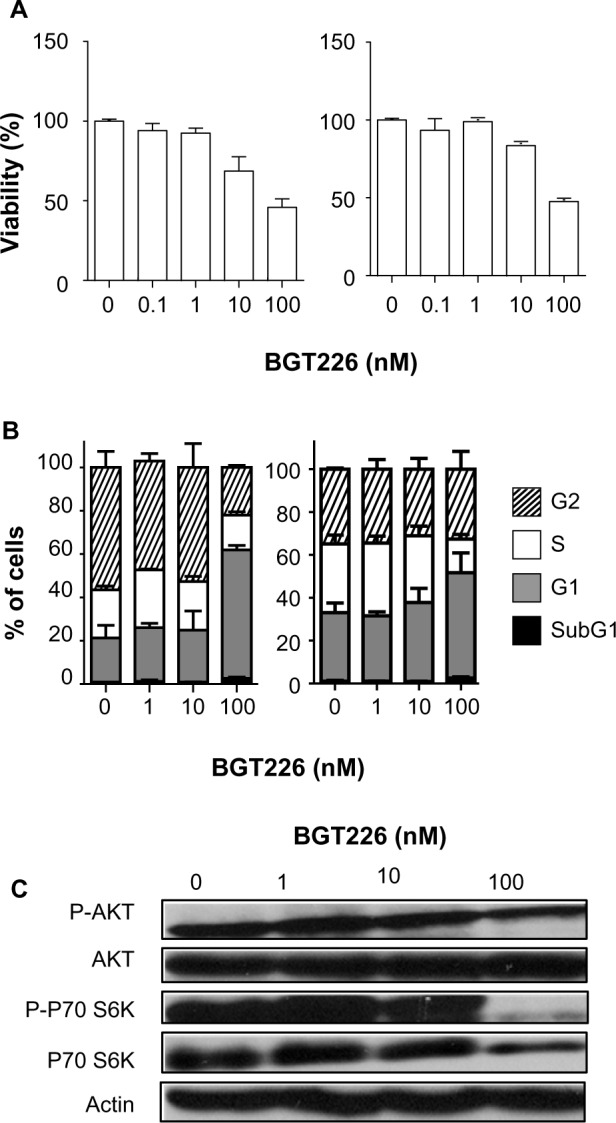
The biological effects of BGT226 were determined in vitro in the NPM-ALK positive cell lines SU-DHL-1 and Karpas299 by 3-[4,5-Dimethylthiazol-2-yl]-2,5-diphenyltetrazolium bromide assay, propidium iodide staining, and biochemical analysis of PI3K and mTOR downstream signaling. FDG-PET and FLT-PET were performed in immunodeficient mice bearing either SU-DHL-1 or Karpas299 xenografts at baseline and 7 days after initiation of treatment with BGT226. Lymphomas were removed for immunohistochemical analysis of proliferation and apoptosis to correlate PET findings with in vivo treatment effects.
SU-DHL-1 cells showed sensitivity to BGT226 in vitro, with cell cycle arrest in G0/G1 phase and an IC50 in the low nanomolar range, in contrast with Karpas299 cells, which were mainly resistant to BGT226. In vivo, both FDG-PET and FLT-PET discriminated sensitive from resistant lymphoma, as indicated by a significant reduction of tumor-to-background ratios on day 7 in treated SU-DHL-1 lymphoma-bearing animals compared with the control group, but not in animals with Karpas299 xenografts. Imaging results correlated with a marked decrease in the proliferation marker Ki67, and a slight increase in the apoptotic marker, cleaved caspase 3, as revealed by immunostaining of explanted lymphoma tissue.
Dual PI3K/mTOR inhibition using BGT226 is effective in ALK-positive anaplastic large cell lymphoma and can be monitored with both FDG-PET and FLT-PET early on in the course of therapy.
双磷脂酰肌醇 3-激酶(PI3K)/哺乳动物雷帕霉素靶蛋白(mTOR)抑制剂抑制在依赖癌基因核磷蛋白-间变性淋巴瘤激酶(NPM-ALK)信号的间变大细胞淋巴瘤中提供了一种有吸引力的治疗策略。我们在体外和体内测试了新型双 PI3K/mTOR 抑制剂 NVP-BGT226(BGT226)对两种间变大细胞淋巴瘤细胞系的疗效,并使用标准示踪剂 2-脱氧-2-[[18]F]氟-D-葡萄糖(FDG)和胸苷类似物 3'-脱氧-3'-[[18]F]氟胸苷(FLT)进行正电子发射断层扫描(PET)成像进行早期反应评估。
通过 3-[4,5-二甲基噻唑-2-基]-2,5-二苯基四唑溴盐测定法、碘化丙啶染色和 PI3K 和 mTOR 下游信号的生化分析,在 NPM-ALK 阳性细胞系 SU-DHL-1 和 Karpas299 中确定 BGT226 的生物学效应。在开始用 BGT226 治疗后 7 天,在携带 SU-DHL-1 或 Karpas299 异种移植物的免疫缺陷小鼠中进行 FDG-PET 和 FLT-PET。为了将 PET 结果与体内治疗效果相关联,从淋巴瘤中取出进行增殖和凋亡的免疫组织化学分析。
SU-DHL-1 细胞在体外对 BGT226 敏感,细胞周期停滞在 G0/G1 期,IC50 处于低纳摩尔范围,而 Karpas299 细胞主要对 BGT226 耐药。在体内,FDG-PET 和 FLT-PET 均能区分敏感和耐药的淋巴瘤,这表明与对照组相比,接受治疗的 SU-DHL-1 淋巴瘤荷瘤动物在第 7 天的肿瘤与背景比值显著降低,但在 Karpas299 异种移植物动物中则不然。成像结果与增殖标志物 Ki67 的明显减少以及凋亡标志物 cleaved caspase 3 的轻微增加相关,这是通过对离体淋巴瘤组织进行免疫染色揭示的。
使用 BGT226 进行双重 PI3K/mTOR 抑制对 ALK 阳性间变大细胞淋巴瘤有效,并可在治疗过程的早期通过 FDG-PET 和 FLT-PET 进行监测。