Williams Jessica L, Holman David W, Klein Robyn S
Department of Internal Medicine, Washington University School of Medicine St. Louis, MO, USA.
Infectious Diseases Division, Decision Resources Group Burlington, MA, USA.
Front Cell Neurosci. 2014 May 28;8:154. doi: 10.3389/fncel.2014.00154. eCollection 2014.
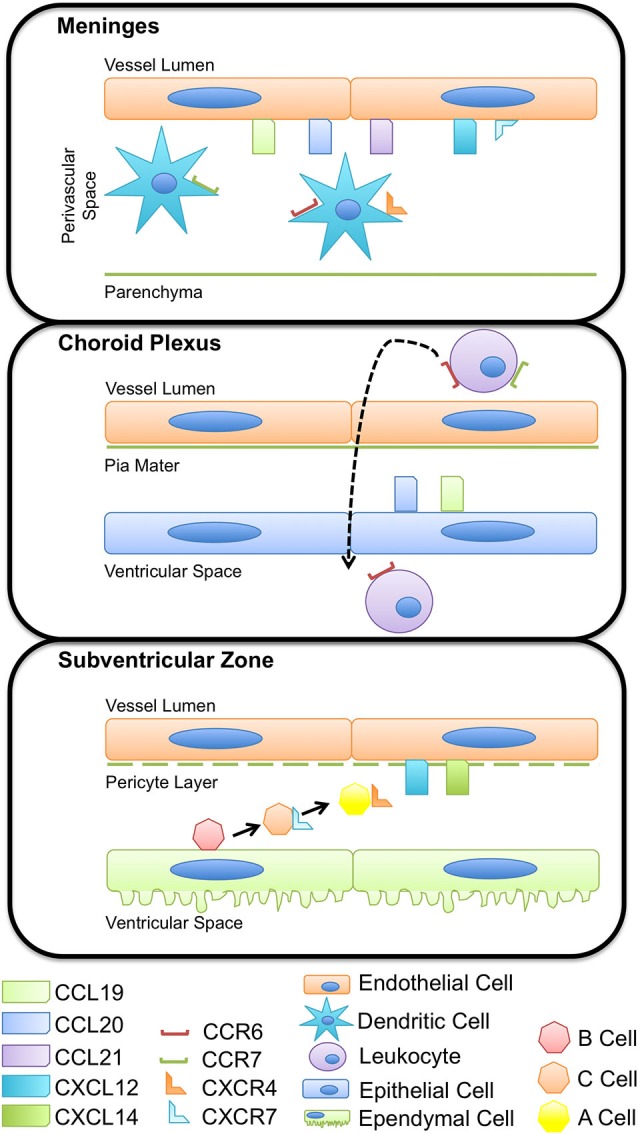
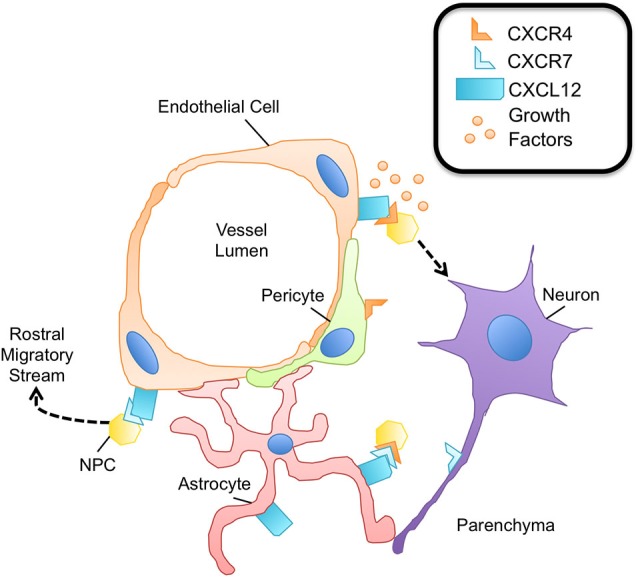
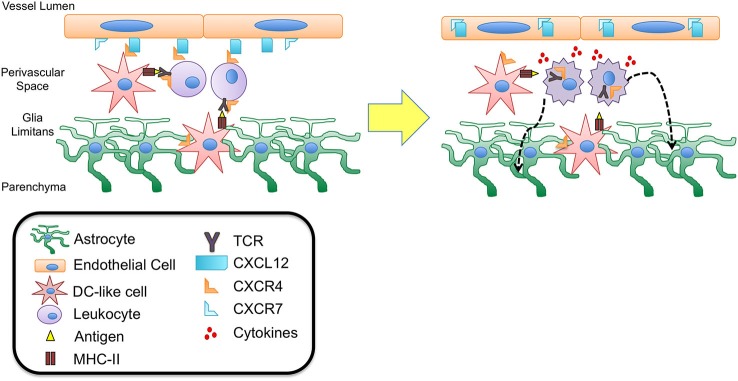
In the adult central nervous system (CNS), chemokines and their receptors are involved in developmental, physiological and pathological processes. Although most lines of investigation focus on their ability to induce the migration of cells, recent studies indicate that chemokines also promote cellular interactions and activate signaling pathways that maintain CNS homeostatic functions. Many homeostatic chemokines are expressed on the vasculature of the blood brain barrier (BBB) including CXCL12, CCL19, CCL20, and CCL21. While endothelial cell expression of these chemokines is known to regulate the entry of leukocytes into the CNS during immunosurveillance, new data indicate that CXCL12 is also involved in diverse cellular activities including adult neurogenesis and neuronal survival, having an opposing role to the homeostatic chemokine, CXCL14, which appears to regulate synaptic inputs to neural precursors. Neuronal expression of CX3CL1, yet another homeostatic chemokine that promotes neuronal survival and communication with microglia, is partly regulated by CXCL12. Regulation of CXCL12 is unique in that it may regulate its own expression levels via binding to its scavenger receptor CXCR7/ACKR3. In this review, we explore the diverse roles of these and other homeostatic chemokines expressed within the CNS, including the possible implications of their dysfunction as a cause of neurologic disease.
在成体中枢神经系统(CNS)中,趋化因子及其受体参与发育、生理和病理过程。尽管大多数研究方向聚焦于它们诱导细胞迁移的能力,但最近的研究表明,趋化因子还能促进细胞间相互作用并激活维持CNS稳态功能的信号通路。许多稳态趋化因子在血脑屏障(BBB)的血管系统上表达,包括CXCL12、CCL19、CCL20和CCL21。虽然已知这些趋化因子在内皮细胞中的表达在免疫监视期间调节白细胞进入CNS,但新数据表明,CXCL12还参与多种细胞活动,包括成体神经发生和神经元存活,其作用与稳态趋化因子CXCL14相反,CXCL14似乎调节对神经前体细胞的突触输入。CX3CL1是另一种促进神经元存活并与小胶质细胞通信的稳态趋化因子,其在神经元中的表达部分受CXCL12调节。CXCL12的调节具有独特性,因为它可能通过与清除剂受体CXCR7/ACKR3结合来调节自身的表达水平。在本综述中,我们探讨了这些以及CNS内表达的其他稳态趋化因子的多种作用,包括它们功能失调作为神经疾病病因的可能影响。