Ethridge Lauren E, Hamm Jordan P, Pearlson Godfrey D, Tamminga Carol A, Sweeney John A, Keshavan Matcheri S, Clementz Brett A
Department of Psychiatry, University of Texas Southwestern Medical Center, Dallas Texas.
Departments of Psychology, BioImaging Research Center, University of Georgia, Athens, Georgi; Neuroscience, BioImaging Research Center, University of Georgia, Athens, Georgia.
Biol Psychiatry. 2015 Jan 15;77(2):127-36. doi: 10.1016/j.biopsych.2014.03.032. Epub 2014 May 4.
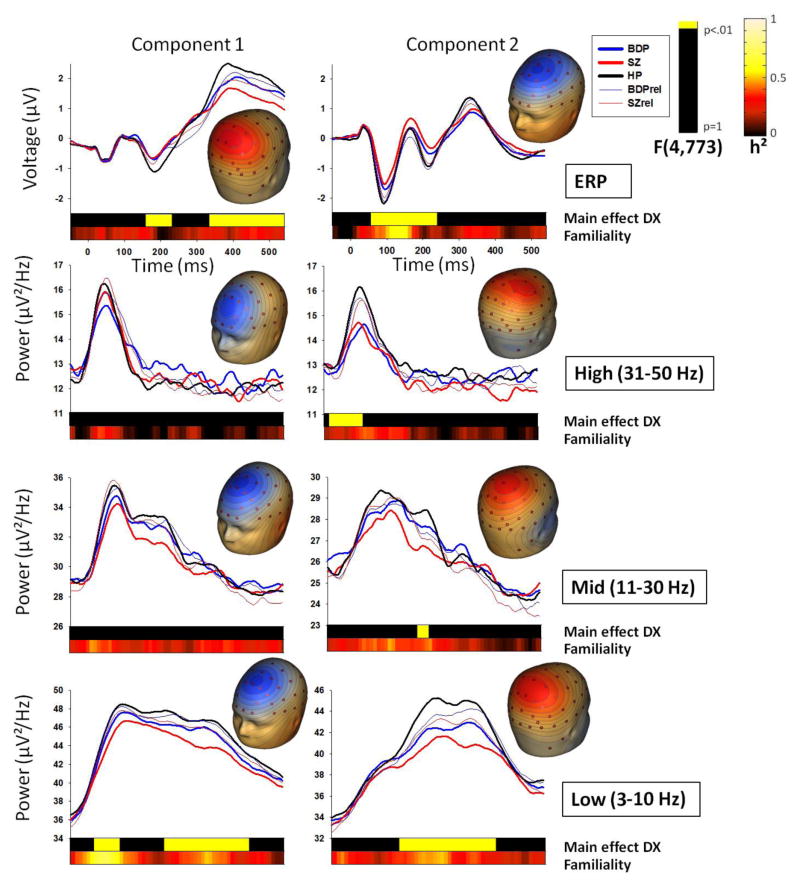
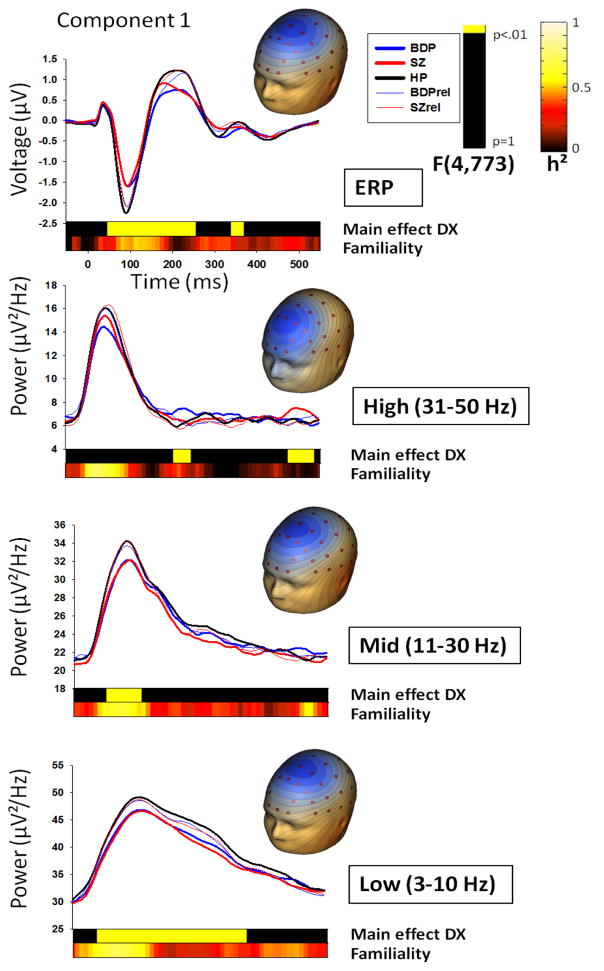
The investigators compared event-related potential (ERP) amplitudes and event-related oscillations across a broad frequency range during an auditory oddball task using a comprehensive analysis approach to describe shared and unique neural auditory processing characteristics among healthy subjects (HP), schizophrenia probands (SZ) and their first-degree relatives, and bipolar disorder I with psychosis probands (BDP) and their first-degree relatives.
This Bipolar-Schizophrenia Network on Intermediate Phenotypes sample consisted of clinically stable SZ (n = 229) and BDP (n = 188), HP (n = 284), first-degree relatives of schizophrenia probands (n = 264), and first-degree relatives of bipolar disorder I with psychosis probands (n = 239). They were administered an auditory oddball task in the electroencephalography environment. Principal components analysis derived data-driven frequency bands evoked power. Spatial principal components analysis reduced ERP and frequency data to component waveforms for each subject. Clusters of time bins with significant group differences on response magnitude were assessed for proband/relative differences from HP and familiality.
Nine variables survived a linear discriminant analysis between HP, SZ, and BDP. Of those, two showed evidence (deficit in relatives and familiality) as genetic risk markers more specific to SZ (N1, P3b), one was specific to BDP (P2) and one for psychosis in general (N2).
This study supports for both shared and unique deficits in early sensory and late cognitive processing across psychotic diagnostic groups. Additional ERP and time-frequency component alterations (frontal N2/P2, late high, early, mid, and low frequency) may provide insight into deficits in underlying neural architecture and potential protective/compensatory mechanisms in unaffected relatives.
研究人员在听觉Oddball任务中,使用综合分析方法比较了健康受试者(HP)、精神分裂症先证者(SZ)及其一级亲属,以及伴有精神病的双相I型障碍先证者(BDP)及其一级亲属在广泛频率范围内的事件相关电位(ERP)振幅和事件相关振荡,以描述共同的和独特的神经听觉处理特征。
这个中间表型双相-精神分裂症网络样本包括临床稳定的SZ(n = 229)和BDP(n = 188)、HP(n = 284)、精神分裂症先证者的一级亲属(n = 264),以及伴有精神病的双相I型障碍先证者的一级亲属(n = 239)。他们在脑电图环境中接受了听觉Oddball任务。主成分分析得出数据驱动的频段诱发功率。空间主成分分析将每个受试者的ERP和频率数据简化为成分波形。评估反应幅度上具有显著组间差异的时间窗簇,以确定先证者/亲属与HP的差异以及家族性。
9个变量在HP、SZ和BDP之间的线性判别分析中幸存下来。其中,两个显示出作为更特异于SZ的遗传风险标志物的证据(亲属和家族性缺陷)(N1、P3b),一个特异于BDP(P2),一个总体上特异于精神病(N2)。
本研究支持了精神病诊断组在早期感觉和晚期认知加工方面存在共同和独特的缺陷。额外的ERP和时频成分改变(额叶N2/P2、晚期高频、早期、中期和低频)可能有助于深入了解潜在神经结构的缺陷以及未受影响亲属中的潜在保护/补偿机制。