Lockhart Marie M, Phelps Aimee L, van den Hoff Maurice J B, Wessels Andy
Department of Regenerative Medicine and Cell Biology, Medical University of South Carolina, 173 Ashley Avenue, Charleston, SC 29425, USA;
Academic Medical Center, Heart Failure Research Center, Department of Anatomy, Embryology and Physiology, Meibergdreef 15, 1105AZ, Amsterdam, The Netherlands;
J Dev Biol. 2014 Mar 1;2(1):1-17. doi: 10.3390/jdb2010001.
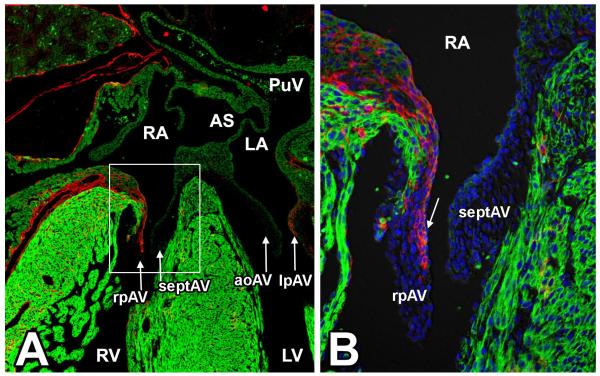
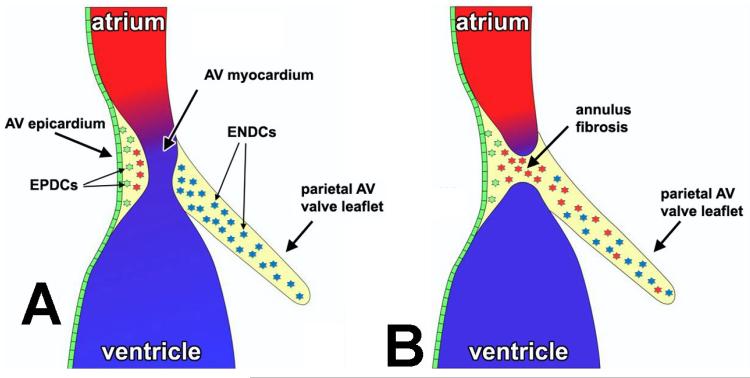
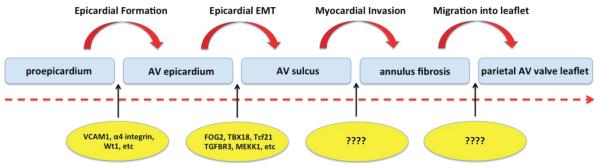
Insight into the role of the epicardium in cardiac development and regeneration has significantly improved over the past ten years. This is mainly due to the increasing availability of new mouse models for the study of the epicardial lineage. Here we focus on the growing understanding of the significance of the epicardium and epicardially-derived cells in the formation of the atrioventricular (AV) junction. First, through the process of epicardial epithelial-to-mesenchymal transformation (epiEMT), the subepicardial AV mesenchyme is formed. Subsequently, the AV-epicardium and epicardially-derived cells (EPDCs) form the annulus fibrosus, a structure important for the electrical separation of atrial and ventricular myocardium. Finally, the AV-EPDCs preferentially migrate into the parietal AV valve leaflets, largely replacing the endocardially-derived cell population. In this review, we provide an overview of what is currently known about the regulation of the events involved in this process.
在过去十年中,对心外膜在心脏发育和再生中作用的认识有了显著提高。这主要归功于用于研究心外膜谱系的新型小鼠模型越来越容易获得。在这里,我们重点关注对心外膜和心外膜衍生细胞在房室(AV)连接形成中的重要性的日益深入的理解。首先,通过心外膜上皮-间充质转化(epiEMT)过程,形成心外膜下AV间充质。随后,AV-心外膜和心外膜衍生细胞(EPDCs)形成纤维环,这是心房和心室心肌电分离的重要结构。最后,AV-EPDCs优先迁移到房室瓣叶,在很大程度上取代了心内膜衍生的细胞群体。在这篇综述中,我们概述了目前已知的关于该过程中涉及事件的调控情况。