Ehninger A, Kramer M, Röllig C, Thiede C, Bornhäuser M, von Bonin M, Wermke M, Feldmann A, Bachmann M, Ehninger G, Oelschlägel U
Medizinische Klinik und Poliklinik I, University Hospital 'Carl Gustav Carus', Technische Universität Dresden, Dresden, Germany.
Institute of Immunology, Medical Faculty 'Carl Gustav Carus', Technische Universität Dresden, Dresden, Germany.
Blood Cancer J. 2014 Jun 13;4(6):e218. doi: 10.1038/bcj.2014.39.
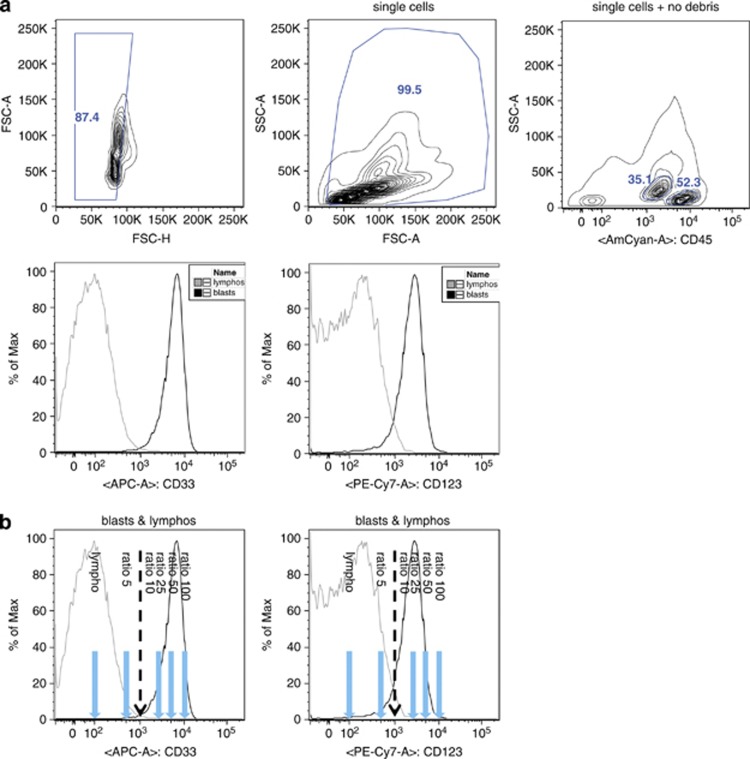
Owing to the more recent positive results with the anti-CD33 immunotoxin gemtuzumab ozogamicin, therapy against acute myeloid leukemias (AMLs) targeting CD33 holds many promises. Here, CD33 and CD123 expression on AML blasts was studied by flow cytometry in a cohort of 319 patients with detailed information on French-American-British/World Health Organization (FAB/WHO) classification, cytogenetics and molecular aberrations. AMLs of 87.8% express CD33 and would therefore be targetable with anti-CD33 therapies. Additionally, 9.4% of AMLs express CD123 without concomitant CD33 expression. Thus, nearly all AMLs could be either targeted via CD33 or CD123. Simultaneous presence of both antigens was observed in 69.5% of patients. Most importantly, even AMLs with adverse cytogenetics express CD33 and CD123 levels comparable to those with favorable and intermediate subtypes. Some patient groups with unfavorable alterations, such as FMS-related tyrosine kinase 3-internal tandem duplication (FLT3-ITD) mutations, high FLT3-ITD mutant/wild-type ratios and monosomy 5 are even characterized by high expression of CD33 and CD123. In addition, blasts of patients with mutant nucleophosmin (NPM1) revealed significantly higher CD33 and CD123 expression pointing toward the possibility of minimal residual disease-guided interventions in mutated NPM1-positive AMLs. These results stimulate the development of novel concepts to redirect immune effector cells toward CD33- and CD123-expressing blasts using bi-specific antibodies or engineered T cells expressing chimeric antigen receptors.
由于抗CD33免疫毒素吉妥单抗奥唑米星最近取得了更积极的成果,针对CD33的急性髓系白血病(AML)治疗前景广阔。在此,通过流式细胞术研究了319例患者AML原始细胞上CD33和CD123的表达情况,这些患者具有关于法国-美国-英国/世界卫生组织(FAB/WHO)分类、细胞遗传学和分子畸变的详细信息。87.8%的AML表达CD33,因此可用抗CD33疗法进行靶向治疗。此外,9.4%的AML表达CD123但不伴有CD33表达。因此,几乎所有AML都可以通过CD33或CD123进行靶向治疗。69.5%的患者同时存在这两种抗原。最重要的是,即使是具有不良细胞遗传学特征的AML,其CD33和CD123水平与具有良好和中等亚型的AML相当。一些具有不良改变的患者群体,如FMS相关酪氨酸激酶3内部串联重复(FLT3-ITD)突变、高FLT3-ITD突变/野生型比率和5号染色体单体,甚至以CD33和CD123高表达为特征。此外,突变型核磷蛋白(NPM1)患者的原始细胞显示出明显更高的CD33和CD123表达,这表明在突变型NPM1阳性AML中进行微小残留病指导干预的可能性。这些结果刺激了新观念的发展,即使用双特异性抗体或表达嵌合抗原受体的工程化T细胞,将免疫效应细胞重新导向表达CD33和CD123的原始细胞。