Department of Clinical and Experimental Epilepsy, UCL Institute of Neurology, Queen Square, WC1N 3BG London, UK.
Acta Neuropathol Commun. 2014 Jun 13;2:72. doi: 10.1186/2051-5960-2-72.
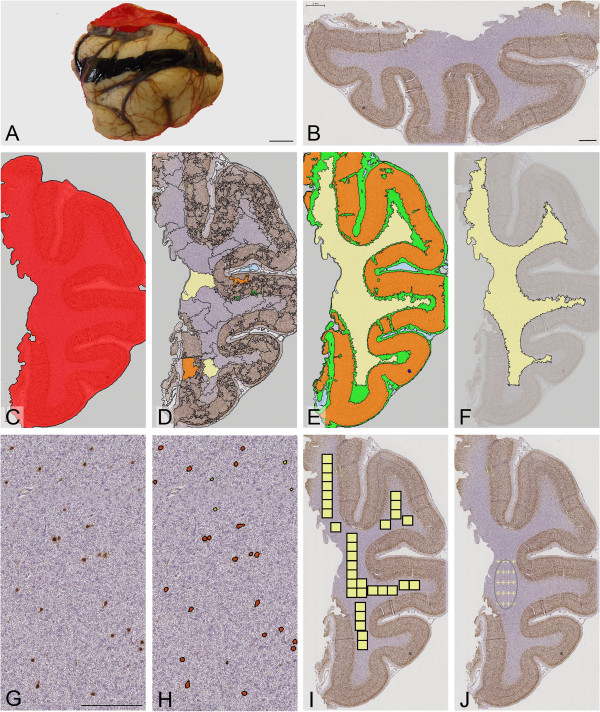
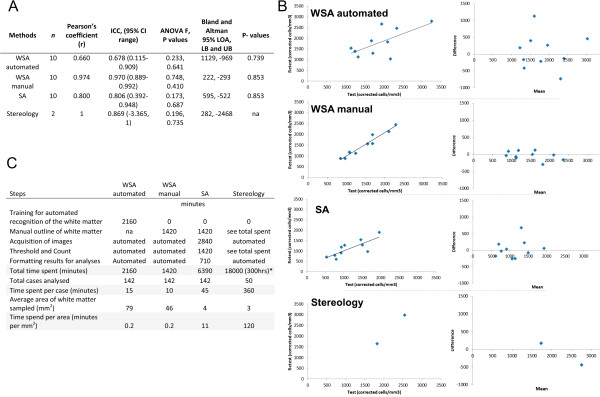
In epilepsy, the diagnosis of mild Malformation of Cortical Development type II (mMCD II) predominantly relies on the histopathological assessment of heterotopic neurons in the white matter. The exact diagnostic criteria for mMCD II are still ill-defined, mainly because findings from previous studies were contradictory due to small sample size, and the use of different stains and quantitative systems. Advance in technology leading to the development of whole slide imaging with high-throughput, automated quantitative analysis (WSA) may overcome these differences, and may provide objective, rapid, and reliable quantitation of white matter neurons in epilepsy. This study quantified the density of NeuN immunopositive neurons in the white matter of up to 142 epilepsy and control cases using WSA. Quantitative data from WSA was compared to two other systems, semi-automated quantitation, and the widely accepted method of stereology, to assess the reliability and quality of results from WSA.
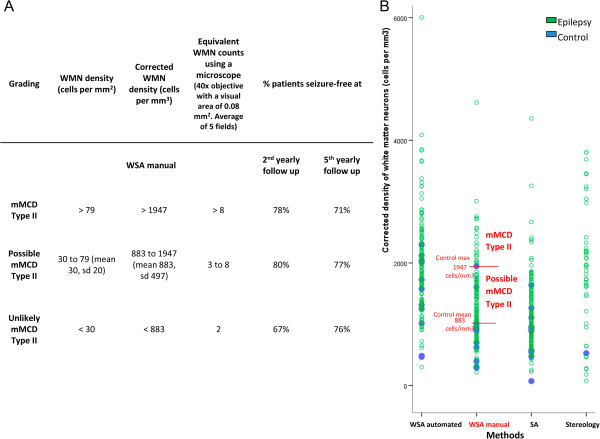
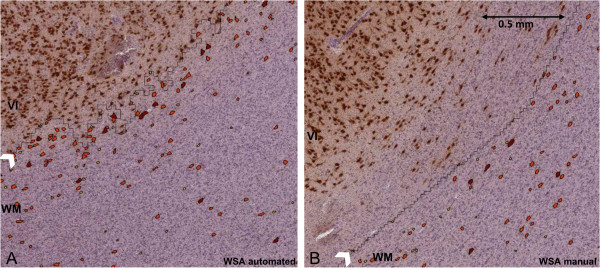
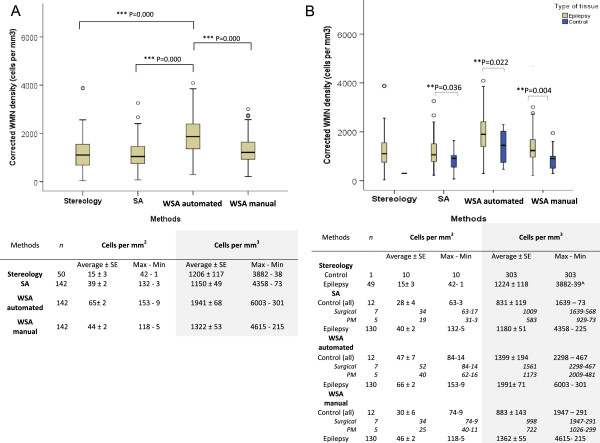
All quantitative systems showed a higher density of white matter neurons in epilepsy cases compared to controls (P = 0.002). We found that, in particular, WSA with user-defined region of interest (manual) was superior in terms of larger sampled size, ease of use, time consumption, and accuracy in region selection and cell recognition compared to other methods. Using results from WSA manual, we proposed a threshold value for the classification of mMCD II, where 78% of patients now classified with mMCD II were seizure-free at the second post-operatively follow up.
This study confirms the potential role of WSA in future quantitative diagnostic histology, especially for the histopathological diagnosis of mMCD.
在癫痫中,轻度皮质发育畸形 II 型(mMCD II)的诊断主要依赖于对脑白质异位神经元的组织病理学评估。mMCD II 的明确诊断标准仍不明确,主要是因为以前的研究由于样本量小,以及使用不同的染色和定量系统,研究结果存在矛盾。技术的进步导致高通量、自动化全切片成像(WSA)的发展,可能克服这些差异,并为癫痫患者脑白质神经元的客观、快速和可靠定量提供可能。本研究使用 WSA 对多达 142 例癫痫和对照病例的脑白质中 NeuN 免疫阳性神经元的密度进行了量化。将 WSA 的定量数据与其他两种系统(半自动定量和广泛接受的体视学法)进行比较,以评估 WSA 结果的可靠性和质量。
所有定量系统均显示癫痫病例的脑白质神经元密度高于对照组(P = 0.002)。我们发现,特别是使用用户定义感兴趣区域的 WSA(手动)在样本量更大、易于使用、耗时和区域选择及细胞识别准确性方面优于其他方法。使用 WSA 手动的结果,我们提出了一个用于 mMCD II 分类的阈值值,其中 78%的被分类为 mMCD II 的患者在第二次术后随访时无癫痫发作。
本研究证实了 WSA 在未来定量诊断组织学中的潜在作用,特别是在 mMCD 的组织病理学诊断中。