
非典型激酶Wee1的基因抑制作用可选择性地驱动p53无活性肿瘤细胞凋亡。
Genetic inhibition of the atypical kinase Wee1 selectively drives apoptosis of p53 inactive tumor cells.
作者信息
Pappano William N, Zhang Qian, Tucker Lora A, Tse Chris, Wang Jieyi
机构信息
Discovery Research, AbbVie Inc,, 1 N, Waukegan Road, North Chicago, IL 60064, USA.
出版信息
BMC Cancer. 2014 Jun 13;14:430. doi: 10.1186/1471-2407-14-430.
BACKGROUND
Tumorigenesis is the result of genomic or epigenomic insults and subsequent loss of the proper mechanisms to respond to these alterations leading to unscheduled growth. Tumors arising from these mutations often have altered cell cycles that offer proliferative advantages and lead to the accumulation of additional mutations that can lead to more aggressive phenotypes. Nevertheless, tumor cells must still adhere to the basic tenets of the cell cycle program to ensure their survival by DNA duplication, chromosomal segregation and cytokinesis. The atypical tyrosine kinase Wee1 plays a key role in regulating the cell cycle at the DNA synthesis and mitotic checkpoints via phosphorylation and subsequent inactivation of cyclin-dependent kinases (CDKs) in both healthy and tumorigenic cells.
METHODS
To assess the role of Wee1 in tumor cell proliferation we performed small interfering RNA (siRNA) experiments in a panel of diverse cell lines derived from various tissue origins. We also tested the hypothesis that any potential effects would be as a result of the kinase activity of Wee1 by siRNA rescue studies with wild-type or kinase-dead versions of Wee1.
RESULTS
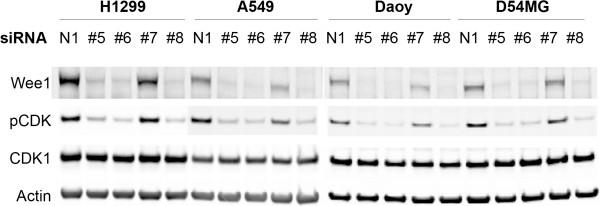
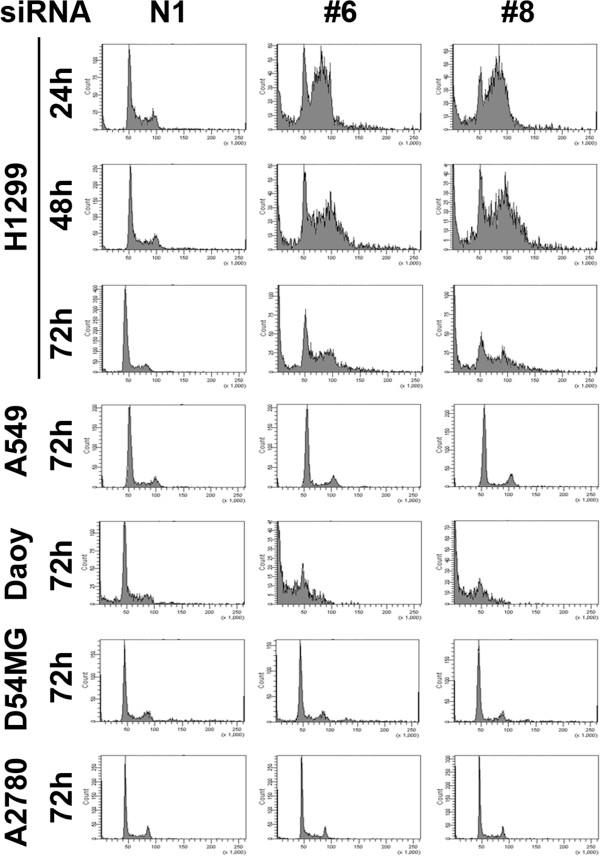
We find that, in general, cells with wild-type p53 activity are not susceptible to loss of Wee1 protein via siRNA. However, Wee1 siRNA treatment in tumor cells with an inherent loss of p53 activity results in a deregulated cell cycle that causes simultaneous DNA synthesis and premature mitosis and that these effects are kinase dependent. These cumulative effects lead to potent inhibition of cellular proliferation and ultimately caspase-dependent apoptosis in the absence of co-treatment with cytotoxic agents.
CONCLUSIONS
These results suggest that, while Wee1 acts as a tumor suppressor in the context of normal cell growth and its functional loss can be compensated by p53-dependent DNA damage repairing mechanisms, specific inhibition of Wee1 has deleterious effects on the proliferation and survival of p53 inactive tumors. In total, targeting the atypical kinase Wee1 with an siRNA-based therapeutic or a selective ATP competitive small molecule inhibitor would be a feasible approach to targeting p53 inactive tumors in the clinic.
背景
肿瘤发生是基因组或表观基因组受到损伤以及随后失去应对这些改变的正常机制,从而导致异常生长的结果。由这些突变产生的肿瘤通常具有改变的细胞周期,这赋予了增殖优势,并导致更多可导致更具侵袭性表型的额外突变的积累。然而,肿瘤细胞仍必须遵循细胞周期程序的基本原则,通过DNA复制、染色体分离和胞质分裂来确保其存活。非典型酪氨酸激酶Wee1在健康细胞和致瘤细胞中,通过磷酸化及随后使细胞周期蛋白依赖性激酶(CDK)失活,在DNA合成和有丝分裂检查点调节细胞周期中起关键作用。
方法
为了评估Wee1在肿瘤细胞增殖中的作用,我们在一组源自不同组织的多种细胞系中进行了小干扰RNA(siRNA)实验。我们还通过用野生型或激酶失活型Wee1进行siRNA拯救研究,测试了任何潜在效应是由Wee1的激酶活性导致的这一假设。
结果
我们发现,一般来说,具有野生型p53活性的细胞不易因siRNA而失去Wee1蛋白。然而,对固有p53活性缺失的肿瘤细胞进行Wee1 siRNA处理会导致细胞周期失调,引起DNA合成和过早有丝分裂同时发生,并且这些效应是激酶依赖性的。在不与细胞毒性药物联合治疗的情况下,这些累积效应导致细胞增殖受到有效抑制,并最终导致半胱天冬酶依赖性凋亡。
结论
这些结果表明,虽然Wee1在正常细胞生长环境中作为肿瘤抑制因子起作用,其功能丧失可由p53依赖性DNA损伤修复机制补偿,但特异性抑制Wee1对p53无活性肿瘤的增殖和存活具有有害影响。总体而言,用基于siRNA的疗法或选择性ATP竞争性小分子抑制剂靶向非典型激酶Wee1将是临床上靶向p53无活性肿瘤的一种可行方法。





 Zotero 插件