Robinaugh Donald J, LeBlanc Nicole J, Vuletich Heidi A, McNally Richard J
Department of Psychology, Harvard University.
J Abnorm Psychol. 2014 Aug;123(3):510-22. doi: 10.1037/abn0000002. Epub 2014 Jun 16.
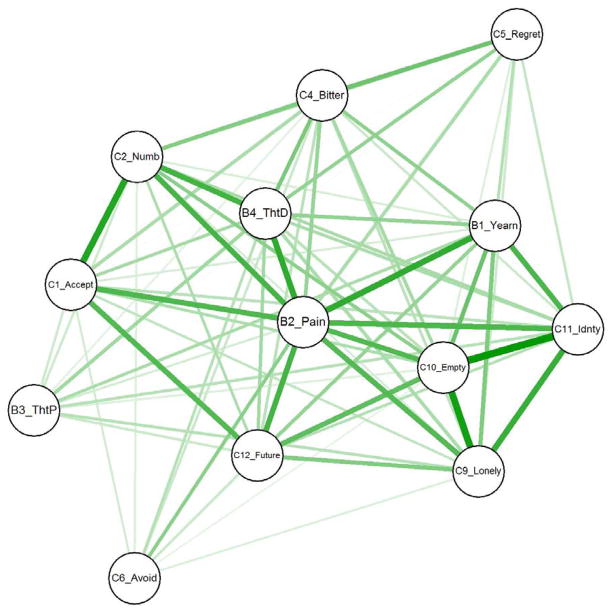
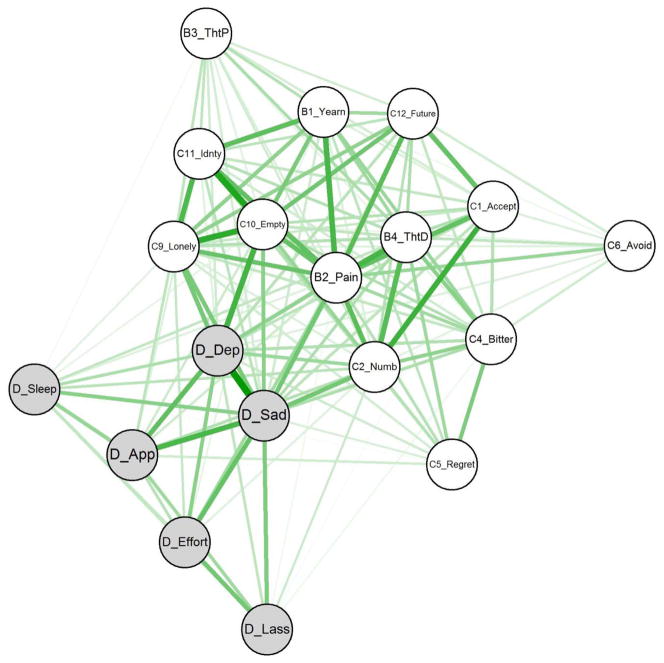
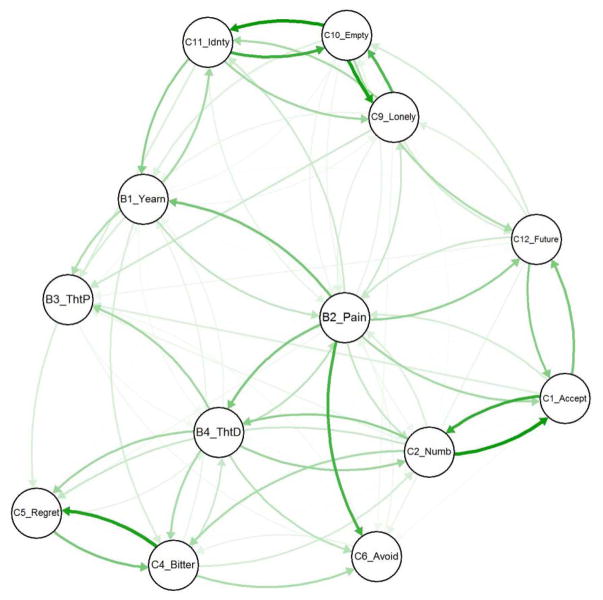
Persistent complex bereavement disorder (PCBD) is a bereavement-specific syndrome characterized by prolonged and impairing grief. Most research on this syndrome rests on the traditional latent variable model, whereby symptoms reflect an underlying entity. The network (or causal system) approach offers an alternative framework for understanding PCBD that does not suffer from limitations inherent in the latent entity approach. The network approach to psychopathology conceptualizes the relation between symptoms and disorder as mereological, not reflective. That is, symptoms do not reflect an inferred, unobservable category or dimension, but rather are themselves constitutive of the disorder. Accordingly, we propose that PCBD constitutes a causal system of mutually reinforcing symptoms that arise following the death of a loved one and settle into a pathological equilibrium. In this study, we used data from the Changing Lives of Older Couples database to identify symptoms central to PCBD, to distinguish the PCBD network from an overlapping but distinct network of depression symptoms, and to examine how previously identified risk factors may contribute to the maintenance or development of PCBD. Together, these findings provide an important first step toward understanding the nature and etiology of the PCBD network.
持续性复杂丧亲之痛障碍(PCBD)是一种特定于丧亲之痛的综合征,其特征为长时间且具有损害性的悲痛。关于该综合征的大多数研究基于传统的潜变量模型,即症状反映一个潜在实体。网络(或因果系统)方法为理解PCBD提供了一个替代框架,该框架不存在潜实体方法所固有的局限性。精神病理学的网络方法将症状与障碍之间的关系概念化为整体论的,而非反映性的。也就是说,症状并不反映一个推断出的、不可观察的类别或维度,而是其本身构成了障碍。因此,我们提出PCBD构成了一个由相互强化的症状组成的因果系统,这些症状在所爱之人去世后出现,并陷入一种病理平衡状态。在本研究中,我们使用了“老年夫妻生活变化”数据库中的数据,以确定PCBD的核心症状,将PCBD网络与重叠但不同的抑郁症状网络区分开来,并研究先前确定的风险因素可能如何促成PCBD的维持或发展。总之,这些发现为理解PCBD网络的性质和病因迈出了重要的第一步。