Alshanbari F A, Mousel M R, Reynolds J O, Herrmann-Hoesing L M, Highland M A, Lewis G S, White S N
Department of Veterinary Microbiology and Pathology, Washington State University, Pullman, WA, 99164, USA.
Anim Genet. 2014 Aug;45(4):565-71. doi: 10.1111/age.12181. Epub 2014 Jun 17.
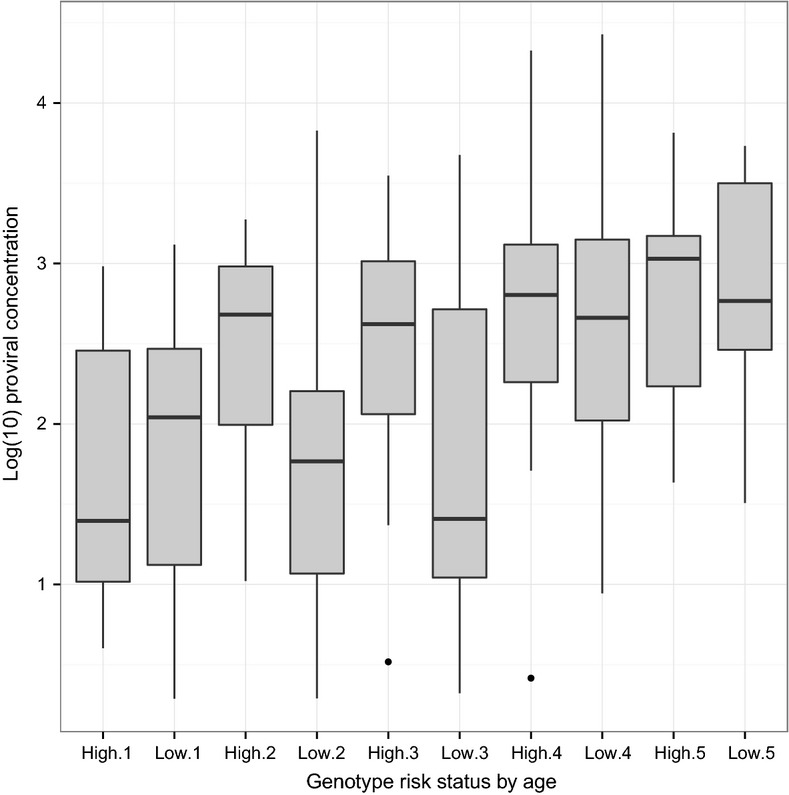
Small ruminant lentivirus (SRLV), also called ovine progressive pneumonia virus or maedi-visna, is present in 24% of US sheep. Like human immunodeficiency virus, SRLV is a macrophage-tropic lentivirus that causes lifelong infection. The production impacts from SRLV are due to a range of disease symptoms, including pneumonia, arthritis, mastitis, body condition wasting and encephalitis. There is no cure and no effective vaccine for preventing SRLV infection. However, breed differences in prevalence and proviral concentration indicate a genetic basis for susceptibility to SRLV. Animals with high blood proviral concentration show increased tissue lesion severity, so proviral concentration represents a live animal test for control post-infection in terms of proviral replication and disease severity. Recently, it was found that sheep with two copies of TMEM154 haplotype 1 (encoding lysine at position 35) had lower odds of SRLV infection. In this study, we examined the relationship between SRLV control post-infection and variants in two genes, TMEM154 and CCR5, in four flocks containing 1403 SRLV-positive sheep. We found two copies of TMEM154 haplotype 1 were associated with lower SRLV proviral concentration in one flock (P < 0.02). This identified the same favorable diplotype for SRLV control post-infection as for odds of infection. However, frequencies of haplotypes 2 and 3 were too low in the other three flocks to test. The CCR5 promoter deletion did not have consistent association with SRLV proviral concentration. Future work in flocks with more balanced allele frequencies is needed to confirm or refute TMEM154 association with control of SRLV post-infection.
小反刍兽慢病毒(SRLV),也被称为绵羊进行性肺炎病毒或梅迪-维斯纳病毒,在美国24%的绵羊中存在。与人类免疫缺陷病毒一样,SRLV是一种嗜巨噬细胞慢病毒,可导致终身感染。SRLV产生的生产影响归因于一系列疾病症状,包括肺炎、关节炎、乳腺炎、身体状况消瘦和脑炎。目前没有治愈方法,也没有有效的疫苗来预防SRLV感染。然而,患病率和原病毒浓度的品种差异表明对SRLV易感性存在遗传基础。血液中原病毒浓度高的动物组织病变严重程度增加,因此原病毒浓度代表了一种针对感染后控制的活体动物检测,涉及原病毒复制和疾病严重程度。最近发现,具有两个TMEM154单倍型1拷贝(在第35位编码赖氨酸)的绵羊感染SRLV的几率较低。在本研究中,我们在四个包含1403只SRLV阳性绵羊的羊群中,研究了感染后SRLV控制与两个基因TMEM154和CCR5变体之间的关系。我们发现,在一个羊群中,两个TMEM154单倍型1拷贝与较低的SRLV原病毒浓度相关(P < 0.02)。这确定了与感染几率相同的、对感染后SRLV控制有利的双倍型。然而,在其他三个羊群中,单倍型2和3的频率过低,无法进行检测。CCR5启动子缺失与SRLV原病毒浓度没有一致的关联。需要在等位基因频率更平衡的羊群中开展进一步研究,以证实或反驳TMEM154与感染后SRLV控制的关联。